

This blog focuses on how vaccines safeguard children from deadly diseases like measles, polio, and meningitis across the UK and worldwide. This updated blog from 2026 provides a quick reference for the NHS routine schedule, key vaccine-preventable diseases and UNICEF’s global work to help parents protect their children on time.
The worldwide immunisation averts 4-5 million deaths yearly, yet coverage stalls at 85% for DTP3, leaving 14 million infants unvaccinated.
UK Childhood Vaccines Overview
The GP practices give out free vaccines on behalf of the NHS and protect against 13 diseases in the routine schedule. Herd immunity is preserved by a high rate of uptake (95%+), which prevents outbreaks in schools and communities.
Post 1940s, the epidemics saw a 99% reduction in deaths due to diphtheria, and polio was eliminated in the UK just because of vaccines. The current challenges include resurgences of measles from hesitancy (1800+ cases in 2024).
Complete NHS Vaccination Schedule 2026
From the September 2025 updates, the schedule emphasises early protection and boosters.
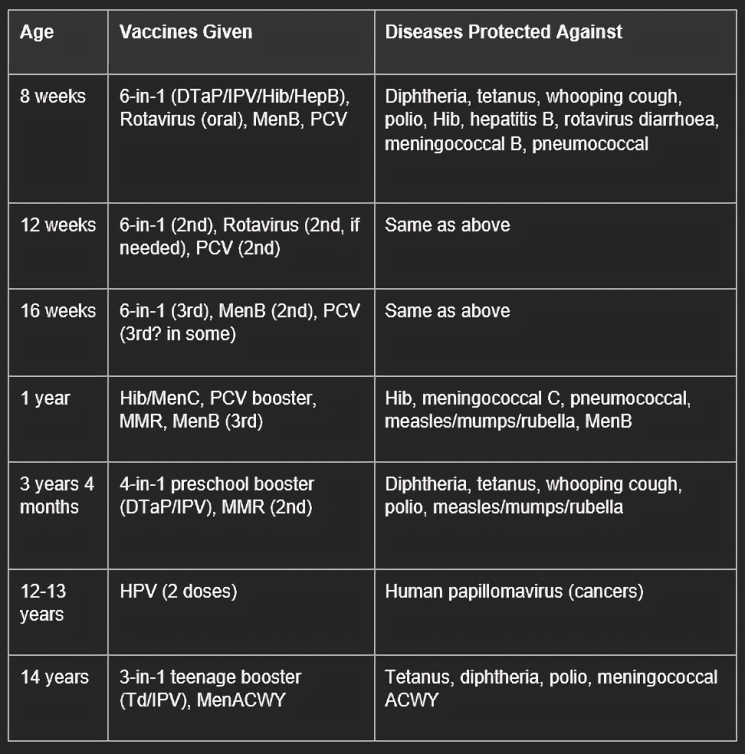
Pregnancy: Whooping cough (16-32 weeks), RSV (28+ weeks), and flu (seasonal). Catch-ups available anytime.
Know More.
Key Vaccines and Diseases Prevented
6-in-1 Vaccine: Multi-Disease Shield
This actually combines protection against diphtheria (throat toxin and heart damage), tetanus (lockjaw spasms), pertussis (whooping cough and infant killer), polio (paralysis), Hib (meningitis), and hepatitis B (liver cancer). Given 8/12/16 weeks, 93% UK uptake.
Rotavirus Vaccine
Oral drops prevent severe gastroenteritis, dehydrating 1 in 5 unvaccinated infants. The UK has halved hospital admissions since the 2013 rollout.
MenB and MenACWY: Meningitis Defence
MenB (Bexsero) targets group B meningitis/sepsis; 3 doses by 1 year. MenACWY covers A, C, W, Y strains at 14 years amid rising W cases.
MMR/MMRV: Viral Outbreak Blockers
Two doses prevent measles (pneumonia and SSPE brain disease), mumps (orchitis and infertility), and rubella (congenital defects). UK MMR1 coverage is 92%, but needs 95%.
HPV Vaccine: Cancer Prevention

Targets cancer-causing HPV; 2 doses at age 12-13. Prevents 90% of cervical cancers; boys are protected too since 2019.
Pneumococcal (PCV): Respiratory Guardian
Prevents pneumonia and meningitis from Streptococcus pneumoniae; 13 strains covered.

Global Perspective: UNICEF’s Vaccination Mission
Every year, UNICEF purchases more than 2 billion doses of vaccines for over 100 countries, giving roughly half of all children under five worldwide immunity to preventable diseases. The focus remains on the gaps: an estimated 40% of children in Afghanistan, Nigeria, and Yemen receive zero doses.
According to WHO/UNICEF estimates for 2025, DTP3 coverage has plateaued at around 85% and the first dose of measles at 83% – with COVID-era setbacks erasing nearly a decade of progress. Yet there are wins worth holding on to: maternal and neonatal tetanus has been eliminated in most countries, and polio cases have fallen by more than 99% since 1988.
For more on UNICEF’s immunization work and the latest country-level data, see UNICEF Immunization.

Vaccine Science and Safety
Antigens, or weakened or killed pathogens, are used in vaccines to produce a sufficient number of antibodies without causing illness. 90–95% is the threshold for herd immunity.
UK Yellow Card: The serious reactions are 1/million doses. No autism link (Lancet retraction 2010). Aluminium/thimerosal safe traces.
Benefits: Health, Economic, Social.
UK: £23 saved per £1 spent; averts 1,000 infant deaths/decade. Globally: $17 ROI; boosts GDP via a healthy workforce.
Minimises protracted COVID-like complications and school absences (pertussis: two weeks off).
UK Challenges and Outbreaks
2023-2026: Measles clusters in London/Birmingham (low uptake areas). MenW rising pre-MenACWY. Mpox/flu strain systems.
Hesitancy: Online myths; NHS counters via GP reminders and school programs.
Know more.
Global Barriers and Solutions
14.5M zero-dose kids: Conflict (Sudan), poverty, misinformation.
UNICEF: The cold-chain solar fridges, community health workers, Gavi funding.
Outbreaks: 300,000 cases of measles in Europe and cholera in Africa in 2025.
Pregnancy and Family Vaccinations
The newborn receives antibodies from the mother’s whooping cough vaccination. Flu/RSV reduces preterm risks.
Adults: Td every 10y, shingles 65+.
Travel and High-Risk Vaccines
UK travellers: HepA, typhoid, and rabies per destination.
Back-to-school: Check Red Book.
Myths Debunked
- Overload immunity? No, babies fight 6,000 germs/day.
- Natural better? Herd immunity from vaccines > infection risks.
- Microchips/sterility? Debunked by science.
Future Innovations

mRNA expansions (RSV, dengue); universal flu. UK trials nasal vaccines.
Global: Equitable access goals by 2030.
Practical Tips for UK Parents
- Download the NHS app for reminders.
- GP catch-up clinics are free.
- School entry requires proof.
- Discuss concerns openly.

FAQs
1. What is the UK childhood vaccination schedule 2026?
Ans: 8 weeks: 6-in-1, rotavirus, MenB, PCV; up to 14y boosters. Full table above.
2. Which diseases do NHS vaccines actually prevent?
Ans: Diphtheria, tetanus, pertussis, polio, Hib, HepB, rotavirus, MenB/C/ACWY, pneumococcal, MMR, HPV.
3. Are vaccines irritation-free and safe for UK babies?
Ans: Yes, monitored rigorously. Mild side effects are common; severe ones are rare.
4. Why do the worldwide vaccines matter the most to UK parents?
Ans: Travel migration risks outbreaks; solidarity aids eradication.
5. Can missed UK vaccines be caught up?
Ans: Yes, anytime via GP; no restart needed.
6. Does MMR prevent measles outbreaks in the UK completely?
Ans: Yes; 95% coverage stops the spread.
7. What is UNICEF’s role in UK/global vaccines?
Ans: Procures/supplies globally; advocates UK coverage.
8. HPV vaccine in the UK: works for both boys and girls?
Ans: Yes, both prevent genital warts/cancers.
Read our detailed blog – “Avoid These Common Pitfalls After the UK NMC CBT in 2026” – to ensure your journey stays on track.
Free Consultation – Chat now with a Mentor.