


Imagine receiving a letter from another healthcare professional about a patient who requires your attention. The letter contains detailed information about the patient’s medical history, symptoms, investigations, medications, and treatment. However, after reading several paragraphs, you are still unsure why the patient has been referred to you or what you are expected to do next. Would you consider this an effective professional letter? Probably not.
In healthcare communication, the reader should be able to understand the reason for receiving a letter without searching through unnecessary information. This is particularly important when healthcare professionals communicate about patient referrals, transfers, discharges, and ongoing management. The same principle applies to the Occupational English Test (OET) Writing sub-test.
One of the most important aspects of OET Writing is Purpose, which evaluates how clearly the writer communicates the reason for writing the letter and the action expected from the recipient. Many OET candidates concentrate heavily on grammar, vocabulary, sentence construction, and medical terminology. Although these elements are essential, they sometimes overlook a more fundamental question:
Why am I writing this letter, and what do I want the reader to do?
A grammatically accurate letter can still be ineffective if its purpose is unclear, incomplete, or incorrectly presented.
In this guide, we will explore how to identify, formulate, and communicate the purpose of an OET letter, supported by practical examples, common errors, and strategies that candidates can apply during the examination.
What Is Purpose in OET Writing?
In simple terms, purpose refers to the main reason for writing a professional healthcare letter. It tells the recipient why the patient is being referred, transferred, discharged, or discussed, and what professional action or response is expected. For example, consider the following sentence:
I am writing to refer Mr Daniel Morris, a 58-year-old man with poorly controlled type 2 diabetes, for specialist assessment and optimisation of his treatment.
This sentence immediately communicates three important elements:
- The communication: A referral.
- The medical reason: Poorly controlled type 2 diabetes.
- The expected action: Specialist assessment and treatment optimisation.
The recipient can quickly understand the situation and their role in the patient’s ongoing care. Now consider another introduction:
Mr Daniel Morris is a 58-year-old man who has had diabetes for approximately ten years. He lives with his wife and has been attending our clinic regularly.
Although the information may be accurate, it does not explain why the letter has been written. The reader must continue reading to discover what is required. This is the difference between providing patient information and communicating purpose.
Purpose Is More Than Mentioning the Letter Type
Some candidates believe that using words such as refer, transfer, or discharge is enough to establish purpose. However, these words only indicate the type of communication.
Compare: I am writing to refer Mrs Smith to your department.
With: I am writing to refer Mrs Smith, who has persistent rectal bleeding and unexplained weight loss, for urgent gastroenterological assessment.
The second sentence is significantly more informative because it communicates both the clinical concern and the reason specialist involvement is necessary. An effective purpose statement should help the recipient understand not only what is happening but also why their involvement is required.
Why Is Purpose Important in OET Writing?
Purpose is one of the six assessment criteria used to evaluate OET Writing performance. The criteria are:
- Purpose
- Content
- Conciseness and Clarity
- Genre and Style
- Organisation and Layout
- Language
Purpose is assessed separately from the other criteria and uses a score ranging from 0 to 3. To achieve the highest score, the purpose must be immediately apparent and sufficiently developed.
This means candidates should not merely mention the reason for writing somewhere in the letter. They should make it clear from the beginning and provide enough information throughout the letter for the reader to understand the required action.
Why Does Purpose Matter in Healthcare?
In real clinical settings, healthcare professionals often work under considerable time pressure. A general practitioner receiving a discharge letter needs to know what follow-up care is required. A physiotherapist receiving a referral needs to understand the patient’s functional limitations and rehabilitation goals. A pharmacist receiving a medication-related request needs to identify the specific concern requiring review. Similarly, a specialist receiving an urgent referral should be able to recognise the clinical concern and the urgency of the request immediately.
Therefore, communicating purpose is not simply an examination requirement. It reflects an essential skill in professional healthcare communication.

The Three Essential Components of an Effective Purpose Statement
A useful way to construct a clear purpose statement is to identify three elements before writing.
Component 1: The Reason for Communication
First, determine the nature of the letter. Is the patient being referred, discharged, transferred, or presented for ongoing management?
Common expressions include:
- I am writing to refer…
- I am writing to request…
- I am writing to arrange…
- I am writing to update you regarding…
- I am writing to inform you of the discharge of…
- I am writing to transfer…
The expression should reflect the actual writing task. For example, if the task asks you to write to a community nurse requesting home visits, the purpose should not be presented as a specialist referral. Similarly, if the task involves updating a general practitioner about a patient’s hospital treatment, describing it as a new referral may misrepresent the situation.
Component 2: The Medical or Clinical Reason
The next component explains why the communication is necessary. This may involve:
- A confirmed diagnosis
- A suspected medical condition
- A recent surgical procedure
- Persistent or worsening symptoms
- Functional limitations
- Medication-related complications
- The need for continued care or monitoring
For example: I am writing to refer Mr James Wilson, who has developed persistent lower back pain with associated neurological symptoms…
Here, the clinical reason is the patient’s persistent back pain and neurological symptoms. However, candidates must be careful not to present an unconfirmed diagnosis as a confirmed condition.
Incorrect: I am referring Mr Wilson, who has lumbar disc herniation…
This would be inappropriate if the case notes only mention suspected disc herniation.
Better: I am referring Mr Wilson, whose symptoms are suggestive of lumbar disc herniation…
The second version accurately communicates the level of diagnostic certainty.
Component 3: The Expected Action
The final component explains what the recipient is expected to do. This is often the most overlooked element in OET Writing.
Consider: I am writing to refer Mrs Laura Evans, who has persistent hypertension. Although the medical reason is evident, the sentence does not explain what the recipient should do.
A more complete version would be: I am writing to refer Mrs Laura Evans, whose hypertension remains poorly controlled despite treatment, for specialist evaluation and medication review. The expected action is now clear.
Depending on the task, the recipient may be expected to:
- Conduct further investigations
- Provide specialist assessment
- Review medication
- Continue treatment
- Monitor symptoms
- Arrange rehabilitation
- Provide psychological support
- Conduct home visits
- Offer advice regarding further management
A Practical Formula
Candidates can use the following framework: Purpose = Communication Type + Clinical Reason + Expected Action
For example: I am writing to refer Mr Thomas Green, who has experienced recurrent episodes of chest discomfort, for cardiological assessment and further investigations.
However, this is a planning framework rather than a compulsory grammatical structure. The final sentence should sound natural, professional, and appropriate to the task.

4. How to Identify Purpose from OET Case Notes
Before writing the letter, candidates must carefully analyse the writing task and case notes. A common mistake is beginning the letter immediately after reading the patient’s diagnosis or presenting complaint. However, the diagnosis alone may not reveal the actual purpose.
Step 1: Read the Writing Task First
The writing task usually provides essential information about the recipient and the communication required.
For example: Using the information in the case notes, write a referral letter to Dr Sarah Mitchell, an endocrinologist, requesting further assessment and management of the patient’s poorly controlled diabetes.
From this instruction, candidates can identify:
- Recipient: Endocrinologist
- Letter type: Referral
- Clinical concern: Poorly controlled diabetes
- Expected action: Further assessment and management
This information should guide the entire letter.
Step 2: Identify the Patient’s Current Clinical Situation
Next, examine the case notes to determine the patient’s present condition. Consider these hypothetical notes:
Patient: Mr Andrew Lewis, 62 years old
Medical history: Type 2 diabetes for 12 years
Current treatment: Metformin and gliclazide
Recent findings: HbA1c 10.2%; persistent hyperglycaemia
Current concern: Inadequate glycaemic control despite treatment
Plan: Referral to endocrinologist for treatment review
The medical reason is not simply that the patient has diabetes. It is that his diabetes remains inadequately controlled despite his current treatment. That distinction makes the purpose more precise.
Step 3: Determine the Recipient’s Responsibility
Ask yourself: What is the recipient expected to do after reading this letter?
In this example, the endocrinologist is expected to assess the patient’s diabetes and consider changes to treatment.
Therefore, an appropriate introduction would be: I am writing to refer Mr Andrew Lewis, a 62-year-old man with inadequately controlled type 2 diabetes, for specialist assessment and optimisation of his treatment regimen.
Step 4: Check for Urgency
Some writing tasks involve urgent clinical situations. If the case notes indicate that immediate assessment is necessary, this urgency should be reflected in the purpose.
For example: I am writing to request an urgent assessment of Mrs Helen Carter, who presents with symptoms suggestive of acute appendicitis.
However, candidates should never add urgency merely to make the letter sound more serious. Urgency must be supported by the case notes and writing task.

Communicating Purpose in Different Types of OET Letters
Although the fundamental principle remains the same, purpose should be expressed differently depending on the type of letter.
1. Referral Letters
Referral letters request another healthcare professional to assess, investigate, treat, or manage a patient.
Example — Medicine
I am writing to refer Mr Robert Clarke, a 67-year-old man with progressive exertional breathlessness and bilateral ankle oedema, for cardiological assessment and further management.
This introduction identifies the clinical problem and the need for specialist involvement.
Example — Nursing
I am writing to refer Mrs Emily Brown, who is recovering from a right hip replacement, for community nursing support with wound monitoring and postoperative care. Here, the purpose is to arrange nursing support following surgery.
2. Discharge Letters
Discharge letters communicate a patient’s discharge from a healthcare facility and outline the care required after discharge. The purpose should reflect the patient’s current condition and any necessary follow-up.
Example — Nursing
I am writing to inform you of the discharge of Mr Peter Collins, who has undergone treatment for pneumonia and requires continued monitoring and support at home.
This sentence explains the patient’s clinical situation and the need for ongoing care.
Importantly, a discharge letter should not simply announce that the patient is leaving hospital. It should communicate information that enables the recipient to provide safe continuity of care.
3. Transfer Letters
Transfer letters are used when a patient moves from one healthcare facility or service to another. The purpose usually involves continuing treatment, monitoring, or rehabilitation.
Example: I am writing to arrange the transfer of Mrs Susan Taylor, who is recovering from a cerebrovascular accident, to your rehabilitation facility for continued physiotherapy and multidisciplinary care.
The recipient immediately understands why the patient is being transferred and what care is required.
4. Letters Requesting Medication Review
Medication-related communication may involve treatment effectiveness, adverse effects, adherence, or medication safety.
Example — Pharmacy
I am writing to request a medication review for Mr David Harris, who has experienced recurrent dizziness following recent changes to his antihypertensive treatment.
This introduction identifies a medication-related concern and the action requested.
5. Physiotherapy Referral Letters
Physiotherapy-related letters frequently focus on mobility, pain, functional impairment, and rehabilitation.
Example — Physiotherapy
I am writing to refer Ms Rachel Moore, who has persistent shoulder pain and restricted movement following a workplace injury, for orthopaedic assessment and further management. The purpose connects the patient’s functional problem with the requested specialist assessment.
6. Letters Providing Clinical Updates
Not every OET letter requests a new referral or transfer. Some letters provide updates to professionals already involved in the patient’s care.
Example: I am writing to update you on the progress of Mrs Linda Scott, who has completed six weeks of physiotherapy following knee replacement surgery, and to outline recommendations for her ongoing rehabilitation.
The purpose is to communicate progress and recommendations rather than initiate a new referral. The key is to identify the actual communication requirement instead of automatically using a familiar referral template.

Where Should Purpose Appear in an OET Letter?
Purpose should be apparent early in the letter and sufficiently developed through relevant information. In most OET letters, the opening paragraph is the most effective place to introduce it.
The body paragraphs then provide clinical information that explains or supports the communication. The concluding paragraph can reinforce the expected action, particularly when the recipient’s responsibilities need further clarification.
Purpose in the Introduction
The introduction should help the reader understand the main reason for writing without unnecessary delay. Consider the following example.
Weak introduction: Mr George Miller is a 70-year-old retired teacher who lives with his daughter. He was admitted to our hospital on 12 June and has a history of hypertension and arthritis.
This introduction provides background information but does not establish why the letter has been written.
Improved introduction: I am writing to arrange community nursing support for Mr George Miller, a 70-year-old man who is being discharged following treatment for a lower respiratory tract infection and requires assistance with medication administration and monitoring.
The improved introduction prioritises the patient’s immediate care needs. Other relevant information, such as medical history and social circumstances, can be included later if it helps the recipient provide appropriate care.
Purpose in the Body Paragraphs
The body paragraphs should contain relevant information that supports the purpose. For example, if the purpose is to request a medication review because of recurrent dizziness, relevant details may include:
- The patient’s current medications
- Recent changes in dosage
- Onset and frequency of dizziness
- Relevant blood pressure readings
- Any associated falls or safety concerns
However, unrelated historical information should not dominate the letter. The principle is simple: Include information because it helps the reader understand or act on the purpose, not merely because it appears in the case notes.
Purpose in the Conclusion
The conclusion provides an opportunity to clarify the specific action expected from the recipient.
Introduction: I am writing to refer Mrs Olivia Martin, who has persistent knee pain following an injury, for orthopaedic assessment and management.
Conclusion: I would appreciate your assessment of Mrs Martin’s ongoing knee pain and advice regarding further investigations and appropriate treatment.
The introduction establishes the overall purpose, while the conclusion reinforces the expected action. However, candidates should avoid repeating the same sentence unnecessarily. The conclusion should add clarity or provide an appropriate professional request rather than mechanically restating the introduction.
General Purpose Versus Specific Purpose
An important skill in OET Writing is knowing how much information to include when introducing the purpose. A purpose statement should be specific enough to communicate the patient’s clinical situation and the recipient’s role. However, it does not need to contain every investigation, treatment, or clinical finding.
Consider the following case.
Patient: Mrs Anne Parker
Condition: Chronic obstructive pulmonary disease (COPD)
Current concern: Increasing breathlessness and reduced exercise tolerance
Plan: Pulmonary rehabilitation and respiratory review
Too general:
I am writing to refer Mrs Parker for further management.
The recipient does not know the clinical reason or what management is required.
Too Detailed:
I am writing to refer Mrs Parker, who has had COPD for eight years, experiences breathlessness when climbing stairs, has recently reported increased sputum production, takes inhaled medication twice daily, and has experienced reduced exercise tolerance over the past three weeks, for pulmonary rehabilitation and respiratory review.
Although this contains useful information, the introduction is unnecessarily overloaded.
Appropriately Specific
I am writing to refer Mrs Anne Parker, whose COPD symptoms have recently worsened, for respiratory assessment and pulmonary rehabilitation.
This version communicates the essential information clearly and concisely. The supporting clinical details can be developed in subsequent paragraphs.
The goal is not to make the purpose statement as long as possible. It is to make the intended communication immediately understandable.
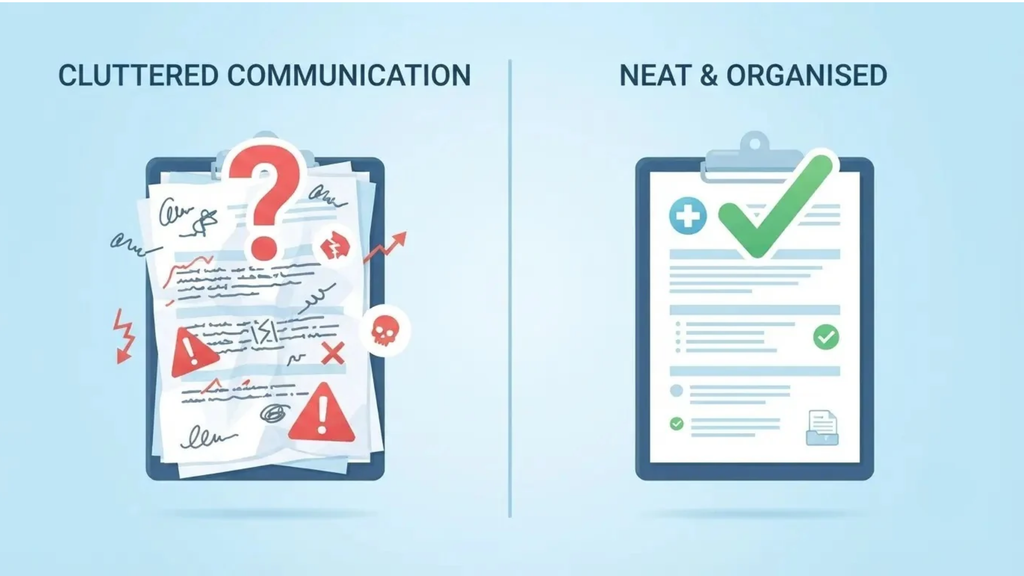
Common Mistakes Candidates Make When Writing Purpose
Mistake 1: Beginning with Unnecessary Background Information
Some candidates begin their letters with the patient’s age, occupation, family circumstances, or medical history without first explaining why they are writing.
For example: Mrs Wilson is a 65-year-old widow who lives alone and has two children.
This information may become relevant if the patient requires home support, but it should not obscure the primary reason for communication.
Improvement: Establish the purpose first and include background information where it supports the patient’s care needs.
Mistake 2: Mentioning Only the Diagnosis
Weak: I am writing regarding Mr Thomas, who has hypertension.
Improved: I am writing to refer Mr Thomas, whose hypertension remains poorly controlled, for specialist evaluation and treatment review.
A diagnosis identifies the condition, but it does not necessarily explain why the recipient is being contacted.
Mistake 3: Using Vague Expressions
Expressions such as further management, necessary action, and appropriate care are common in healthcare correspondence. However, they can be unclear when used without context.
For example : I am referring Mrs Adams for necessary management.
What management does she require?
A more informative statement would be: I am referring Mrs Adams for assessment of her persistent abdominal pain and further investigation of its underlying cause.
General expressions are not automatically incorrect, but they should not leave the recipient uncertain about the intended action.
Mistake 4: Confusing the Presenting Complaint with the Final Clinical Assessment
A patient may initially present with symptoms that lead to a diagnosis or provisional diagnosis. For example, the case notes may show:
- Initial complaint: Fever and productive cough
- Investigation: Chest X-ray
- Diagnosis: Community-acquired pneumonia
- Treatment: Antibiotics
- Current status: Clinically improved
- Plan: Discharge with follow-up
For example:
An introduction focusing only on fever and cough would not accurately reflect the patient’s current clinical situation.
Better: I am writing to inform you of the discharge of Mr James Carter, who has responded well to treatment for community-acquired pneumonia and requires follow-up assessment.
The purpose should reflect the patient’s current status and the reason for communication.
Mistake 5: Misrepresenting Diagnostic Certainty
Candidates sometimes convert suspected conditions into confirmed diagnoses.
Case note: Suspected deep vein thrombosis
Incorrect: The patient has been diagnosed with deep vein thrombosis.
Correct: The patient is suspected of having deep vein thrombosis.
Clinical accuracy is essential because the recipient’s decisions may depend on the information communicated.
Mistake 6: Adding Unsupported Requests
Candidates may include requests that are not supported by the writing task or case notes. For example, a letter requesting physiotherapy assessment should not automatically ask for surgery unless the available information justifies such a request.
The expected action must come from the case notes, not from the candidate’s assumptions.
Mistake 7: Failing to Clarify the Recipient’s Responsibilities
An introduction may be clear, but the remainder of the letter may fail to explain what the recipient needs to do. This is particularly problematic in discharge and transfer letters, where continuity of care may depend on several specific actions.
For example, a discharge letter may need to communicate medication monitoring, wound care, mobility assistance, or follow-up appointments.
These responsibilities should be presented clearly and accurately rather than hidden among unrelated details.
How Purpose Influences Content Selection
One of the most important relationships in OET Writing is the connection between Purpose and Content.
Purpose answers: Why am I writing this letter?
Content answers: What information does the recipient need to fulfil that purpose?
Consider two letters involving the same patient.
Patient: Mr William Jones, 72 years old
Clinical details:
- Type 2 diabetes
- Hypertension
- Recent hip replacement
- Reduced mobility
- Requires assistance with daily activities
- Lives alone
- Current medications include metformin and amlodipine
Scenario A: Referral to a Physiotherapist
The purpose is to arrange postoperative rehabilitation. The most relevant information may include:
- Recent hip replacement
- Current mobility limitations
- Pain affecting movement
- Weight-bearing instructions
- Rehabilitation goals
- Relevant precautions
The patient’s diabetes and hypertension may also be relevant if they affect rehabilitation or safety.
Scenario B: Referral to a Community Nurse
The purpose is to arrange home-based support after discharge. The most relevant information may include:
- Reduced mobility
- Living arrangements
- Need for assistance with daily activities
- Medication administration or monitoring requirements
- Wound care needs, if documented
- Follow-up arrangements
Although the patient is the same, the information selected and emphasised should differ because the recipients have different responsibilities. This demonstrates an essential principle: The purpose of the letter determines which case notes are relevant and how they should be prioritised.
Candidates who understand this relationship are better equipped to produce focused, reader-centred letters rather than simply converting every case note into a sentence.
Choosing Appropriate Verbs to Communicate Purpose
The verb used in the introduction can significantly influence the clarity of the letter. Different verbs communicate different professional intentions.
| Verb or expression | Typical function | Example |
| Refer | Request another professional’s assessment or care | I am writing to refer Mr Smith for neurological assessment. |
| Request | Ask for a specific action or service | I am writing to request a medication review. |
| Arrange | Coordinate a service or care requirement | I am writing to arrange home nursing support. |
| Transfer | Communicate movement to another facility or service | I am writing to transfer Mrs Brown for rehabilitation. |
| Inform | Communicate an important development | I am writing to inform you of Mr Lee’s discharge. |
| Update | Provide progress or new clinical information | I am writing to update you on Mrs Green’s recovery. |
| Seek | Request professional advice or an opinion | I am writing to seek your advice regarding further management. |
Candidates should select the verb according to the writing task rather than relying on the same expression for every letter.
For example, I am writing to refer is appropriate for many referral letters but may be unsuitable when the recipient is simply being informed of a patient’s discharge.
Developing Purpose Without Unnecessary Repetition
A common misconception is that the purpose must be repeated several times to achieve a high score. However, repetition does not necessarily make the purpose clearer.
Introduction: I am writing to refer Mr Adams for specialist assessment of his persistent headaches.
Conclusion: I would appreciate it if you could assess Mr Adams for his persistent headaches.
The conclusion adds little new information.
A more useful conclusion, if supported by the case notes, would be: I would appreciate your neurological assessment and recommendations regarding further investigations and management of his recurrent headaches.
This version clarifies the professional action requested.
A Useful Distinction
The introduction should establish the overall purpose. The body should provide the evidence and clinical context that justify the communication. The conclusion should clarify or reinforce the required action when appropriate.
This creates a logical progression: Reason for writing → Supporting clinical information → Expected action
However, this should not be treated as an inflexible template. Some letters have a straightforward purpose that can be fully communicated in the opening paragraph. The final paragraph should always serve the communication rather than exist solely to repeat information.
Purpose in Urgent and Non-Urgent Letters
Not all OET letters involve the same level of urgency. Recognising urgency is important because it affects the wording and tone of the communication.
Non-Urgent Referral
I am writing to refer Mrs Helen White, who has experienced intermittent knee pain for six months, for orthopaedic assessment and advice regarding further management.
This communicates a routine specialist referral.
Urgent Referral
I am writing to request an urgent assessment of Mr Michael Reed, who has developed sudden-onset unilateral weakness and speech difficulties suggestive of an acute stroke.
This communicates a potentially time-critical situation. The second sentence makes the urgency clear.
However, candidates should avoid describing every referral as urgent. Terms such as urgent, immediate, and emergency should be used only when justified by the task and clinical information.
It is equally important not to weaken an urgent request by using vague language that fails to communicate the seriousness of the situation.

A Step-by-Step Strategy for Writing Purpose During the OET Exam
Candidates can use the following approach during the planning stage of the Writing sub-test.
Step 1: Identify the Recipient
Determine who will receive the letter. Is it a general practitioner, specialist, community nurse, pharmacist, physiotherapist, or another healthcare professional?
The recipient’s professional role influences the type of information and action required.
Step 2: Identify the Communication Type
Decide whether the letter is intended to refer, transfer, discharge, update, or request a specific service.
Step 3: Identify the Current Clinical Concern
Look for the most relevant clinical information. This could be a diagnosis, suspected condition, persistent symptom, treatment complication, or functional limitation.
Step 4: Identify the Expected Action
Determine what the recipient should do after reading the letter. Be as specific as the case notes allow.
Step 5: Formulate a Concise Purpose Statement
Combine the communication type, clinical concern, and expected action into a clear professional sentence.
Step 6: Select Supporting Information
Choose case notes that help the recipient understand the patient’s condition and carry out the requested action.
Step 7: Review the Conclusion
Check whether any responsibilities or requests need further clarification.
Step 8: Perform a Final Purpose Check
Before submitting the letter, ask yourself:
- Can the recipient identify the reason for writing immediately?
- Have I accurately represented the patient’s current condition?
- Is the requested action clear?
- Have I included only requests supported by the case notes?
- Does the letter provide enough information for the recipient to act?
These questions can help identify weaknesses that may not be obvious during grammar or spelling checks.
Practice Activity: Identify and Improve the Purpose
Read the following examples and consider how the purpose could be communicated more effectively.
Practice 1: Nursing
Case notes:
Patient: Mrs Dorothy Hill, 79 years old
Recent admission: Fall resulting in a fractured wrist
Current status: Medically stable; reduced ability to perform daily activities
Plan: Discharge home with community nursing assistance
Weak introduction: Mrs Hill is a 79-year-old woman who was admitted following a fall.
Improved introduction: I am writing to arrange community nursing support for Mrs Dorothy Hill, who is being discharged following treatment for a wrist fracture and requires assistance with daily activities.
Why is it better? The improved sentence communicates the patient’s current status, the purpose of the letter, and the assistance required.
Practice 2: Medicine
Case notes:
Patient: Mr Kevin Brown, 54 years old
Symptoms: Recurrent upper abdominal pain
Investigation: Ultrasound showing gallstones
Plan: Surgical consultation
Weak introduction: Mr Brown has been experiencing abdominal pain for several months.
Improved introduction: I am writing to refer Mr Kevin Brown, a 54-year-old man with symptomatic gallstones, for surgical assessment and advice regarding further management.
Why is it better? The sentence identifies the established clinical finding and clearly states why surgical assessment is requested.
Practice 3: Pharmacy
Case notes:
Patient: Mrs Susan James, 68 years old
Current treatment: Multiple medications for chronic conditions
Concern: Possible medication-related dizziness
Plan: Comprehensive medication review
Weak introduction: Mrs James is taking several medications and has complained of dizziness.
Improved introduction: I am writing to request a comprehensive medication review for Mrs Susan James, who has experienced dizziness potentially associated with her current treatment regimen.
Why is it better? The improved sentence identifies the medication-related concern without presenting an uncertain relationship as a confirmed adverse drug reaction.
Practice 4: Physiotherapy
Case notes:
Patient: Mr Oliver Grant, 43 years old
Condition: Persistent lower back pain
Current findings: Limited lumbar movement; pain radiating into the right leg
Plan: Referral for specialist assessment
Weak introduction: Mr Grant has been attending physiotherapy for back pain.
Improved introduction: I am writing to refer Mr Oliver Grant, who has persistent lower back pain with right-sided radiating symptoms, for specialist assessment and further management.
Why is it better? The sentence clearly communicates the current clinical concern and the reason for specialist involvement.

Final Checklist: Is Your Purpose Clear?
Before completing an OET letter, use the following checklist.
Identification
- Have I identified the correct type of letter?
- Have I understood the recipient’s professional role?
- Have I identified the main clinical reason for writing?
Introduction
- Is the purpose immediately apparent?
- Have I used an appropriate verb?
- Have I communicated the patient’s current condition accurately?
- Have I indicated the expected action?
Development
- Do the body paragraphs support the purpose?
- Have I selected information relevant to the recipient?
- Have I avoided unnecessary background details?
- Have I maintained accuracy regarding diagnoses, treatment, and urgency?
Conclusion
- Are the recipient’s responsibilities sufficiently clear?
- Have I included necessary requests or recommendations?
- Have I avoided unnecessary repetition?
Overall Communication
- Can the reader understand why the letter has been written?
- Does the letter provide enough information to support the intended next steps?
- Is the purpose consistent throughout the letter?
If the answers are yes, the letter is more likely to communicate its purpose effectively.
Conclusion
Purpose is the foundation of effective OET Writing. It determines why the letter is being written, what information should be included, and what action the recipient is expected to take.
A successful OET letter does not simply present medical information in grammatically correct sentences. It communicates a clear professional message that enables another healthcare professional to understand the patient’s situation and respond appropriately.
To improve purpose in OET Writing, candidates should focus on three essential questions:
Why am I writing?
What is the patient’s current clinical concern?
What do I expect the recipient to do?
Once these questions have been answered, candidates can develop a focused introduction, select relevant case notes, organise supporting information, and communicate the required action effectively.
Remember, the best OET letters are not necessarily those containing the most information, but those that communicate the right information to the right reader for the right purpose.
By practising this skill consistently, candidates can improve not only their performance in the OET Writing sub-test but also their ability to communicate professionally in real healthcare settings.
Frequently Asked Questions
1. What is Purpose in OET Writing?
It is the reason you are writing the letter and what you expect the reader to do. It is one of the six criteria used to assess the Writing sub-test.
2. How is Purpose scored?
Purpose is scored from 0 to 3. The other five criteria are scored from 0 to 7.
3. What does “immediately apparent” mean?
The reader should understand why the letter has been written as soon as they start reading, without searching through background details.
4. Where should I state the purpose in the letter?
Introduce it early in the opening paragraph, then develop it further through the body and the closing paragraph.
5. Is “I am writing to refer…” enough?
No. A verb like “refer” only shows the type of letter. Add the clinical reason and the action you expect, and choose a verb that matches the task, such as transfer, discharge, update, request or arrange.
6. What should the opening sentence include?
The patient’s name, the type of communication, the current diagnosis or main clinical concern, and the expected action.
7. Can I describe a suspected diagnosis as confirmed?
No. If the case notes say the condition is suspected or provisional, keep it that way. If there is no diagnosis, use the presenting symptoms.
8. Should the conclusion repeat the introduction?
No. Use it to clarify or add to the action you expect from the reader. If you refer to the same request, paraphrase it.
9. What are the most common mistakes?
Starting with background details, naming only the diagnosis, using vague phrases like “further management”, opening every letter with “refer” and adding requests that the case notes don’t support.
10. How do I find the purpose in the case notes?
Read the writing task first for the recipient, letter type and request. Then check the final section of the case notes for the patient’s current situation.
References
OET Writing Guide: Purpose: oet.com/post/writing-guide-purpose
The OET Writing Guide: oet.com/post/the-oet-writing-guide
OET Writing Assessment Criteria: – oet.com/post/study-skills-assessment-criteria
Read our Recent Blog – “How to Answer Reference Questions in OET Reading Part C” – to ensure your journey stays on track.
Why Wait? Just Merlin It!
Free Consultation – Chat now with a Mentor