

When candidates think about improving their OET Writing score, they often focus on vocabulary, memorising referral letter formats, or learning impressive medical terminology. While these are all important, many overlook one of the most heavily tested aspects of the Writing sub-test: grammar.
The good news? You don’t need to write like a novelist or use complicated sentence structures to score well in OET Writing.
In fact, the opposite is true.
The Occupational English Test (OET) is designed to assess your ability to communicate effectively in a healthcare setting. Examiners are not looking for elaborate language-they’re looking for writing that is clear, accurate, concise, and appropriate for the reader. Grammar plays a vital role in achieving that goal.
In OET, Writing is assessed using six assessment criteria, one of which is language. Rather than assessing grammar separately, the language criterion evaluates your use of grammar, vocabulary, punctuation, and spelling. Frequent grammatical mistakes can, therefore, affect not only your language score but also the overall clarity and professionalism of your letter.
Whether you’re writing a referral, discharge, or transfer letter, your reader is another healthcare professional. They should be able to understand the patient’s condition, relevant history, and the purpose of your communication quickly and without confusion.
In this blog, we’ll explore the seven grammar mistakes that most commonly reduce OET Writing scores and show you exactly how to avoid them.
Understanding How Grammar Is Assessed in OET Writing
Before discussing the common mistakes, it’s important to understand how grammar fits into the marking criteria.
The OET Writing sub-test is marked using six assessment criteria:
- Purpose
- Content
- Conciseness and Clarity
- Genre and Style
- Organisation and Layout
- Language
The Language criterion focuses on how accurately and appropriately you use:
- Grammar
- Vocabulary
- Punctuation
- Spelling
It’s a common misconception that using advanced grammar will help you achieve a higher score in OET Writing. In reality, effective communication matters far more than grammatical complexity. Your letter should present patient information clearly, accurately, and appropriately for another healthcare professional. A simple, grammatically correct sentence is often far more effective than a complicated one that contains multiple errors.
Compare these examples:
Less Effective
“The patient who had been suffering from hypertension for many years and was admitted because she developed chest pain which became severe was subsequently transferred for further management after investigations were completed.”
Better
“The patient has a history of hypertension. She was admitted after developing severe chest pain. Following initial investigations, she was transferred for further management.”
Both versions communicate similar information, but the second is clearer, easier to read, and more appropriate for a busy healthcare professional.
OET recommends writing approximately 180-200 words. This encourages candidates to communicate information concisely while including all relevant details.
Mistake 1: Subject-Verb Agreement
Subject–verb agreement means that the verb must match the subject in number.
Although this sounds like a basic grammar rule, it remains one of the most frequent mistakes made by OET candidates.
Example 1
Incorrect
The patient’s blood results indicates infection.
Correct
The patient’s blood results indicate infection.
Example 2
Incorrect
The medications was discontinued.
Correct
The medications were discontinued.
Healthcare letters often contain complex noun phrases, making it easy to choose the wrong verb.
Consider this sentence:
“A series of blood tests was ordered.”
Although “blood tests” is plural, the subject is actually series, which is singular. Therefore, was is correct.
Quick Tip
Before choosing the verb, identify the true subject of the sentence-not just the noun closest to the verb.

Mistake 2: Inconsistent Tense Usage
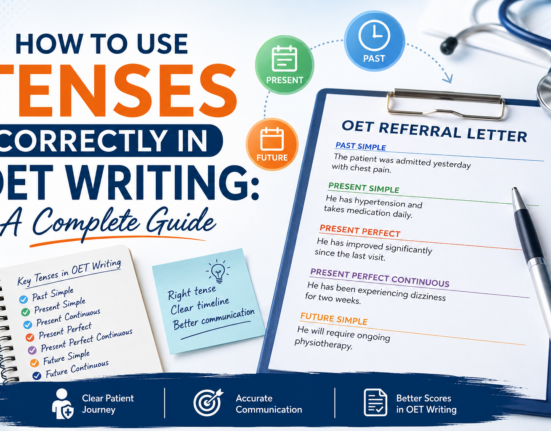
Medical letters naturally move between different time frames. Choosing the correct tense is essential because it helps the reader understand when events occurred.
Generally:
- Past tense describes previous medical history or completed treatment.
- Present tense describes the patient’s current condition.
- Future tense describes recommendations or ongoing management plans.
Correct Examples
Past
The patient underwent laparoscopic surgery in March.
Present
She currently reports persistent abdominal pain.
Future
She will require ongoing community nursing support.
A common mistake is switching tenses unnecessarily.
Incorrect
The patient presented with dizziness and is admitted for observation.
Correct
The patient presented with dizziness and was admitted for observation.
Maintaining consistent tenses makes your writing more logical and easier to follow.
Mistake 3: Incorrect Use of Articles
Articles (a, an, and the) can be surprisingly difficult, particularly for candidates whose first language does not use articles.
However, incorrect article usage can make otherwise fluent writing sound unnatural.
Example 1
Incorrect
Patient has hypertension.
Correct
The patient has hypertension.
Example 2
Incorrect
She underwent MRI scan.
Correct
She underwent an MRI scan.
Example 3
Incorrect
Patient complained of headache.
Correct
The patient complained of a headache.
Practical Tip
- Use a/an when mentioning something for the first time.
- Use the when referring to something already identified or specific.
- Many disease names, such as diabetes, hypertension, and asthma, are generally used without an article. However, countable conditions such as “a cough,” “an infection,” or “a fracture” require one.
Reading model OET letters is an excellent way to become familiar with these patterns.

Mistake 4: Preposition Errors
Prepositions are small words that often create big problems.
Medical English contains many fixed expressions that simply need to be memorised.
Here are some of the most common:
- admitted to hospital
- diagnosed with diabetes
- allergic to penicillin
- treated with antibiotics
- suffering from asthma
- referred for physiotherapy
- concerned about weight loss
- responded to treatment
- recovered from surgery
Example 1
Incorrect
The patient was diagnosed by diabetes.
Correct
The patient was diagnosed with diabetes.
Example 2
Incorrect
She is allergic for penicillin.
Correct
She is allergic to penicillin.
Because these expressions occur repeatedly in OET case notes, learning them as complete phrases is much more effective than learning individual prepositions.
Mistake 5: Unclear Pronoun Reference
Pronouns help avoid unnecessary repetition, but they should never create confusion.
Consider this sentence: “The patient discussed the treatment with her daughter because she was worried.”
Who was worried?
- The patient?
- The daughter?
The sentence leaves the reader guessing.
A clearer version would be:
“The patient discussed the treatment with her daughter because the patient was concerned about the possible side effects.”
Although repeating a noun may seem repetitive, clarity is always more important.
This is particularly important in OET because letters often mention several people:
- the patient
- a spouse
- a daughter
- a caregiver
- another healthcare professional
If the examiner has to stop and think about who a pronoun refers to, the sentence is less effective.
Mistake 6: Incorrect or Unnecessary Passive Voice
Passive voice is common in healthcare writing because the patient or procedure is often more important than the person performing the action.
For example:
“The patient was admitted for observation.”
This sentence is perfectly appropriate.
However, some candidates overuse passive voice, making their writing sound heavy and repetitive.
Example
Overused Passive Voice
Blood tests were performed, medication was administered, observations were completed, and follow-up arrangements were made.
Balanced Version
The medical team performed blood tests, administered medication, completed observations, and arranged follow-up care.
The second version is easier to read because it varies sentence structure and clearly identifies the healthcare team when appropriate.
Remember
Passive voice is not incorrect.
It simply shouldn’t be used when active voice communicates the information more naturally.
Mistake 7: Punctuation Errors
Punctuation may seem like a minor detail, but it significantly affects readability.
Busy healthcare professionals need to understand your letter quickly.
Poor punctuation slows them down.
Comma Splices
Incorrect
The patient was discharged yesterday, she returned today.
Correct
The patient was discharged yesterday. However, she returned today.
Run-on Sentences
Trying to include too much information in one sentence often leads to grammatical errors.
Instead of writing:
“The patient presented with chest pain which had started two days earlier and she had also developed shortness of breath and nausea and was therefore admitted for further investigation.”
Break it into shorter sentences:
“The patient presented with chest pain that began two days earlier. She also developed shortness of breath and nausea. She was admitted for further investigation.”
The meaning remains the same, but the information is much easier to process.
Missing Commas
Introductory phrases usually require commas.
Correct
Following her discharge, the patient attended physiotherapy twice weekly.
Small punctuation improvements can dramatically increase the professionalism of your writing.
Use the Five Minutes of Reading Time Wisely
Before writing begins, OET provides five minutes of reading time.
Many candidates spend this time simply reading the case notes.
A better approach is to use these five minutes strategically.
Ask yourself:
- What is the purpose of the letter?
- Which information is relevant?
- What information can be omitted?
- What order should the information follow?
Planning your letter before writing helps reduce grammatical mistakes because you spend less time rewriting sentences during the exam.
A clear plan leads to clearer grammar.

Proofreading: The Easiest Marks You Can Gain
One of the biggest mistakes candidates make is submitting their letter immediately after finishing.
Even two or three minutes of proofreading can eliminate several avoidable errors.
Use this simple checklist before submission.
✅ Have I used consistent tenses?
✅ Do all subjects agree with their verbs?
✅ Have I checked articles?
✅ Are prepositions correct?
✅ Are pronouns clear?
✅ Is punctuation accurate?
✅ Have I corrected spelling mistakes?
Many grammar mistakes are not caused by lack of knowledge-they’re simply the result of writing too quickly.
A final review gives you the opportunity to catch those errors before the examiner does.
Final Thoughts
Improving your grammar doesn’t mean learning hundreds of complicated rules or memorising advanced sentence structures.
Instead, focus on mastering the mistakes that occur most frequently in OET Writing:
- Subject-verb agreement
- Tense consistency
- Article usage
- Medical prepositions
- Pronoun clarity
- Appropriate use of passive voice
- Accurate punctuation
These are the areas that have the greatest impact on the language criterion and, more importantly, on the clarity of your letter.
Remember, OET Writing is a professional communication task-not a test of literary creativity.
Your goal is to help another healthcare professional understand the patient’s situation quickly, accurately, and efficiently. Every sentence should support that goal.
The next time you practise an OET referral, discharge, or transfer letter, don’t just ask yourself whether you’ve included all the relevant case notes.
Ask yourself something even more important:
“Would another healthcare professional understand this letter immediately?”
If the answer is yes, your grammar is doing exactly what OET expects, and you’ll be one step closer to achieving the score you deserve.
Read our detailed blog – “How to Show Empathy in OET Speaking: Complete Guide with Phrases, Examples & Role-Play Tips” – to ensure your journey stays on track.
Why Wait? Just Merlin It!
Free Consultation – Chat now with a Mentor.