

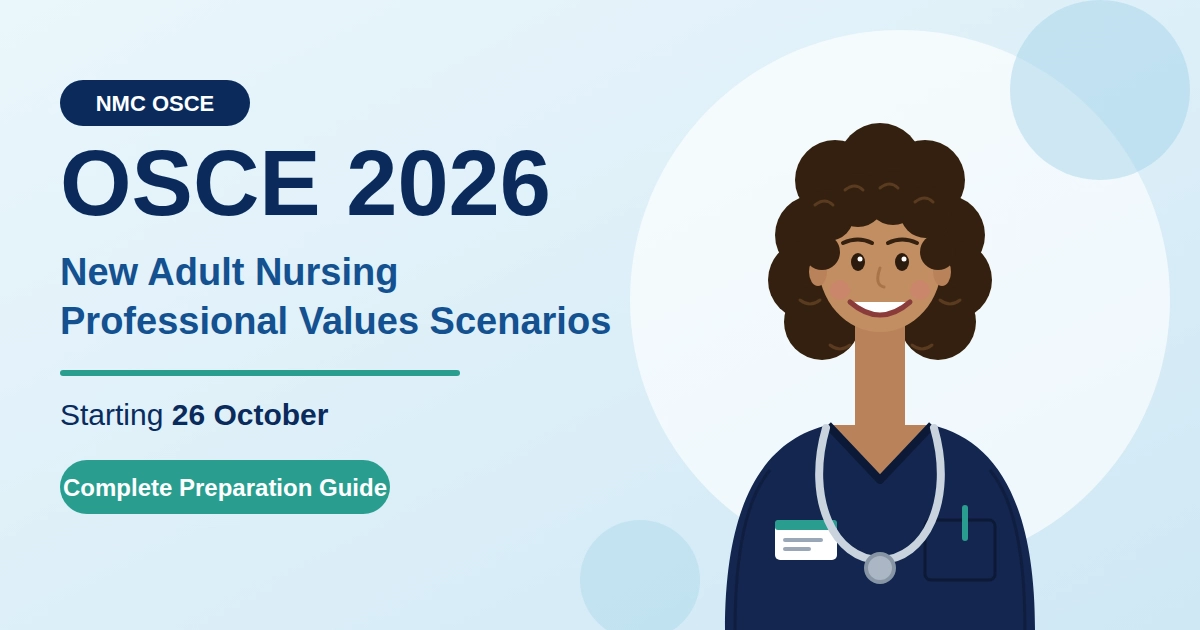
The NMC has introduced three new Professional Values scenarios for Adult Nursing as part of its September 2026 OSCE update:
- Self-medication from ward stock
- Unsafe staffing levels
- Use of bed rails
Candidates sitting their first OSCE from 26 October 2026 onwards may encounter these newly introduced scenarios and should prepare using the updated marking criteria. These stations are not primarily testing your ability to perform a clinical procedure. Instead, they assess whether you can demonstrate professional judgement, accountability, patient safety, escalation, ethical awareness and appropriate documentation.
This blog explains the three new scenarios, breaks down the marking criteria provided for each, and gives an exam-focused approach to help candidates prepare confidently.
The NMC describes Professional Values as an area where candidates are assessed on professional responsibility and the application of professional standards. The wider NMC Code is structured around four themes: prioritise people, practise effectively, preserve safety, and promote professionalism and trust.
This means that candidates should not prepare these stations simply by memorising sentences.
Instead, you should understand:
What is the concern?
Why is it a concern?
Who could be at risk?
What should I do?
Who should I escalate to?
What should I document?
The scenario may contain several issues, so your answer should demonstrate professional reasoning rather than simply identifying one problem.

1. Self-Medication From Ward Stock
The first new scenario focuses on the professional, ethical and legal implications of someone taking medication from ward stock for themselves.
According to the marking criteria provided, candidates are expected to demonstrate five key areas:
- Recognise the professional implications.
- Recognise the ethical implications and patient-safety concerns.
- Discuss possible legal implications.
- Report the incident appropriately and be willing to go on record if required.
- Ensure handwriting is clear and legible.
Understand the scenario
A scenario may describe a healthcare professional or colleague taking medication from ward stock for their own use.
The important point is that you should not treat this as a minor issue.
The marking criteria specifically expect you to recognise that taking medication from ward stock is a serious professional concern and may represent theft, a breach of professional accountability and a breach of hospital rules.
Therefore, an answer such as:
“I would tell my colleague not to do it again.”
would be insufficient.
You need to demonstrate a structured professional response.
A. Recognise the professional implications
Your first priority is to identify the behaviour as inappropriate.
You could explain:
“Taking medication from ward stock for personal use is inappropriate and breaches professional accountability and hospital policies. It may also have implications for the colleague’s professional conduct and could result in disciplinary action.”
The NMC Code expects nurses to uphold professional standards, act with honesty and integrity and comply with the laws of the country in which they practise.
B. Recognise the ethical implications
The second marking criterion focuses on patient safety.
Ask yourself:
Could this action affect patients?
Yes.
For example:
“This is also a patient-safety concern because medication taken from ward stock may not be available when required for a patient. It also compromises professional trust and accountability.”
The NMC Code states that nurses must make care and safety their main concern and must take action where patient safety is at risk.
C. Recognise the possible legal implications
Demonstrate awareness that inappropriate removal or use of medication may have legal and regulatory consequences for the individual and potentially implications for the organisation.
You could say:
“There may also be legal and regulatory implications for the individual and potentially for the organisation, so I would follow the appropriate reporting and investigation procedures.”
This demonstrates professional awareness without making unsupported legal claims.
D. Report the incident appropriately
One of the most important parts of this station is escalation.
If you identify a serious professional concern, you should not simply ignore it because the person involved is your colleague or someone senior to you.
A strong response could include:
“I would report the concern through the appropriate organisational process and escalate it to the appropriate senior member of staff.”
You should always demonstrate that you would follow local policy and appropriate escalation procedures.
The NMC Code requires nurses to raise concerns when patient or public safety may be at risk.
E. Be willing to go on record
The marking criteria specifically state that the candidate should be willing to go on record if an investigation takes place.
This is an important exam point.
You could say:
“I would provide an accurate factual account of what I observed and cooperate with any investigation.”

2. Unsafe Staffing Levels
The second new professional values scenario is unsafe staffing levels.
This scenario is particularly important because it tests your ability to recognise how staffing shortages can affect patient safety and how a nurse should respond professionally.
The marking criteria contain seven areas:
- Escalate patient-safety concerns with clear reasoning.
- Formally document patient risks and actions taken.
- Request additional staff.
- Explain how care would be prioritised.
- Recognise tasks that cannot safely be undertaken.
- Conduct ongoing risk assessment.
- Maintain clear and legible handwriting.
A. Recognise that staffing is a patient-safety issue
Do not simply say:
“There are not enough nurses.”
You need to explain why the staffing level is unsafe.
For example:
“The staffing deficit may compromise patient safety because there may not be sufficient staff to provide essential care, monitor deteriorating patients and complete time-critical interventions safely.”
The NMC Code specifically expects professionals to manage risk, prioritise needs and take action where safety is threatened.
B. Escalate with a clear justification
The marking criteria specifically require you to provide a clear and reasoned justification.
A strong answer could be:
“I would escalate the staffing concern to the nurse in charge or appropriate senior person, clearly explaining the number and acuity of patients, the staffing deficit and the specific risks this creates for patient safety.”
C. Request additional staff
The marking criteria specifically state that you should request additional staff and explain why.
You could say:
“I would request additional appropriately skilled staff and explain which areas require support, based on patient acuity and immediate clinical risks.”
Think about the type of help required.
For example:
- Additional registered nurse
- Healthcare support worker
- Appropriate specialist support
- Senior clinical support
The answer should be based on the needs of the ward rather than simply saying:
“I need more people.”
D. Prioritise patients according to clinical risk
This is one of the most important areas.
When staffing is inadequate, you cannot simply work through patients in order.
You could say:
“I would prioritise patients according to clinical urgency and risk, ensuring patients with immediate or deteriorating clinical needs receive attention first.”
The NMC Code includes the expectation that nurses manage time, staff and resources effectively and deal with risk while putting people’s needs first.
E. Identify what cannot safely be done
This criterion is extremely important.
“I would recognise which tasks cannot be safely undertaken with the available staffing and escalate these concerns rather than carrying out care that could put patients or staff at risk.”
The key word is safely.
A nurse should work within their competence and should not allow pressure or workload to result in unsafe practice.
F. Conduct ongoing risk assessment.
Unsafe staffing is not a one-time assessment.
The situation can change during the shift.
For example:
- A patient may deteriorate.
- A new admission may arrive.
- A patient may require urgent intervention.
- A staff member may become unavailable.
- The workload may increase.
Therefore, your answer should include:
“I would continue to reassess the staffing situation and patient risks throughout the shift and escalate any further concerns promptly.”
This is a strong sentence to practise.
Remember:
Assess → Prioritise → Escalate → Act → Reassess → Document
G. Document patient risks and actions taken
Documentation is specifically included in the marking criteria.
Document objectively:
“Staffing levels were below the planned level. Patient acuity was reviewed and concerns regarding safe delivery of care were escalated to the nurse in charge.”
3. Use of Bed Rails
The third new Professional Values scenario is Use of Bed Rails.
This scenario is different from the previous two because it involves patient autonomy, risk, consent, capacity, legal considerations and least-restrictive care.
The marking criteria contain eight areas:
- Identify at least five risk factors and prevention strategies.
- Discuss risks and benefits of bed rails.
- Respect Mrs Kelly’s autonomy.
- Recognise legal implications of restricting liberty.
- Suggest practical and least-restrictive alternatives.
- Consider the family’s perspective while respecting patient rights.
- Obtain consent and document decisions/actions.
- Maintain clear and legible handwriting.
This is likely to require more detailed reasoning than simply saying:
“Bed rails prevent falls.”
A. Identify at least five risk factors
The marking criteria specifically require at least five risk factors.
The exact risk factors will depend on the scenario, so do not memorise one fixed list.
Look for information such as:
- Previous falls
- Confusion or cognitive impairment
- Reduced mobility
- Weakness
- Poor balance
- Medication effects
- Toileting needs
- Environmental hazards
- Poor vision
- Previous attempts to climb over bed rails
- Inability to understand safety advice
You should then link the risk to a prevention strategy.
Example
Risk: Reduced mobility
Prevention: Appropriate mobility assessment and assistance.
Risk: Confusion
Prevention: Reorientation, appropriate observation and a calm environment.
Risk: Environmental hazards
Prevention: Keep the environment safe, clear and appropriately arranged.
The key is:
Risk → Prevention strategy
B. Discuss the risks and benefits of bed rails
Do not assume that bed rails are automatically safe.
You should demonstrate balanced professional reasoning.
Potential benefits may include:
- Supporting some patients who need assistance with positioning.
- Providing a physical boundary in certain circumstances.
- Potentially assisting some patients to reposition, where appropriate and assessed.
- Supporting a particular care plan where the benefits outweigh risks.
Potential risks may include:
- Injury
- Attempting to climb over the rails
- Falls from a greater height
- Distress or fear
- Restriction of movement
Therefore, your answer should be individualised.
You could say:
“I would assess the individual risks and benefits rather than assuming that bed rails are appropriate simply because the patient is at risk of falling.”

C. Respect Mrs Kelly’s autonomy
This is a major marking point.
If Mrs Kelly has capacity and does not want bed rails, you cannot simply say:
“Her family wants them, so I would use them.”
The patient’s rights and wishes must be considered.
The NMC Code states that nurses should respect individual choice, dignity and human rights.
A strong OSCE statement would be:
“I would respect Mrs Kelly’s autonomy and involve her in decisions about her care. I would discuss the risks and benefits with her and support her to make an informed decision.”
D. Recognise the legal implications of restricting liberty
This criterion is specifically included in the marking criteria.
Bed rails can raise important legal and ethical questions where their use restricts a person’s freedom of movement.
Therefore say
“I would consider whether the use of bed rails could amount to a restriction of the person’s liberty and ensure that any decision is made in accordance with relevant legal requirements, professional standards and local policy.”
You should demonstrate awareness without attempting to provide a detailed legal judgment during the station.
E. Consider least-restrictive alternatives
This is another high-value area.
Before deciding that bed rails are necessary, consider alternatives.
Depending on the scenario, these may include:
- Increased observation
- Appropriate bed positioning
- Lower bed
- Appropriate footwear
- Ensuring the call bell is accessible
- Regular toileting
- Mobility assistance
- Environmental assessment
- Appropriate lighting
- Review of medications contributing to falls risk
- Physiotherapy or occupational therapy input
The key principle is:
Use the least restrictive option that safely meets the person’s needs.
Do not simply list alternatives. Explain why they may be appropriate for the individual.
F. Consider the family’s perspective
The marking criteria specifically mention the family’s perspective.
Families may say:
“Please put the bed rails up because we are worried she will fall.”
You should acknowledge their concern.
You could say:
“I would listen to the family’s concerns and explain the risks and benefits of the available options, while ensuring that Mrs Kelly’s rights, wishes and best interests remain central to the decision.”
If the patient lacks capacity, the decision-making approach changes.
You should consider:
- Capacity
- Best interests
- Patient’s previous wishes and feelings
- Relevant people involved in the person’s care
- Relevant legal and organisational requirements
The NMC Code emphasises individual choice, rights and dignity as part of person-centred care.
G. Consent and documentation
Consent is another important marking criterion.
For example:
“Discussed risks and benefits of bed rails with patient. Patient’s views and preferences considered. Alternatives discussed. Decision documented and care plan updated.”
If the patient lacks capacity, You should explain that you would follow the appropriate capacity and best-interests process and document the decision-making process.
Common Mistakes Candidates Should Avoid
Mistake 1: Memorising without understanding
Professional Values scenarios are designed to assess judgement.
Do not memorise one answer and repeat it regardless of the scenario.
Mistake 2: Ignoring escalation
Identifying a problem is not enough.
You need to explain what you would do about it.
Mistake 3: Blaming colleagues
Professional communication should remain factual and respectful.
Do not use emotional or judgmental language.
Mistake 4: Forgetting documentation
Documentation is explicitly included in all three marking criteria.
Make sure your written response is clear, relevant and legible.
How to Prepare for the Three New Stations
1. Learn the marking criteria
Read each criterion carefully.
Do not just read the scenario title.
The marking criteria tell you what the examiner is looking for.
2. Practise documentation
Practise writing your answer with reasoning.
For example:
“I recognise this as a patient-safety concern. I would assess the immediate risk, take appropriate action, escalate to the appropriate senior person and document the concern and action taken.”
3. Practise handwriting
All three scenarios include clear and legible handwriting as a marking criterion.
Therefore, your preparation should include writing practice.
A candidate may understand the scenario but lose the opportunity to demonstrate their knowledge if their written answer is difficult to read.

Quick Revision Table
| Scenario | Main focus | Key actions |
| Self-medication from ward stock | Professional accountability and patient safety | Recognise concern → explain professional/ethical implications → consider legal implications → report → document |
| Unsafe staffing levels | Staffing-related patient safety | Assess risk → escalate → request support → prioritise patients → identify unsafe tasks → ongoing risk assessment → document |
| Use of bed rails | Autonomy, consent, restriction and least-restrictive care | Identify risks → discuss benefits/risks → respect autonomy → consider legal implications → alternatives → family involvement → consent/capacity → document |
The introduction of Self-Medication from Ward Stock, Unsafe Staffing Levels and Use of Bed Rails gives Adult Nursing candidates three new Professional Values scenarios to prepare for from 26 October 2026 onwards. The NMC’s September 2026 announcement confirms that these scenarios are part of the updated Adult Nursing OSCE preparation materials for first-time candidates sitting from that date.
Although the scenarios are different, the underlying professional principles are closely connected.
For Self-Medication from Ward Stock, focus on professional accountability, patient safety, ethical concerns, possible legal implications and appropriate reporting.
For Unsafe Staffing Levels, focus on recognising patient-safety risks, escalation, requesting appropriate support, prioritising care, identifying tasks that cannot safely be completed and continuing risk assessment.
For Use of Bed Rails, focus particularly on individualised assessment, autonomy, consent, capacity, risks and benefits, legal considerations, family involvement and least-restrictive alternatives.
Most importantly, do not approach these stations as exercises in memorising perfect sentences. The NMC expects candidates to demonstrate professional standards in the context of the scenario. The NMC Code requires nurses to put people’s interests and safety first, communicate effectively, work cooperatively, manage risk and uphold professional standards.
Prepare the marking criteria, practise your written answers and make sure every written response is clear and legible.
At Mentor Merlin, candidates can use these updated scenarios as part of their preparation so they can become familiar with the new marking criteria and approach the updated OSCE with greater confidence.
OSCE Preparation Tips 2026: Exams After 26 October
- Download the updated marking criteria documentation for your field from the NMC portal; forwarded PDFs are often the pre-update version.
- Have a better understanding of how the new OSCE stations from 26 October 2026 break down for your field: Adult adds three PV scenarios; Paediatric adds one PV, three EBP, one APIE and two skills; Mental Health adds four PV, four EBP, two APIE and three skills.
- Do sit only for the mocks aligned to the new version; a mock built on the old bank is practice for an exam you are not taking.
- Remember to keep the existing bank in your revision; the new stations are additions, not replacements.
FAQs: NMC OSCE Changes 2025-2026
1. Why did the NMC update the OSCE exam?
To align the exam with current clinical practice and improve fairness.
2. Are OSCE stations easier now?
Not necessarily; while some processes are simplified, expectations remain high.
3. Do I still need to wear PPE in every station?
No, PPE is now based on clinical need and risk assessment.
4. What is the biggest change in OSCE?
Updated clinical practices, reduced scenarios, and improved marking clarity.
5. How should I prepare for these changes?
By using updated training materials and practising real exam scenarios.
6. Can I rely on old OSCE preparation materials?
No, outdated materials may not reflect current exam expectations.
7. Where can I get updated OSCE training?
Through structured programs that align with the latest NMC guidelines.
Worth A Try
Read our recent blog – “NMC OSCE MSU Station: Complete Guide to Urine Dipstick Analysis and Clinical Significance” – to ensure your journey stays on track.
Why Wait? Just Merlin It!
Stay tuned to Mentor Merlin for further NMC OSCE updates, preparation guidance and exam-focused resources.
NMC Updates 2026, Mentor Merlin, NMC September 2026, NMC Fee Changes, New OSCE Stations, OSCE Update 2026, NMC Registration UK, OSCE Training UK, International Nurses UK, UK Nursing, CBT Training, OET Training, Overseas Nurses UK, UK Nurse Registration.
#nmcupdates #nmcosce #mentormerlin #uknursing #oscetraining #oettraining #cbttraining #nmcregistration #oscetraininguk #overseasnurses #nurses #internationalnurses #freeosce #oscetips #osceupdates2026
Free Consultation – Chat now with a Mentor.