


Grammar Improvement Happens Through Application
Grammar is often misunderstood as a collection of rules that must be memorised. In reality, grammar provides the structure through which meaning is communicated accurately. For healthcare professionals, grammatical accuracy is especially important because tense, sentence structure, and word choice can influence the meaning of clinical information. Compare these sentences:
The patient had experienced dizziness.
The patient has been experiencing dizziness.
The first describes an experience occurring before another past point. The second describes an experience that began in the past and continues into the present. Understanding this distinction is essential when describing patient histories. However, grammar development should not stop at recognising these differences. Candidates need to practise using grammatical structures in realistic contexts. An effective method is to take a sentence and transform it into different forms.
Original: The patient developed a rash.
Expanded: The patient developed a widespread rash following the initiation of antibiotic therapy.
Present perfect: The patient has experienced recurrent episodes of skin irritation over the past six months.
Passive construction: The patient was prescribed topical corticosteroids to manage the symptoms.
Such exercises help learners move from theoretical knowledge towards practical application.Candidates should also maintain an error log documenting recurring grammatical mistakes. Reviewing these errors periodically can reveal patterns that ordinary practice tests may not expose.
Developing Listening Skills Beyond Practice Recordings
Listening is frequently one of the most challenging areas for candidates because spoken language must be processed immediately. Unlike reading, listeners generally cannot pause naturally occurring conversations to examine every sentence.
Successful listening requires more than recognising individual words. Learners must understand connected speech, identify key information, interpret the speaker’s intention, and follow the development of ideas. One effective method is to incorporate regular listening activities outside examination materials. Healthcare podcasts, patient interviews, educational discussions, and professional presentations can expose candidates to different accents, speaking styles, and vocabulary.
However, passive listening alone may produce limited improvement. Candidates should engage actively with recordings by identifying main ideas, noting unfamiliar expressions, summarising important information, and reviewing difficult sections. For example, after listening to a five-minute healthcare discussion, a learner could answer three questions:
- What was the main issue discussed?
- What recommendations did the speaker provide?
- Which expressions or phrases were unfamiliar?
Repeated listening can then help the learner identify information that was initially missed. Over time, this develops both listening accuracy and confidence in processing spoken English.

Reading Regularly Builds Comprehension and Language Awareness
Reading is one of the most accessible ways to develop language proficiency. Regular exposure to well-written English helps learners become familiar with sentence structures, vocabulary, argument development, and relationships between ideas.
For OET candidates, reading should extend beyond examination passages.Healthcare articles, patient information leaflets, professional publications, and general-interest texts provide valuable opportunities to develop comprehension. Candidates should practise two complementary approaches.
- Extensive reading involves reading longer texts for general understanding, without stopping to analyse every unfamiliar word.
- Intensive reading involves examining shorter passages carefully to understand vocabulary, grammar, implied meanings, and the writer’s purpose.
Both are important. Extensive reading develops fluency and familiarity with language, while intensive reading strengthens accuracy and deeper comprehension. For instance, when reading an article about antibiotic resistance, a candidate could identify the central argument, distinguish evidence from opinion, examine how paragraphs are connected, and record useful expressions. Such activities develop the linguistic abilities required for challenging Reading Part C questions.
Writing and Speaking Improve Through Feedback and Revision
Writing and Speaking are productive skills. They require learners to retrieve language and organise it into meaningful communication. Many candidates focus primarily on producing more written responses or completing more speaking role-plays. However, improvement depends heavily on what happens after the activity.
A candidate who writes several referral letters but repeatedly makes the same grammatical mistakes may experience little progress. Similarly, completing multiple speaking role-plays without identifying weaknesses in fluency, clarity, pronunciation, or language appropriateness may reinforce existing habits. Feedback helps candidates recognise difficulties they may not notice independently. Effective writing development involves drafting, receiving feedback, identifying recurring errors, revising sentences, and applying the corrections in future tasks. Speaking development can involve recording short explanations, listening critically, identifying unnatural expressions, and attempting improved versions.
For example, a candidate explaining hypertension may initially say,” your blood pressure is very high, and it will cause many diseases”. After feedback, the explanation might become,”your blood pressure is higher than the recommended range. If it remains uncontrolled, it can increase your risk of developing heart and kidney problems”. The revised explanation is more precise, appropriately cautious, and suitable for patient communication.This process of producing, reviewing, and refining language is essential for long-term improvement.

Why Consistency Matters More Than Occasional Intensive Study
Many learners follow an irregular study pattern. They may study for several hours immediately before an examination but spend relatively little time developing their English during ordinary weeks. Although intensive preparation has its place, language development benefits from frequent and sustained engagement. Short, focused learning sessions provide regular opportunities to encounter, retrieve, and apply language.
A practical daily routine could include a 60-minute daily language improvement plan
Sample Routine
Reading, 15 min: Read an article and identify useful expressions
Listening, 15 min: Listen actively and summarise key information
Vocabulary and grammar, 15 min: Review expressions and practise sentence construction
Speaking or writing, 15 min: Produce a short response and review its accuracy
This routine is not a fixed requirement. Candidates can adjust the duration according to their current proficiency, learning needs, and available time. The important principle is maintaining consistency.
Studying English for one hour daily over several months provides repeated opportunities for learning and consolidation. It also encourages candidates to view language development as a regular habit rather than an emergency activity before an examination.
Recognising Progress Beyond Examination Scores
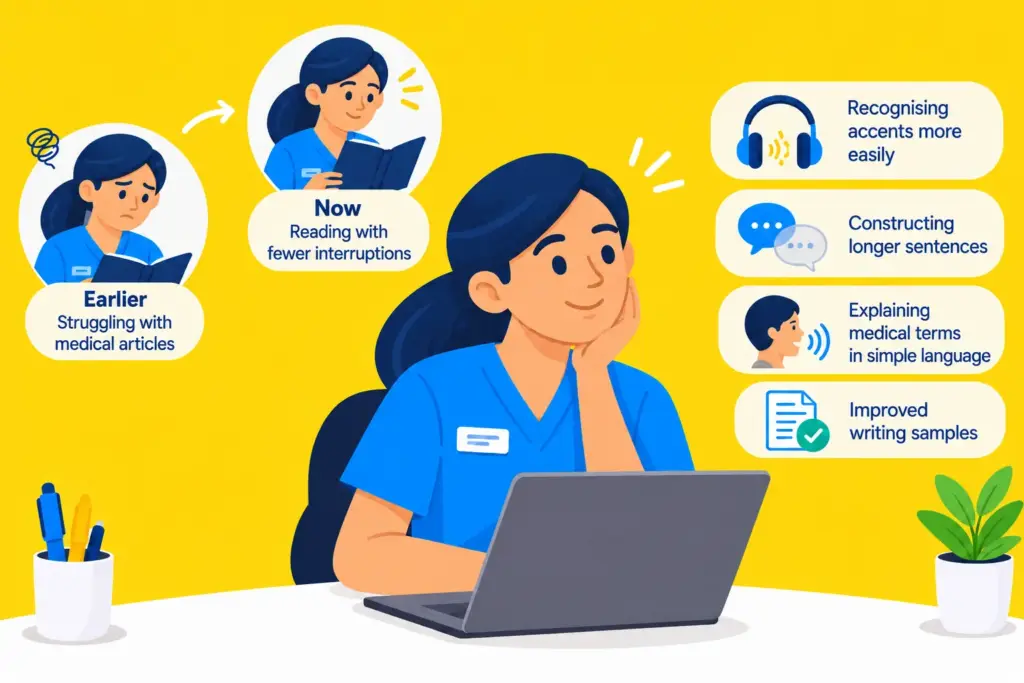
One reason candidates become discouraged is that they measure improvement exclusively through practice test scores. Although scores provide useful information, they do not capture every aspect of language development. Progress may also become visible through smaller changes.
A candidate who previously struggled to understand healthcare articles may begin reading them with fewer interruptions. Another candidate may gradually recognise unfamiliar accents more easily or construct longer sentences with greater grammatical accuracy. A speaking candidate may become better at explaining medical terminology in patient-friendly language, even before a substantial change appears in formal assessment results. These developments matter because they represent improvements in underlying language ability.
Candidates can monitor progress by comparing earlier and more recent writing samples, reviewing speaking recordings, tracking recurring errors, and noting improvements in reading or listening comprehension. A useful reflection exercise is to ask, “what can I understand or communicate today that I found difficult a month ago?”
This shifts attention from immediate scores towards measurable development. It also encourages learners to appreciate that progress is not always linear. Some skills may improve quickly, while others require longer periods of practice.
Developing a Growth-Oriented Approach to Language Learning
Successful language learners generally recognise that mistakes are part of the learning process. A mistake should not simply be treated as evidence of poor performance. It can provide information about what requires further attention.
For example, repeatedly confusing since and for suggests a specific difficulty with expressions of time. Rather than memorising the correct answer to one question, the learner should examine the underlying concept and practise it in multiple contexts. A growth-oriented approach involves setting realistic goals, accepting corrective feedback, monitoring progress, and adapting learning strategies. It also means avoiding comparisons with candidates whose language backgrounds and learning experiences may be very different.
Someone with years of regular English exposure may require less time to become familiar with OET tasks than someone who has had limited opportunities to use English professionally. This does not mean improvement is impossible for the second candidate. It means their preparation must account for the language development they need. The most productive question is not simply, “How quickly can I pass the examination?” but “What language abilities do I need to strengthen to perform confidently?”
The Role of OET Preparation Courses in Language Development
A well-structured OET preparation course should do more than familiarise candidates with examination formats. It should help learners identify their current proficiency, understand their weaknesses, develop relevant language skills, and apply those skills effectively in examination tasks.
Diagnostic assessments can help identify whether a candidate’s difficulties arise from limited vocabulary, grammatical inaccuracies, comprehension problems, or unfamiliarity with examination techniques. Targeted lessons can then address these weaknesses through guided practice, feedback, and progressive skill development. However, candidates must also recognise the limitations of classroom instruction. A tutor can explain grammatical concepts, demonstrate effective strategies, identify errors, and provide corrective feedback. The learner must reinforce that guidance through regular independent practice.
Language development requires active participation beyond scheduled classes. Candidates who consistently read, listen, write, speak, and reflect on their progress are better positioned to benefit from examination-focused instruction. Ultimately, the purpose of a preparation course should be to strengthen the candidate’s ability to use English effectively, not merely to help them reproduce familiar answers.

English Proficiency Matters Beyond the OET Examination
For healthcare professionals, English proficiency is not simply an examination requirement. It is an essential component of effective professional communication. Healthcare environments involve complex interactions with patients, relatives, colleagues, and multidisciplinary teams. Professionals may need to explain diagnoses, discuss treatment options, obtain relevant information, document clinical findings, and respond sensitively to patient concerns. These responsibilities require linguistic accuracy, clarity, flexibility, and confidence.
A candidate who memorises several phrases for a speaking examination may perform adequately in familiar situations. However, real healthcare interactions are unpredictable. Patients may ask unexpected questions, express concerns in unfamiliar ways, or struggle to understand technical explanations. Effective communication therefore depends on the ability to adapt language according to the situation.
Similarly, professional writing requires more than knowing the format of a referral or discharge letter. Healthcare professionals must communicate information accurately and appropriately across different contexts. Continuous language improvement supports both examination success and long-term professional competence. Passing the OET should therefore be viewed as an important milestone, not the endpoint of English language development.
Conclusion: Develop Your English Beyond the Examination
Improving English proficiency is an ongoing process that requires consistency, purposeful practice, and a willingness to learn from mistakes. While examination strategies and preparation courses can guide candidates towards their target scores, lasting progress depends on developing the language skills that make effective communication possible.
Regular reading and listening, practical grammar and vocabulary work, and feedback-driven writing and speaking practice can help learners gradually improve their accuracy, fluency, and confidence. Tracking progress and addressing recurring weaknesses also make learning more focused and effective.
For OET candidates, the goal extends beyond achieving a required grade. Healthcare professionals need to communicate clearly, explain information accurately, respond to patient concerns, and adapt their language to different clinical situations. These abilities develop through continued learning, not simply through familiarity with an examination format.
Do not learn English only to pass an examination. Develop your English to become a more effective communicator.
Your OET result can mark an important achievement, but it does not have to mark the end of your language-learning journey. Continuous improvement can support your professional development and help you communicate more confidently long after the examination is over.
Frequently Asked Questions
1. How can I improve my grammar for real communication?
Knowing a rule is only the first step. Use the patterns you’ve studied in your own sentences, both spoken and written, until they come naturally. Keep a grammar reference handy and check it as soon as a doubt comes up, because answers you look up when you need them stick better. Pay attention to correct grammar in what you read and hear, and learn new words inside whole phrases so you can see how they are used.
2. How can I make my English listening better?
Little and often works best. Listen for a short time every day, and replay the same podcast or recording several times so you catch more with each listen. Following the transcript as you listen can help, and so can hearing different accents and real conversations.
3. How much time should I spend on English each day?
Try for at least 30 minutes, or an hour if your schedule allows. Short, regular sessions are easier to keep up than occasional long ones. Treat English as a daily habit rather than something to cram when the exam gets close.
4. How can I improve my OET writing?
Start by learning the method for each task, then practise with questions that match the real test. After that, get personal feedback on your writing, either as a marked assessment or in a one-to-one session. Use that feedback to correct repeated mistakes in your next attempt.
5. Can I pass the OET without studying?
It’s very unlikely. The writing and speaking sub-tests in particular need a proper study plan. If your English needs more work, allow extra time to build your language skills before concentrating on the exam.
6. Is it better to read widely or study short texts closely?
Do both. Reading longer texts you enjoy, without worrying about every unknown word, builds fluency and confidence. When a passage is especially useful, go back and study it closely to understand its grammar, vocabulary and meaning. The two approaches support each other.
References
OET Preparation Information: oet.com/learn/preparation-information
Five Tips to Improve Your English Vocabulary: learnenglish.britishcouncil.org
Read our Recent Blog – “English Language Skills: Why Continuous Improvement Wins” – to ensure your journey stays on track.
Why Wait? Just Merlin It!
Free Consultation – Chat now with a Mentor