

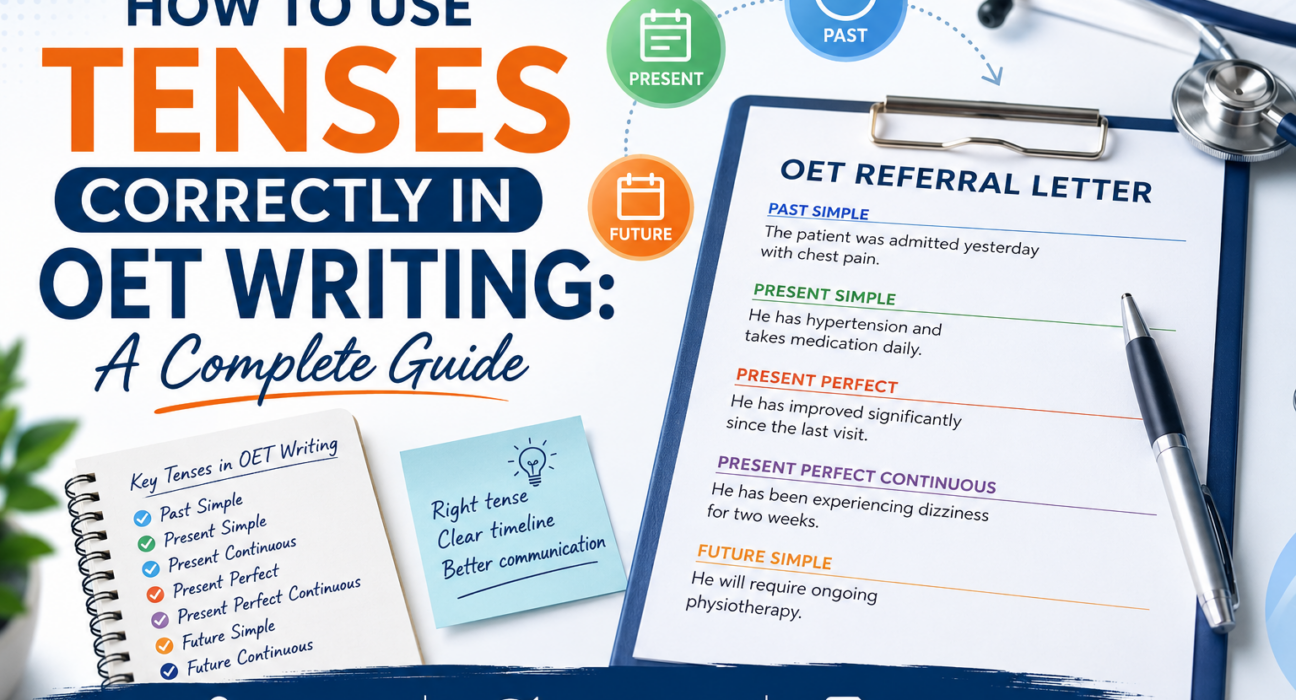
Tenses are one of the most overlooked aspects of OET Writing, yet they play a crucial role in producing an accurate and professional referral letter. Unlike academic essays, OET letters are clinical documents where every sentence reflects a patient’s journey from their medical history to their current condition and future management. Choosing the wrong tense can confuse the timeline of events, making it difficult for the receiving healthcare professional to understand the patient’s case.
Fortunately, OET Writing does not require you to master every complex English tense. Instead, you need to know which tense is appropriate for each stage of patient care. Once you understand this relationship, selecting the correct tense becomes much easier.
In this blog, we’ll explore how the different English tenses are used in OET writing, when to use them, and how they help present patient information clearly and professionally.
Why Are Tenses Important in OET Writing?
An OET referral letter tells a patient’s story.
It answers questions such as:
- What happened in the past?
- What is happening now?
- What treatment has been provided?
- What still needs to happen?
Every answer depends on the correct tense.
Consider these examples
❌ The patient complains of chest pain for three days.
✔ The patient has been experiencing chest pain for the past three days.
The first sentence suggests an incorrect timeline, while the second accurately indicates that the symptoms began in the past and continue into the present.
Accurate tense usage helps the reader immediately understand the patient’s condition without having to interpret unclear timelines.
Understanding Tenses Through the Patient Journey
Instead of memorising grammar rules, think about where the patient is in their healthcare journey.
| Stage of Patient Care | Common Tense |
|---|---|
| Medical history | Past Simple |
| Previous treatments | Past Simple / Present Perfect |
| Current condition | Present Simple |
| Ongoing symptoms | Present Continuous / Present Perfect Continuous |
| Current medication | Present Simple |
| Investigations completed | Present Perfect |
| Future management | Future Simple |
| Planned monitoring | Future Continuous |
Once you associate each tense with a stage of care, grammar becomes much more intuitive.
1. Present Simple
When do we use it?
The Present Simple describes facts that are true now.
In OET Writing, this is probably the most frequently used tense.
Use it for:
- current diagnoses
- current medications
- allergies
- lifestyle habits
- stable conditions
- examination findings
- purpose of referral
Examples
✔ Mr Taylor has hypertension.
✔ She takes Metformin 500 mg twice daily.
✔ He is allergic to penicillin.
✔ She lives independently with her husband.
✔ His blood pressure is 130/80 mmHg.
In patient care, Present Simple represents:
- Current medical condition
- Current medications
- Current lifestyle
- Established diagnoses
- General facts
Common mistake
❌ She is taking Metformin for diabetes.
Although grammatically possible, this suggests a temporary action.
Better:
✔ She takes Metformin 500 mg twice daily.
Long-term medications are generally written using the Present Simple.

2. Present Continuous
When do we use it?
The Present Continuous describes actions happening now or temporary situations.
In OET Writing, it is useful for describing:
- ongoing symptoms
- current treatment
- temporary admission
- current monitoring
Examples
✔ The patient is experiencing severe abdominal pain.
✔ She is receiving intravenous antibiotics.
✔ He is recovering well following surgery.
✔ The patient is currently undergoing physiotherapy.
Patient care situations
Use Present Continuous when describing:
- Ongoing treatment
- Current symptoms
- Hospital admission
- Rehabilitation
- Recovery
Compare
Present Simple:
She takes insulin daily.
(long-term medication)
Present Continuous:
She is receiving insulin via an intravenous infusion.
(temporary treatment during admission)
3. Past Simple
When do we use it?
Past Simple describes completed events.
This tense is essential in OET referral letters because much of the patient’s history has already happened.
Use it for:
- admission details
- previous illnesses
- surgeries
- completed investigations
- previous treatment
- accidents
- discharge information
Examples
✔ The patient presented to the emergency department with chest pain.
✔ He underwent appendicectomy in 2022.
✔ Mrs Green was admitted on 14 March.
✔ She completed a seven-day course of antibiotics.
Patient care situations
Past Simple represents:
- Medical history
- Hospital admission
- Previous operations
- Completed treatments
- Previous consultations
Common mistake
❌ The patient has presented yesterday.
Yesterday requires Past Simple.
✔ The patient presented yesterday.

4. Present Perfect
When do we use it?
Present Perfect connects the past with the present.
Something started before now but still has relevance.
This tense is common in OET letters because many previous events continue to affect current patient care.
Use it for:
- investigations completed
- improvement
- deterioration
- previous treatment with present relevance
- repeated admissions
Examples
✔ The patient has responded well to treatment.
✔ She has completed the antibiotic course.
✔ His condition has improved significantly.
✔ The patient has attended several physiotherapy sessions.
Patient care situations
Present Perfect is useful for:
- Progress
- Recovery
- Response to treatment
- Clinical improvement
- Investigations already completed
Compare
Past Simple
She completed physiotherapy last month.
(The event is finished.)
Present Perfect
She has completed physiotherapy.
(The completion is important now.)
5. Present Perfect Continuous
When do we use it?
This tense emphasises duration.
The condition began in the past and continues now.
This is extremely useful when describing symptoms.
Examples
✔ The patient has been experiencing dizziness for two weeks.
✔ She has been suffering from migraines since January.
✔ He has been taking pain medication regularly.
✔ She has been attending counselling sessions weekly.
Patient care situations
Use it for:
- Duration of symptoms
- Ongoing complaints
- Continuing treatment
- Long-term monitoring
Compare
Present Continuous
The patient is experiencing dizziness.
(Current symptom)
Present Perfect Continuous
The patient has been experiencing dizziness for two weeks.
(Current symptom plus duration)

6. Future Simple
When do we use it?
Future Simple describes recommendations or future actions.
This tense appears frequently in the final paragraph of referral letters.
Use it for:
- recommendations
- follow-up
- planned investigations
- referrals
- discharge advice
Examples
✔ She will require ongoing physiotherapy.
✔ The patient will benefit from dietary counselling.
✔ He will attend the outpatient clinic next month.
✔ You will be able to review his medications.
Patient care situations
Future Simple is ideal for:
- Recommendations
- Follow-up care
- Referral purpose
- Future appointments
- Planned management
7. Future Continuous
When do we use it?
Future Continuous describes actions that will be in progress at a future time.
Although less common than other tenses, it can make future management plans sound more precise.
Examples
✔ The patient will be attending weekly physiotherapy sessions.
✔ She will be receiving community nursing support following discharge.
✔ He will be undergoing further rehabilitation over the coming months.
Patient care situations
Use Future Continuous for:
- Ongoing rehabilitation
- Long-term management
- Community care
- Continuing treatment
Choosing the Right Tense for Each Section of an OET Letter
Understanding the structure of an OET letter makes tense selection much easier.
Introduction
Usually includes:
- reason for writing
- current diagnosis
Example
I am writing to refer Mr Brown for further assessment of his chronic lower back pain.
Present Simple
Medical History
Usually includes:
- previous illnesses
- surgeries
- admissions
Example
He underwent coronary artery bypass surgery in 2021.
Past Simple
Current Condition
Usually includes:
- examination findings
- medications
- diagnosis
Example
He currently takes Aspirin 75 mg daily.
Present Simple
Progress
Usually includes:
- response to treatment
- improvement
Example
He has responded well to the prescribed medication.
Present Perfect
Current Symptoms
Usually includes:
- ongoing complaints
Example
She has been experiencing increasing breathlessness over the past month.
Present Perfect Continuous
Recommendation
Usually includes:
- future management
Example
She will require ongoing wound care and monitoring.
Future Simple
Common Tense Errors in OET Writing
Even candidates with good English can lose marks by choosing the wrong tense. Most tense-related mistakes occur because the timeline of the patient’s care is not presented clearly.
Below are some of the most common errors and their correct forms.
Mixing timelines
❌
The patient was admitted yesterday and is discharged today.
✔
The patient was admitted yesterday and is being discharged today.
Using Present Simple for completed events
❌
He attends the emergency department last night.
✔
He attended the emergency department last night.
Using Past Simple for current symptoms
❌
She experienced chest pain for three days.
✔
She has been experiencing chest pain for three days.
Using ‘continuous’ unnecessarily
❌
He is having hypertension.
✔
He has hypertension.
Permanent medical conditions are generally expressed using the Present Simple (or “has” for conditions), not the Continuous form.

Quick Reference: Tenses in OET Writing
| Tense | Purpose | Example |
|---|---|---|
| Present Simple | Current condition, medication, diagnosis | She has asthma. |
| Present Continuous | Ongoing treatment or temporary condition | She is receiving IV antibiotics. |
| Past Simple | Medical history, completed events | He underwent surgery in 2023. |
| Present Perfect | Completed action with current relevance | She has recovered well. |
| Present Perfect Continuous | Symptoms continuing until now | He has been experiencing headaches for two weeks. |
| Future Simple | Recommendation, follow-up | She will require community support. |
| Future Continuous | Ongoing future care | He will be attending rehabilitation sessions. |
Conclusion
Mastering tenses in OET Writing is not about memorising complex grammar rules – it is about accurately reflecting the patient’s clinical journey. Every section of a referral letter has a distinct purpose, and each purpose naturally aligns with a particular tense.
A helpful way to remember this is to think of the timeline of care:
- Past Simple records the patient’s history and completed events.
- Present Simple describes their current condition, medications, and established diagnoses.
- Present Continuous highlights treatments or situations happening right now.
- Present Perfect links previous care to the patient’s current status.
- Present Perfect Continuous emphasises symptoms or treatments that began in the past and are still ongoing.
- Future Simple communicates recommendations and planned management.
- Future Continuous describes continuing care that will take place after referral or discharge.
When your tense choices clearly reflect the patient’s past, present, and future, your referral letter becomes easier to follow, more professional, and more effective. In OET Writing, clear timelines are just as important as accurate clinical information, and choosing the correct tense is one of the simplest ways to demonstrate both language proficiency and professional communication.
Key Takeaway
Understanding tenses becomes much easier when you stop thinking about grammar rules and start thinking about the patient’s journey.
- Past = What happened
- Present = What is true now
- Present Perfect = What happened and still matters
- Present Perfect Continuous = What started before and continues now
- Future = What needs to happen next
Read our detailed blog – “How Panic Reading Lowers Your Score and How to Stop It” – to ensure your journey stays on track.
Why Wait? Just Merlin It!
Free Consultation – Chat now with a Mentor.