

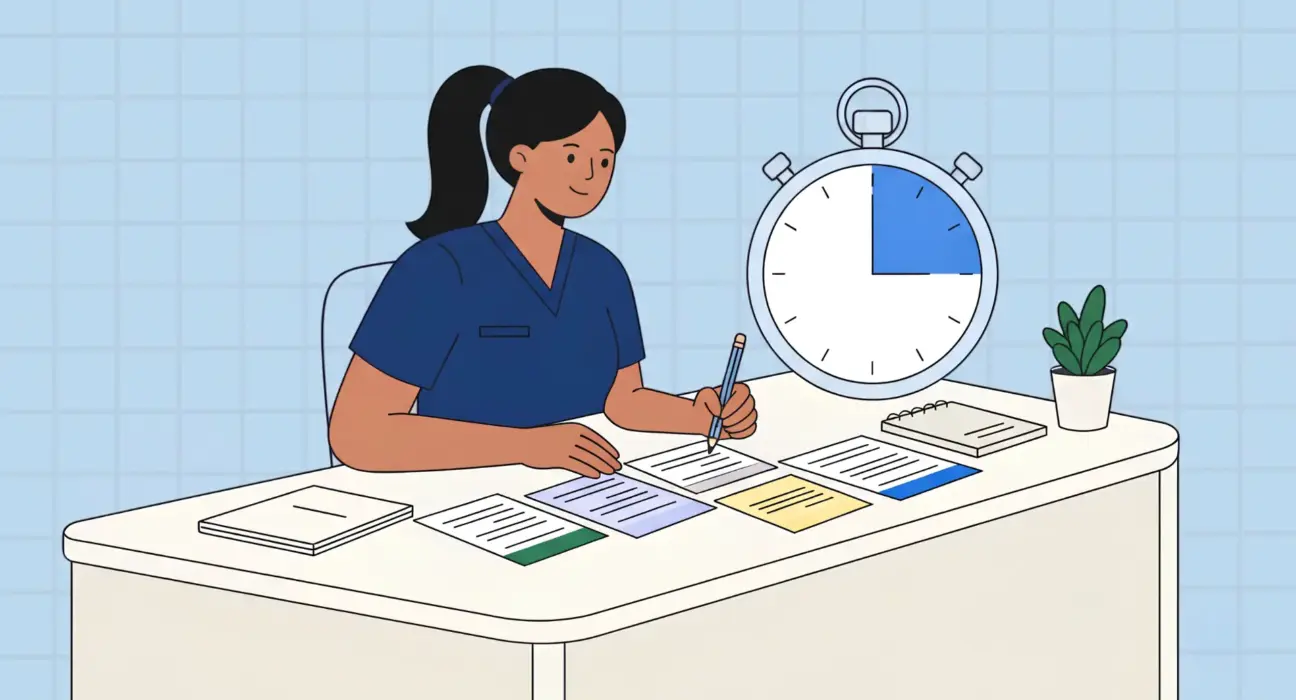
OET Reading Part A is one of the most time-sensitive sections of the OET exam. Candidates must answer 20 questions based on four short healthcare-related texts within just 15 minutes. Unlike the other parts of the Reading sub-test, you cannot return to Part A once the allocated time is over. This makes effective time management essential for achieving a good score.
Many candidates understand the information in the texts but struggle to complete all 20 questions within the given time. Reading every sentence, repeatedly searching for information or spending too long on difficult questions can affect their overall performance.
The key is to develop a systematic approach that helps you locate relevant information quickly without compromising accuracy. Here are some practical strategies to help you manage your time effectively in OET Reading Part A.
1. Understand the Test Structure and Time Limit
Before developing a time-management strategy, understand how Reading Part A is organised.
The task consists of four short healthcare-related texts, labelled A, B, C and D. These may include clinical guidelines, hospital procedures, medication information, healthcare policies and patient information.
You will encounter three question types:
- Matching: Identify which text contains the information described in the question.
- Short-answer questions: Locate specific information and write the required answer.
- Sentence completion: Complete a sentence using relevant information from the texts.
You have 15 minutes to answer all 20 questions, giving you an average of approximately 45 seconds per question.
However, do not treat this as a strict limit. Some questions can be answered within seconds, while others require more time to locate and verify the information. The objective is to maintain a steady pace throughout the task.
2. Follow a 15-Minute Time-Management Plan
Going into Reading Part A without a clear strategy can make it difficult to judge whether you are progressing at the right pace.
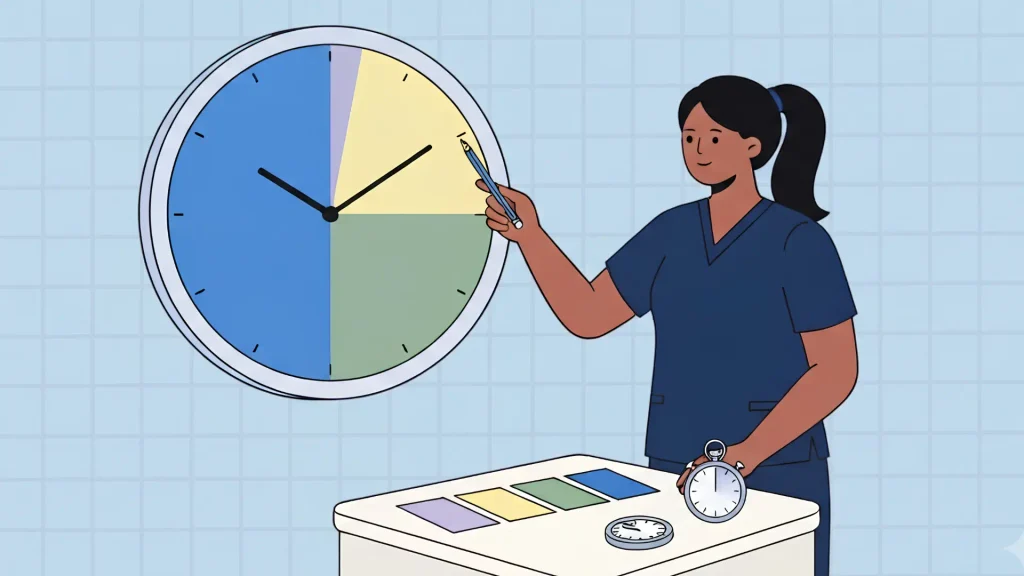
A simple way to manage your time is to divide the 15 minutes into four stages.
| Time | Focus | What to do |
| 0–2 minutes | Scan the texts | Read titles, headings and subheadings. Identify the general topic of each text. |
| 2–14 minutes | Answer questions | Work through all 20 questions, locating relevant information. |
| 14–15 minutes | Final check | Check unanswered questions, spelling and word limits. |
First 2 minutes: Familiarise yourself with the texts
Use this time to scan all four texts. Pay attention to headings, highlighted information, tables, bullet points and numbered lists.
For example, a text titled ‘Medication Administration Guidelines’ is likely to contain information about dosage, administration procedures and precautions. Recognising the topic helps you identify the relevant text more quickly.
Next 12 minutes: Answer the questions
Work through the questions in order. Identify the main keywords, scan the relevant text and record your answer once you find supporting information.
If a question takes too long, make an educated guess and move on.
Final minute: Check your answers
Ensure that all questions have been attempted, answers follow the required word limit and spelling is accurate.
Remember that Part A materials are collected after 15 minutes, so you will not receive additional time to review your answers.
3. Read the Questions Before Searching the Texts
One effective way to save time is to understand what you are looking for before searching through the passages.
Start with the question. Identify its main keywords and determine what information is required.
For example:
Question: Which medication should be avoided in patients with severe kidney impairment?
The important information includes:
- Medication
- Avoided
- Severe kidney impairment
You can now scan the texts for these terms or related expressions.
However, the exact wording in the question may not appear in the passage. You need to recognise paraphrases as well.
| Wording in the question | Possible wording in the text |
| High blood pressure | Hypertension |
| Side effects | Adverse effects |
| Avoid | Contraindicated |
| Given by mouth | Oral administration |
| Reduced kidney function | Renal impairment |
Recognising these relationships helps you locate information without repeatedly searching for the exact words used in the question.
The objective is to search with a purpose rather than read without knowing what information you need.
4. Use Scanning Instead of Reading Every Word
Reading Part A tests your ability to locate specific information across different texts. You do not need to understand every sentence in all four passages before answering the questions.
This is where scanning becomes useful.
Scanning involves moving your eyes quickly through a text to locate specific words, phrases, numbers or other visual clues related to the question.
For example, if a question asks about the recommended storage temperature of a medication, look for numerical information, temperature symbols or words such as ‘store’, ‘refrigerate’ and ‘temperature’.
Similarly, when searching for information about a procedure, pay attention to numbered steps, bullet points and subheadings.
Once you locate the relevant section, read the surrounding sentence carefully to confirm that the information answers the question.
Avoid stopping at the first familiar keyword you find. The information must match what the question actually asks.

5. Be Careful with Short-Answer and Sentence-Completion Questions
Short-answer and sentence-completion questions can consume valuable time, especially when candidates are unsure about how much information to write.
Consider this example:
Question: What is the recommended frequency of wound dressing changes?
Information in the text: The dressing should be replaced every 48 hours, or earlier if it becomes wet or contaminated.
Answer: Every 48 hours.
There is no need to copy the entire sentence from the passage. Identify the specific information requested and provide a concise answer.
For sentence-completion questions, also pay attention to grammar. Your answer should fit naturally into the sentence.
Avoid including unnecessary words simply because they appear in the text. This can waste time and lead to answers that exceed the permitted word limit.
6. Avoid Common Time-Management Mistakes
Even candidates with good reading skills can lose valuable time because of inefficient exam habits.
Here are some common mistakes to avoid:
Reading all four texts in detail: Trying to understand every paragraph before answering the questions is unnecessary. Focus on locating the information you need.
Spending too long on one question: A difficult question should not prevent you from attempting the remaining questions. Make an educated guess and move on.
Searching for exact words only: Questions and passages may express the same information differently. Learn to recognise paraphrases.
Repeatedly reading the same paragraph: Once you have identified the relevant section, read it carefully to confirm your answer. Avoid going over the same lines without a clear purpose.
Leaving questions unanswered: Since you cannot return to Part A after the allocated time, leaving blanks means missing an opportunity to gain marks. Make an educated guess if you are unsure.
7. Practise with a Time-Tracking Method
Knowing the strategies is not enough. You need to practise applying them under timed conditions.
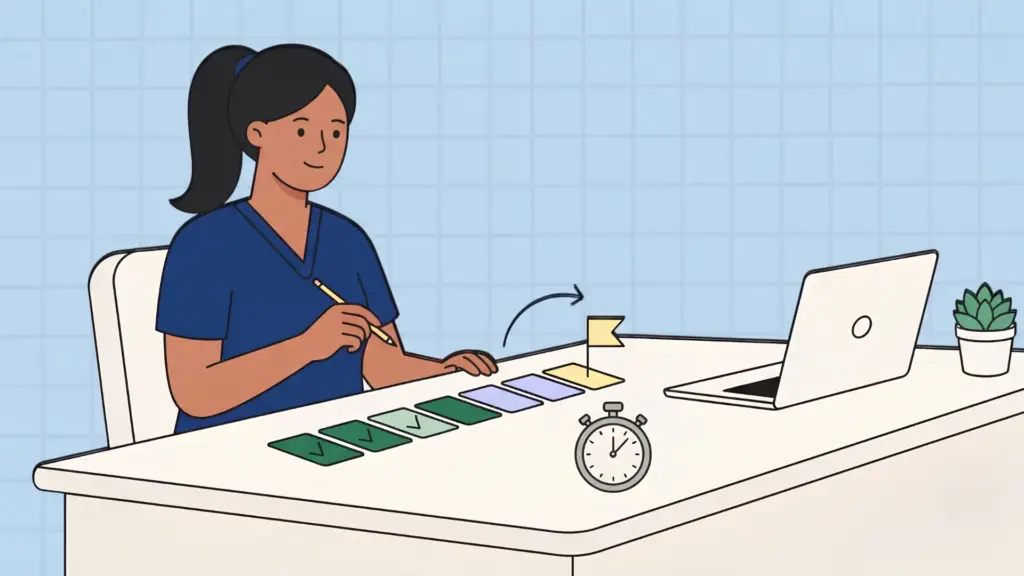
If you consistently struggle to complete Part A within 15 minutes, start by identifying where you lose the most time.
A useful approach is to gradually reduce your practice time.
Stage 1: Focus on accuracy
Begin by completing practice questions without strict time pressure. Concentrate on understanding the question types, locating relevant information and identifying paraphrases.
Stage 2: Move to the actual 15-minute limit
Gradually reduce your time to 15 minutes. Practise completing the entire task without pausing or using external resources.
Stage 3: Review your performance
After each practice test, analyse your mistakes instead of simply checking how many answers you got right.
Ask yourself:
- Did I misunderstand the question?
- Did I fail to recognise a paraphrase?
- Did I search in the wrong text?
- Did I spend too long on a particular question?
- Did I exceed the word limit?
- Did I make a spelling mistake?
This review helps you identify whether your main difficulty is reading accuracy, information retrieval or time management.
Keep a record of your practice scores and completion times to monitor your progress.
9. Follow a Consistent Practice Routine
Regular practice is essential for developing speed and accuracy. Instead of completing several tests without reviewing them, make each attempt an opportunity to improve a specific skill.
You can follow this simple 10-day practice schedule:
| Practice days | Focus | Recommended activity |
| Days 1–3 | Accuracy | Complete one Part A set in approximately 20 minutes and review every answer. |
| Days 4–6 | Speed | Reduce the time to 17–18 minutes and identify questions that cause delays. |
| Days 7–10 | Exam-level practice | Complete practice sets within 15 minutes and analyse your performance. |
Use reliable OET practice materials and review the answer keys carefully. OET also provides official sample tests to help candidates become familiar with the test format.
Try to practise under realistic conditions. Set a timer, avoid distractions and complete all 20 questions within the allocated time.
Most importantly, do not focus only on finishing within 15 minutes. Your aim should be to complete the task within the time limit while maintaining accuracy.

Final Thoughts
Time management in OET Reading Part A is not about reading faster without understanding the information. It is about knowing what to look for, locating relevant details efficiently and making sensible decisions about how to use your time.
Start by scanning the four texts, read each question carefully, recognise paraphrased information and avoid spending too long on difficult questions.
Remember, every second counts in Reading Part A, but rushing through the questions without understanding them will not improve your score. Develop a systematic approach, practise consistently and work towards achieving both speed and accuracy.
Frequently Asked Questions
1. How many questions and texts are there in OET Reading Part A?
There are four short texts (A to D) on one healthcare topic and 20 questions. The question types are matching, short-answer and sentence-completion.
2. How long do I get for Part A?
Fifteen minutes for all 20 questions. Your answers are collected at the end of that time, and you can’t come back to this part later.
3. Should I answer the questions in order?
Yes. The early matching questions give you an overview of the four texts, which makes the later questions easier to place.
4. What should I do if I can’t find an answer?
Don’t stay stuck on it. Make an educated guess, mark the question and return to it if there is time left.
5. Do I need to read all four texts in full?
No. Skim the titles, headings and bullet points first, then scan for the keywords or similar expressions from each question.
6. Can I repeat words from the question in my answer?
No. Repeating the question’s words can lose the mark. Write only the specific word or short phrase that answers it.
7. Do spelling mistakes cost marks?
Yes. A misspelled answer receives no mark, so copy the wording from the text carefully and write clearly.
8. Should I include units with numbers?
Yes. If a question asks for a quantity, include the unit too, such as 2.5 mg.
9. How can I practise finishing in 15 minutes?
Start with more time to build accuracy, then reduce it gradually, for example 20, then 18, then 15 minutes. Review your mistakes after every attempt.
10. How should I use the last minute?
Check that every question has an answer, that your answers fits and that your spelling is correct.
References
OET Reading Part A Complete Guide: oet.com/post/reading-part-a-the-complete-guide
OET Reading Time Management: oet.com/post/managing-time-reading
Common Questions on Reading Part A: oet.com/post/common-questions-reading-part-a
Read our Recent Blog – “3 Easy Steps to a Clear, Relevant, and Effective OET Writing Letter” – to ensure your journey stays on track.
Learn More About Mentor Merlin
Explore our OET, CBT and OSCE preparation programmes, along with free resources and expert mentor support, at
www.mentormerlin.com
Why Wait? Just Merlin It!
Free Consultation – Chat now with a Mentor