

Anti-embolism stockings are an important clinical skill that NMC OSCE candidates may encounter during their examination. This station assesses your ability to measure the patient’s legs correctly, select the appropriate stocking size, provide patient education and complete the required documentation.
Understanding the procedure is essential, but candidates must also demonstrate good communication, patient safety, and professional practice throughout the station.
At Mentor Merlin, we aim to help candidates understand the marking criteria, avoid common mistakes and develop confidence in performing clinical skills within the allocated examination time.
1. What Are Anti-Embolism Stockings?
Anti-embolism stockings (AES), also known as compression stockings for thromboprophylaxis, are specially designed stockings used to help reduce the risk of venous thromboembolism (VTE) in appropriate patients.
They apply graduated compression to the legs. The compression is generally greatest around the ankle and gradually decreases towards the upper leg. This helps promote venous blood flow back towards the heart and reduces venous stasis.
Patients who have reduced mobility, are undergoing surgery or are confined to bed may have an increased risk of developing deep vein thrombosis (DVT).
2. Articles Required for the Procedure
Before starting the procedure, prepare the required equipment.
The articles required include:
- Measuring tape.
- Appropriate anti-embolism stockings chart.

3. Initial Assessment and Patient Preparation
Before measuring or applying anti-embolism stockings, conduct an appropriate patient assessment.
Step 1: Introduce yourself
- Perform hand hygiene.
- Introduce yourself to the patient.
- Explain the procedure.
Step 2: Explain the procedure
Explain that you will measure the patient’s legs to identify the correct stocking size.
Step 3: Obtain consent
- Explain the procedure in simple language.
- Obtain informed consent before proceeding.
- Maintain privacy and dignity throughout.
- Give standing position if patient can do
4. Understanding the Measurement Technique
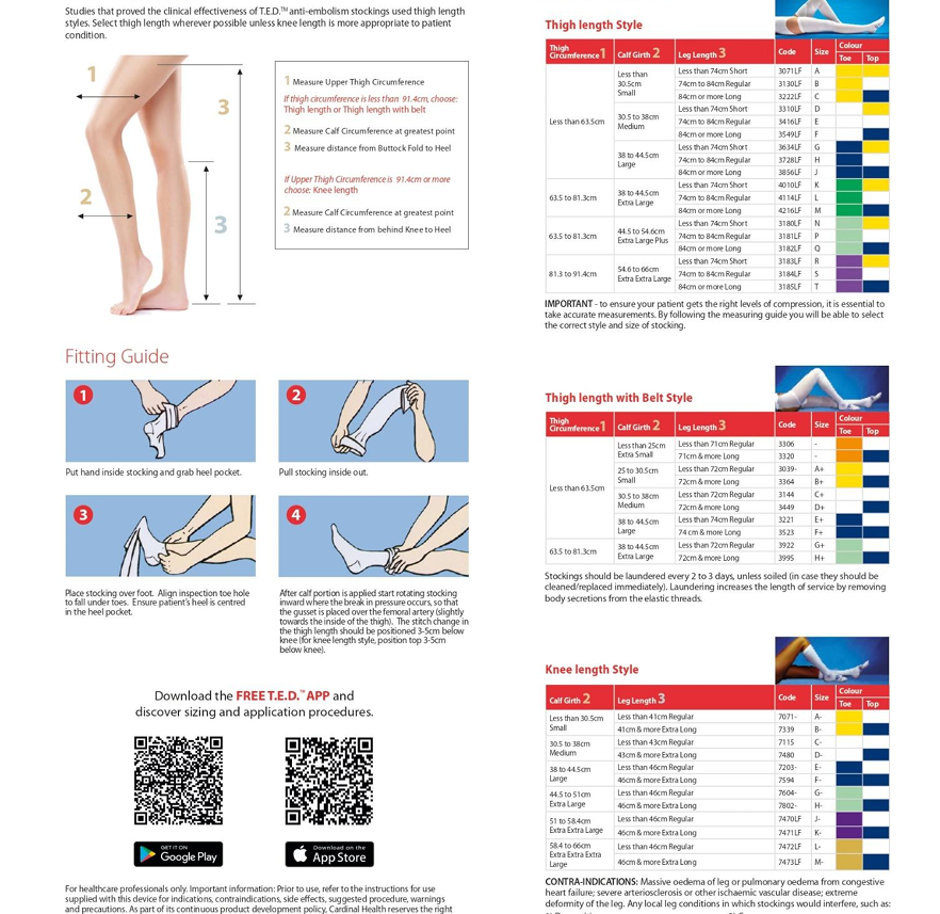
Correct measurement is one of the most important parts of this station. Incorrect measurements can result in an unsuitable stocking size, which may cause discomfort, excessive compression or ineffective treatment.
A. Knee-length stockings
For knee-length anti-embolism stockings, take the following measurements:
- Calf circumference: Measure around the widest part of the calf.
- Lower leg length: Measure from the heel to approximately two fingerbreadths below the knee bend.
B. Thigh-length stockings
For thigh-length anti-embolism stockings, take the following measurements:
- Calf circumference: Measure around the widest part of the calf.
- Thigh circumference: Measure around the widest part of the thigh.
- Leg length: Measure from the heel to 5cm below the gluteal fold (bottom of the buttock).
These measurements help identify the appropriate stocking size and length.
C. Choosing the correct stocking style
- Knee-length style.
- Thigh-length style.
- Thigh-length with belt style.
The selection depends on the patient’s measurements, clinical requirements and the manufacturer’s sizing chart.

Important measurement guidance from the reference document:
- If the upper thigh circumference is less than 91.4 cm, choose thigh-length stockings or thigh-length stockings with a belt.
- If the upper thigh circumference is 91.4 cm or greater, choose knee-length stockings.
- For thigh-length stockings, measure both calf and thigh circumference, along with the leg length from heel to gluteal fold.
- For knee-length stockings, measure calf circumference and the lower leg length from heel to knee.
Always follow the manufacturer’s sizing chart and the clinical guidance provided for the particular stocking.

5. How to Measure the Patient’s Legs During the OSCE
Follow a systematic approach to demonstrate your measurement technique.
Step 1: Position the patient
- Explain that you are going to take measurements.
- Ask the patient to stand if this is appropriate and safe.
- If the patient cannot stand, use a suitable lying position.
- Ensure that the patient is comfortable and that privacy is maintained.
Step 2: Measure calf circumference
- Identify the widest part of the calf.
- Place the measuring tape around the calf.
- Ensure that the tape is positioned correctly.
- Avoid pulling the tape too tightly or compressing the skin.
- Record the measurement in centimetres.
Step 3: Measure thigh circumference (for thigh-length stockings)
- Identify the widest part of the thigh.
- Place the measuring tape around the thigh.
- Ensure that the tape is not compressing the skin.
- Record the measurement accurately.
Step 4: Measure leg length
- For knee-length stockings, measure from the heel to approximately two fingerbreadths below the knee bend.
- For thigh-length stockings, measure from the heel to the gluteal fold.
Step 5: Repeat on the other leg
Repeat the required measurements on the opposite leg.
Step 6: Record all measurements
Document the measurements accurately and use the appropriate manufacturer’s sizing chart to identify the correct stocking size.

6. Identifying the Correct Stocking Size
After completing the measurements, refer to the manufacturer’s sizing chart.
- Thigh-length stockings.
- Thigh-length stockings with a belt style.
- Knee-length stockings.
The charts use measurements such as calf circumference, thigh circumference and leg length to determine the correct product code, size and colour.
Do not select the stocking size based on guesswork or visual estimation.
What if the measurement falls between two sizes?
If a measurement falls between two sizes:
- Recheck the measurement to ensure accuracy.
- Confirm that the measuring tape was positioned correctly.
- Repeat the measurement if necessary.
- Review all measurements rather than considering only one measurement.
- Follow the manufacturer’s sizing chart and local policy.
If the measurement remains exactly on a boundary and there is no specific policy, the reference advises considering the larger size to avoid excessive tightness.
OSCE tip: If the examiner asks about a borderline measurement, explain that you would recheck the measurement, review the complete sizing criteria and follow the manufacturer’s guidance rather than making an unsupported assumption.
7. Anti-Embolism Stockings Measurement and Documentation
Documentation is an essential part of the station. Candidates should demonstrate that they can record measurements clearly and complete the relevant documentation.
A. Patient details
Complete the relevant patient information:
- Patient’s name.
- Hospital number.
- Date of birth.
- Ward.
- Mobility status.
B. Knee-length stocking measurements
The documentation form includes:
| Measurement | Value |
| Calf circumference | ___ cm |
| Lower leg length (heel to knee) | ___ cm |
| Size of stocking | ___ |
C. Thigh-length stocking measurements
The form provides separate columns for the left and right legs.
| Measurement | Left leg | Right leg |
| Calf circumference | ___ cm | ___ cm |
| Thigh circumference | ___ cm | ___ cm |
| Leg length (heel to gluteal fold) | ___ cm | ___ cm |
| Size of stocking | ___ | ___ |
D. Nurse declaration
Complete the declaration section:
- Nurse’s name (print).
- Signature.
- Date.
- Time.
Always ensure that the documentation is accurate, complete and legible.
After completing the documentation, sign the patient measurement sheet and communicate the result to the patient as appropriate.

8. Patient Education: Advice Before Discharge
Patient education is another important part of the station.
Candidates should explain how to use and care for anti-embolism stockings and what problems the patient should report.
Important advice to give the patient
1. Report unusual symptoms
Advise the patient to report:
- Numbness or tingling.
- Burning or aching sensations.
- Changes in skin colour.
- Discomfort or unusual pain.
- Any skin irritation or damage.
2. Do not roll or fold the stockings
Explain that stockings should lie smoothly against the skin.
Rolling or folding the top of the stocking may cause excessive pressure and affect circulation.
3. Wear stockings according to the prescribed instructions
Advise the patient to wear stockings during the day for a maximum of 30 minutes at a time, until the patient returns to their usual level of mobility. Follow the patient’s individual clinical plan and local policy regarding removal and wearing schedules.
4. Perform daily skin checks
Advise the patient to remove the stockings as directed and check the skin regularly for:
- Redness.
- Pressure marks.
- Blisters.
- Skin irritation.
- Changes in skin condition.
5. Encourage mobility
Encourage the patient to remain mobile and perform appropriate leg and ankle movements, if clinically suitable.
6. Maintain adequate hydration
Encourage adequate fluid intake unless the patient has a clinical restriction.
7. Avoid crossing the legs
Explain that crossing the legs can interfere with circulation.
8. Elevate the legs when resting
Advise the patient to elevate their legs slightly when resting, if appropriate.
9. Explain washing instructions
According to the reference document:
- Stockings should be hand-washed at approximately 40°C.
- Allow them to dry naturally.
- Avoid direct heat.
- Avoid bleach and harsh substances.
- Follow the manufacturer’s washing instructions.
10. Avoid applying moisturiser immediately before wearing stockings
Explain that the skin should be clean and dry before application. Avoid moisturising immediately before putting on the stockings, as this may affect the elastic material.
| Common mistake | Correct approach |
| Not explaining the procedure | Explain the purpose and obtain consent. |
| Forgetting hand hygiene | Perform hand hygiene at appropriate stages. |
| Measuring incorrectly | Identify the correct anatomical landmarks. |
| Pulling the tape too tightly | Measure without compressing the skin. |
| Measuring only one leg | Repeat the required measurements on both legs. |
| Selecting the wrong stocking size | Refer to the manufacturer’s sizing chart. |
| Incomplete documentation | Record all measurements and complete the declaration. |
| Forgetting patient education | Provide advice about skin checks, mobility and warning signs. |
| Not maintaining privacy | Expose only the necessary area. |
Final OSCE Tips from Mentor Merlin
Anti-embolism stockings may appear to be a straightforward clinical procedure, but candidates need to demonstrate much more than simply measuring the stockings.
The examiner needs to see that you understand the purpose of the procedure, can identify the correct measurements, select an appropriate stocking size, demonstrate safe application and provide suitable patient education.
Remember these four important areas:
- Assessment: Assess the patient’s legs and clinical suitability before proceeding.
- Measurement: Understand the difference between knee-length and thigh-length stocking measurements.
- Documentation and education: Complete the measurement form and provide appropriate advice before leaving the patient.
How Mentor Merlin Can Help You Prepare
At Mentor Merlin, we understand that new or unfamiliar clinical skills can make OSCE candidates feel anxious. Our aim is to help students understand the procedure, learn the relevant marking criteria and develop confidence through structured practice.
We encourage every candidate to:
- Learn the complete procedure before attending the practice session.
- Understand the measurement techniques for different stocking styles.
- Practise verbalisation to improve confidence.
- Focus on patient safety and communication.
- Practise completing the documentation accurately.
- Manage the examination time effectively.
Remember: Do not simply memorise the steps. Understand why you are performing each action and how it contributes to patient safety.
Prepare well, practise consistently and move one step closer to your OSCE success!

Frequently Asked Questions (FAQs)
Q1. Why do we use anti-embolism stockings?
Anti-embolism stockings help improve venous blood flow and reduce venous stasis, thereby helping to prevent venous thromboembolism in suitable patients.
Q2. Which measurements are required for knee-length stockings?
You need to measure:
- Calf circumference.
- Lower leg length from heel to approximately two fingerbreadths below the knee bend.
Q3. Which measurements are required for thigh-length stockings?
You need to measure:
- Calf circumference.
- Thigh circumference.
- Leg length from heel to 5cm below the gluteal fold.
Q4. Should we measure both legs?
Yes. Repeat the required measurements on both legs and document them accurately.
Q5. What should you do if the measurements fall between two sizes?
Recheck the measurements, review all the sizing parameters and follow the manufacturer’s sizing chart and local policy. Do not select a size based on guesswork.
Q6. What should you explain before leaving the patient?
Explain the importance of correct stocking positioning, daily skin checks, reporting unusual symptoms, maintaining mobility where appropriate and following washing instructions. Give at least 4 pieces of health education before leaving the patient
Read our recent blog – “NMC OSCE Implementation: Essential Tips” – to ensure your journey stays on track.
Stay tuned to Mentor Merlin for further NMC OSCE updates, preparation guidance and exam-focused resources.
Explore our OET, CBT and OSCE preparation programmes, along with free resources and expert mentor support, at
www.mentormerlin.com.
Why Wait? Just Merlin It!
Free Consultation – Chat now with a Mentor.

References
- Horner D, Goodacre S, Davis S, et al. Which is the best model to assess risk for venous thromboembolism in hospitalised patients? BMJ. 2021. Available from: [LINK].
- Hunt BJ. Preventing hospital associated venous thromboembolism. BMJ. 2019. Available from: [LINK].
- Department of Health. Risk Assessment for Venous Thromboembolism (VTE). 2018. Available from: [LINK].
- Hill J, Treasure T. Reducing the risk of venous thromboembolism in patients admitted to hospital: summary of NICE guidance. BMJ. 2010. Available from: [LINK].
- Ye F, Bell LN, Mazza J, et al. Variation in Definitions of Immobility in Pharmacological Thromboprophylaxis Clinical Trials in Medical Inpatients: A Systematic Review. Clinical and Applied Thrombosis/Haemostasis. 2016. Available from: [LINK].
- NICE NG89. Venous thromboembolism in over 16s: reducing the risk of hospital-acquired deep vein thrombosis or pulmonary embolism. 2018. Available from: [LINK].
NMC Updates 2026, Mentor Merlin, NMC September 2026, NMC Fee Changes, New OSCE Stations, OSCE Update 2026, NMC Registration UK, OSCE Training UK, International Nurses UK, UK Nursing, CBT Training, OET Training, Overseas Nurses UK, UK Nurse Registration.
#nmcupdates #nmcosce #mentormerlin #uknursing #oscetraining #oettraining #cbttraining #nmcregistration #oscetraininguk #overseasnurses #nurses #internationalnurses #freeosce #oscetips #osceupdates2026