


Clear communication can change the direction of a patient’s care. A nurse may recognise that someone is becoming unwell, but the next steps depend on explaining the concern clearly and securing an appropriate response. SBAR in nursing provides a practical structure for that conversation.
For international nurses preparing for UK registration, SBAR connects clinical knowledge with safe decision-making. It helps you organise a patient handover, explain important assessment findings and request support without losing essential information.
This guide explains what SBAR means, how to use it during handover and escalation, and why it matters for NMC CBT preparation. You will also find worked examples, common mistakes and practical exercises to strengthen your clinical communication.
What is SBAR in nursing?
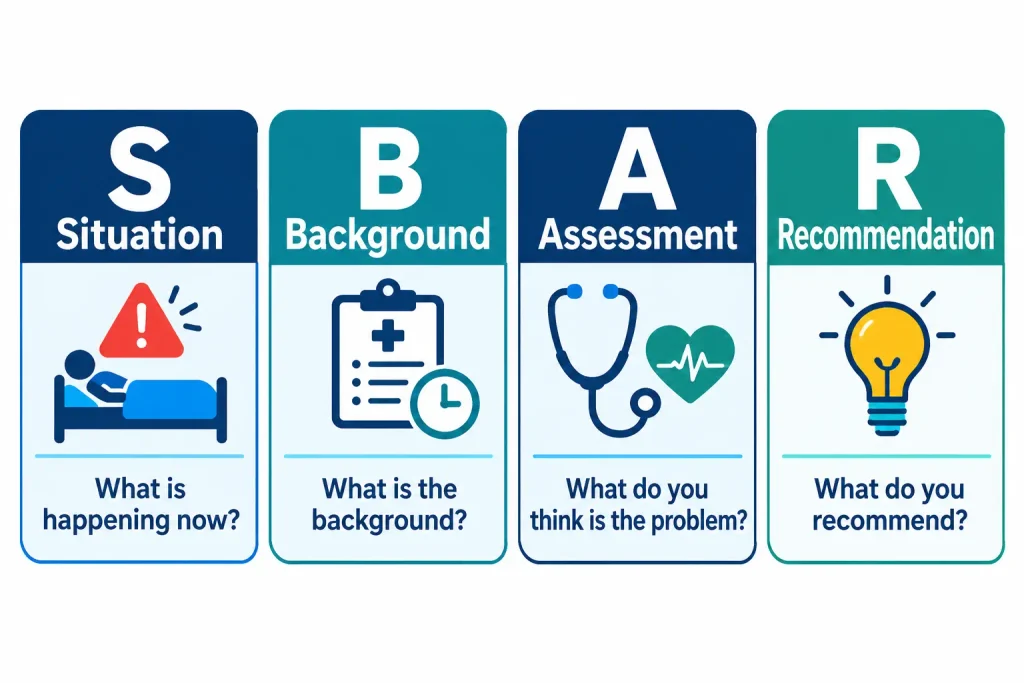
SBAR stands for Situation, Background, Assessment and Recommendation. It is a communication framework that helps healthcare professionals share relevant information in a logical order.
Each part answers a different question:
- Situation: What is happening now?
- Background: What relevant information explains the situation?
- Assessment: What have you found, and what concerns you?
- Recommendation: What needs to happen next?
SBAR in nursing can support telephone calls, face-to-face conversations, clinical updates and transfers of care. It is particularly useful when a patient’s condition changes and another professional needs to understand the problem quickly.
The framework is not a replacement for clinical judgement. A well-organised message can still be unsafe if observations are inaccurate, important risks are omitted or urgent action is delayed.
Think of SBAR as a structure for your reasoning rather than a script to memorise. The content should change according to the patient, the urgency and the professional receiving the information.
Why SBAR matters for patient safety
Clinical information often passes between several people during a patient’s care. Each transition creates an opportunity for information to be misunderstood, overlooked or separated from its clinical importance.
SBAR in nursing helps reduce ambiguity by making the concern and required response easier to identify. Instead of presenting an unstructured list of facts, the nurse explains how those facts connect.
For example, “The patient has a temperature” provides limited direction. A stronger message explains that the temperature is rising, the patient appears more unwell, observations have changed and clinical review is needed.
Structured communication can help teams:
- Recognise deterioration and act on concerns.
- Identify outstanding treatment or investigations.
- Understand medication allergies and omissions.
- Allocate responsibility for follow-up.
- Maintain continuity between shifts and departments.
However, SBAR does not guarantee safety by itself. Nurses must also listen, clarify uncertainties and confirm the agreed plan.
A handover is successful when the receiving professional understands both the patient’s situation and what they need to do next.
S: Explain the situation clearly
The first part of SBAR in nursing should establish who you are, identify the patient and explain why you are communicating.
Introduce yourself using your name, role and clinical location. Confirm that you are speaking to an appropriate professional, particularly during telephone escalation.
Identify the patient using the identifiers required by local policy. A bed number alone is not a reliable identifier because patients may move.
Then state the immediate concern.
For example:
“Hello, this is Priya, the registered nurse on the surgical ward. I am calling about Mr Daniel Reed, whose identity I have confirmed against his records. I am concerned because he has become more breathless and his oxygen saturation has fallen.”
This opening explains the problem before adding background detail.
If the situation is urgent, say so immediately. Do not hide the concern behind a lengthy account of the admission.
For routine handover, the situation may instead explain that you are transferring responsibility at the end of your shift. Always adapt the opening to the purpose of the conversation.
B: Select the relevant background
The background section provides the context needed to understand the current concern. It should be selective, not a complete reading of the patient’s records.
Useful information may include:
- Reason for admission and relevant diagnosis.
- Recent surgery or procedures.
- Significant medical history.
- Allergies and recorded reactions.
- Relevant medicines and recent doses.
- Baseline function or observations.
- Existing escalation plans or treatment limitations.
SBAR in nursing works best when every detail contributes to the clinical picture.
For a patient with new breathlessness, respiratory disease, recent surgery and oxygen therapy may be especially relevant. An unrelated historical condition may not need the same attention.
Medication information should distinguish between treatment prescribed and treatment actually administered. If a medicine was withheld, explain why and what action followed.
For example:
“The prescribed antibiotic was not administered because the documented allergy raised a safety concern. I contacted the prescriber, and a review is outstanding.”
Do not imply that an outstanding review or alternative prescription has already occurred.

A: Communicate your assessment
Assessment is where you explain what you have observed, what has changed and why you are concerned.
Include relevant findings such as respiratory rate, oxygen saturation, oxygen delivery, pulse, blood pressure, temperature and consciousness level. Depending on the situation, pain, urine output, blood glucose, wound appearance or fluid balance may also matter.
Give the observation time and describe trends when available. A change from the patient’s baseline can be more informative than an isolated number.
Where NEWS2 is used, report the correctly calculated score and relevant individual abnormalities. Use the appropriate oxygen saturation scale and follow local escalation procedures.
SBAR in nursing should communicate clinical concern even when a score appears reassuring. Early warning scores support assessment; they do not replace it.
You can say:
“I am concerned about possible deterioration because his respiratory rate has increased and he appears more exhausted.”
You do not need to make an unsupported diagnosis. Clearly distinguish observed facts, your clinical concerns and information that still needs checking.
R: Make a specific recommendation
The recommendation should explain the response you need and how urgently you need it.
Avoid ending with a vague statement such as, “I thought you should know.” That leaves the receiving professional to guess what action you expect.
Depending on the situation, you might request:
- Immediate attendance or urgent clinical review.
- Advice about an unsafe or unclear prescription.
- Review of uncontrolled pain.
- Clarification of monitoring requirements.
- A plan for outstanding investigations.
- Confirmation of escalation arrangements.
A clear recommendation might be:
“Please review him urgently. While awaiting review, I will continue assessment and monitoring in line with the local deterioration pathway. Please confirm who will attend and the expected response time.”
The appropriate response depends on the patient and local procedures.
If a patient has emergency features, activate the emergency response immediately. Do not delay lifesaving action while preparing a polished SBAR.
For routine handover, recommendations should still identify outstanding tasks, who will complete them and when they need attention.
SBAR handover example: postoperative deterioration
The following fictional example demonstrates SBAR in nursing during escalation. It is a communication exercise, not an individual treatment plan.
Situation
“Hello, this is Amina, the registered nurse on the surgical ward. I am calling about Mr Daniel Reed, date of birth 14 February 1968, with his hospital number available in the clinical record. I am concerned because he has become more unwell following abdominal surgery and needs urgent review.”
Background
“He was admitted yesterday following surgery. His relevant medical history and allergy information are documented in his records. He has received his prescribed analgesia, but he continues to report pain and now feels hot and increasingly tired.”
Assessment
“At 14:00, his respiratory rate was 24 breaths per minute, oxygen saturation 95% on room air, pulse 108, blood pressure 102/64 and temperature 38.5°C. He is alert but looks more unwell than earlier. I am concerned about postoperative deterioration and possible infection. I will report his verified NEWS2 score using the appropriate chart.”
Recommendation
“Please arrange urgent clinical review. I will continue assessment and monitoring according to the local escalation pathway. Please confirm who will review him and when, and advise whether any additional immediate actions are required within my competence.”
In actual practice, calculate and communicate the NEWS2 score promptly. Never invent missing findings or delay escalation while waiting to complete documentation.

Routine patient handover versus urgent escalation
The same framework can support different conversations, but the emphasis changes.
A routine patient handover transfers responsibility for ongoing care. It may cover mobility, nutrition, skin integrity, pain management, communication needs and outstanding investigations.
Urgent escalation focuses more narrowly on an immediate concern. Lead with the deterioration, provide essential supporting evidence and request a time-sensitive response.
For example, a routine recommendation might be:
“Please reassess pain after the prescribed analgesia and follow up the outstanding blood results.”
An urgent recommendation might be:
“I need an urgent review because the patient’s breathing and observations have deteriorated.”
SBAR in nursing should make urgent information more visible, not bury it within a routine checklist.
Where several patients are being handed over, prioritise those with the greatest immediate risk. Make clear which tasks are outstanding and which actions have already been completed.
How SBAR supports NMC CBT preparation
The NMC CBT assesses the knowledge needed for safe and effective nursing practice. SBAR is useful preparation because it strengthens the reasoning behind communication, prioritisation and escalation decisions.
You should not assume that every communication question will name the framework. A scenario may instead ask what the nurse should do first, which information is most important or when a concern requires escalation.
When reviewing a practice question, ask:
- What is the immediate patient safety issue?
- Which findings are most relevant?
- What action falls within the nurse’s competence?
- Who needs to receive the information?
- What response is required?
SBAR in nursing helps organise these questions into a practical sequence.
Remember that the CBT and OSCE are different assessments. CBT preparation focuses on applying knowledge to questions, while OSCE preparation involves demonstrating practical and communication skills.
Mentor Merlin’s NMC CBT preparation programme can support knowledge development, while its NMC OSCE preparation programme provides a complementary route for practising structured clinical communication.
Original CBT-style practice questions
These questions illustrate communication principles. They are not official NMC questions.
Question 1: Recognising the priority
A postoperative patient becomes increasingly breathless and confused. What is the most appropriate response?
A. Wait until routine handover.
B. Complete all documentation before seeking help.
C. Assess promptly and escalate through the appropriate urgent pathway.
D. Ask the next shift to repeat observations.
Answer: C. New breathlessness and confusion require prompt assessment and escalation. Documentation matters, but it must not delay urgent help.
Question 2: Making a recommendation
Which statement best demonstrates the recommendation component?
A. “The patient was admitted yesterday.”
B. “The respiratory rate is 28.”
C. “The patient has asthma.”
D. “Please review the patient urgently because their breathing is worsening.”
Answer: D. It states the required action and urgency. The other statements describe background or assessment findings.
Question 3: Reporting an omitted medicine
A nurse withholds a medicine because of a documented allergy concern. What should happen next?
Answer: The nurse should seek appropriate prescriber review, document the omission and actions according to local policy, and communicate any outstanding safety issue during handover.

Common mistakes when using SBAR in nursing
1. Giving too much background
A detailed history can distract from an urgent problem. State the concern first, then select the background that helps explain it.
2. Listing observations without interpretation
Numbers need context. Explain whether findings are new, worsening or different from baseline, and identify your concern without overstating certainty.
3. Omitting allergies or medication issues
These details can directly affect treatment. Explain what was administered, withheld or delayed and what still requires review.
4. Making an unclear request
A recommendation should identify the action required. “Please assess the patient urgently” is clearer than “Can you advise?”
5. Reporting assumptions as facts
Do not describe a wound, investigation result or treatment response that you have not assessed or verified.
6. Treating communication as completed after speaking
Check that the receiver understands the concern and accepts the required follow-up. If the response is inadequate and risk remains, escalate further through local procedures.
Close the loop and document the plan
SBAR in nursing is most effective when communication leads to a shared, confirmed plan.
Closed-loop communication means checking that important information has been understood and that actions are clear. Summarise what has been agreed, especially when instructions are given by telephone.
For example:
“To confirm, you will review the patient urgently, and I will continue monitoring according to our local pathway while awaiting your arrival.”
Clarify instructions that are incomplete, unfamiliar or outside your competence. Follow local requirements for telephone instructions and prescriptions.
Document relevant assessment findings, communication times, who was contacted, advice received and actions taken. Records should distinguish completed actions from outstanding tasks.
Communication must also protect confidentiality. Share information with appropriate professionals through approved channels and avoid discussing identifiable details in public areas.
A structured handover does not remove the need for professional accountability. The nurse remains responsible for responding to continuing deterioration and seeking further help when necessary.
How international nurses can practise SBAR
You do not need complicated English to communicate safely. Clear sentences, accurate information and a direct request are more useful than elaborate medical language.
Practise SBAR in nursing using fictional cases or appropriately anonymised learning materials. Never enter identifiable patient information into public study tools.
Try this routine:
- Identify the main concern in one sentence.
- Select two or three relevant background details.
- Summarise the assessment and important changes.
- Make a specific recommendation.
- Ask a study partner to repeat the agreed plan.
Record yourself and check whether a listener can quickly identify the concern, urgency and next action.
Practise clarification phrases such as, “Could you repeat that instruction?” or, “To confirm, do you mean…?”
Mentor Merlin’s OET preparation programme can complement clinical study by supporting professional English. However, language practice should always remain connected to accurate clinical reasoning and safe nursing practice.
Conclusion: Make communication lead to action
SBAR in nursing turns clinical information into a clear, purposeful conversation. Start with the immediate situation, select relevant background, explain your assessment and make a specific recommendation.
Then confirm the response, document appropriately and continue to act on unresolved concerns.
For international nurses, practising this structure can support both safer clinical communication and stronger exam preparation. Explore Mentor Merlin’s NMC CBT preparation programme, alongside its NMC OSCE and OET preparation programmes, to build the knowledge, practical skills and professional English needed for your UK nursing journey.

Frequently asked Questions
1. What does SBAR stand for in nursing?
SBAR stands for Situation, Background, Assessment and Recommendation. It helps nurses explain the current problem, provide relevant context, communicate assessment findings and request an appropriate response. The structure supports patient handover and escalation, but nurses must still apply clinical judgement and follow local procedures.
2. Is SBAR only used during patient handover?
No. Nurses can use SBAR during urgent escalation, telephone calls, transfers between departments and discussions about medication concerns. The level of detail depends on the situation. In an emergency, obtaining immediate help and starting appropriate action take priority over completing a formal communication structure.
3. What is the difference between assessment and recommendation?
Assessment describes what you have found, including observations, symptoms, changes and your clinical concerns. Recommendation explains what should happen next, such as urgent review or clarification of treatment. Separating them helps the receiver understand both the evidence and the action you are requesting.
4. How does SBAR help with NMC CBT revision?
SBAR helps you organise clinical scenarios around immediate concerns, relevant evidence and appropriate escalation. This supports revision of prioritisation, professional communication and patient safety. Use it alongside current NMC test information and wider nursing study rather than treating it as a complete CBT revision method.
Read our recent blog – “Communicating With Delirium Patients: Nurse Guide” – to ensure your journey stays on track.
Why Wait? Just Merlin It!
Free Consultation – Chat now with a Mentor.