

During the NMC OSCE, one of the stations that requires understanding is the Nutritional assessment station, especially when you are asked a scenario to calculate the Malnutrition Score in the NMC OSCE. Many nurses feel confident with clinical care but become nervous when documentation, scoring systems, and verbal handovers are involved. This is an 8-minute, verbal + silent station of NMC OSCE.
This station usually focuses on the Malnutrition Universal Screening Tool (MUST), which helps identify patients who are malnourished, at risk of malnutrition, or not. In the NMC OSCE, your assessor is not only checking whether you are identifying scores correctly, but they are assessing whether you can give safe clinical judgement and escalate concerns appropriately or not during handover.
This guide will walk you through the step-by-step process of identifying the malnutrition score during your NMC OSCE, including BMI calculation, weight loss assessment, acute disease effect scoring, documentation tips, and common mistakes to avoid.
In this guide, you will learn:
- How to calculate the Malnutrition Score in NMC OSCE
- How to complete the MUST chart correctly
- Common mistakes candidates make
- How to give a strong verbal handover to the examiner
- Practical OSCE tips to help you pass confidently
By the end of this blog, you will be able to approach the nutritional assessment station with clarity and confidence.
What Is the MUST Score in NMC OSCE?
The Malnutrition Universal Screening Tool (MUST) is used to assess whether a patient is at risk of malnutrition. This is a standard five-step screening tool widely used across the UK, especially in hospitals, care homes, and community healthcare settings.
During the NMC OSCE nutritional assessment, students need to complete a MUST chart using patient details such as height, weight, recent weight loss, and acute illness status. Your role is not only to calculate the score correctly but also to interpret the result and give a verbal handover to the assessor.
What Does MUST Stand For?
MUST stands for:
M – Malnutrition
U – Universal
S – Screening
T – Tool
It is designed to identify:
- Patients at what risk of malnutrition
The MUST tool is quick, evidence-based, and suitable for use across different clinical environments.
In your OSCE, you will be given:
- A documentation chart
- Patient scenario
- Chart to identify the score
From this information, you must complete the NMC OSCE MUST chart documentation accurately.

The 5 Steps of MUST Assessment
The Malnutrition Universal Screening Tool follows five structured steps:
Step 1: Measure BMI Score
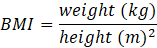
Check scenario and identify the patient height and weight to calculate the patient’s Body Mass Index (BMI) using a chart or a formula:
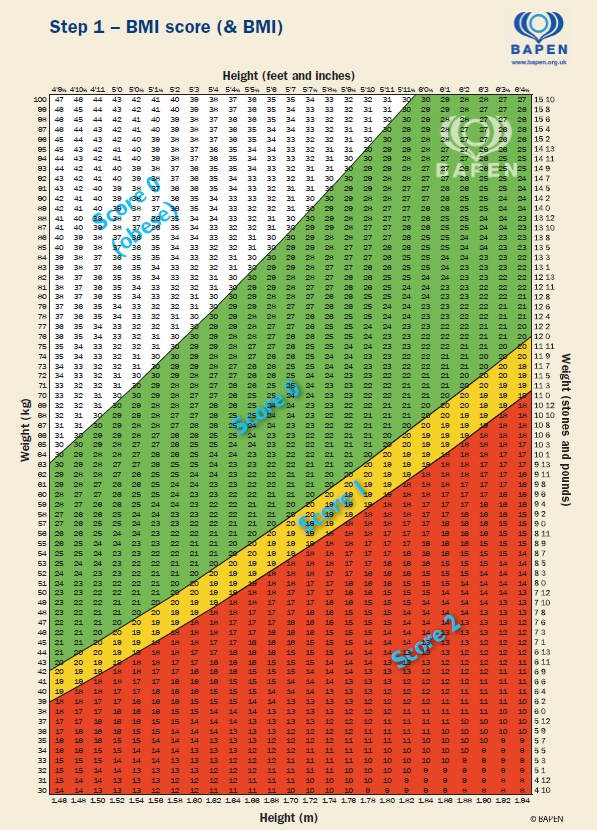
Then identify the BMI score:
- BMI > 20 = Score 0
- BMI 18.5–20 = Score 1
- BMI < 18.5 = Score 2
- In OSCE, usually chart will be given to identify the score
Step 2: Assess Unplanned Weight Loss
Check the scenario to identify how much weight loss occurred of the patient, weight before weight loss and identify the weight loss score.
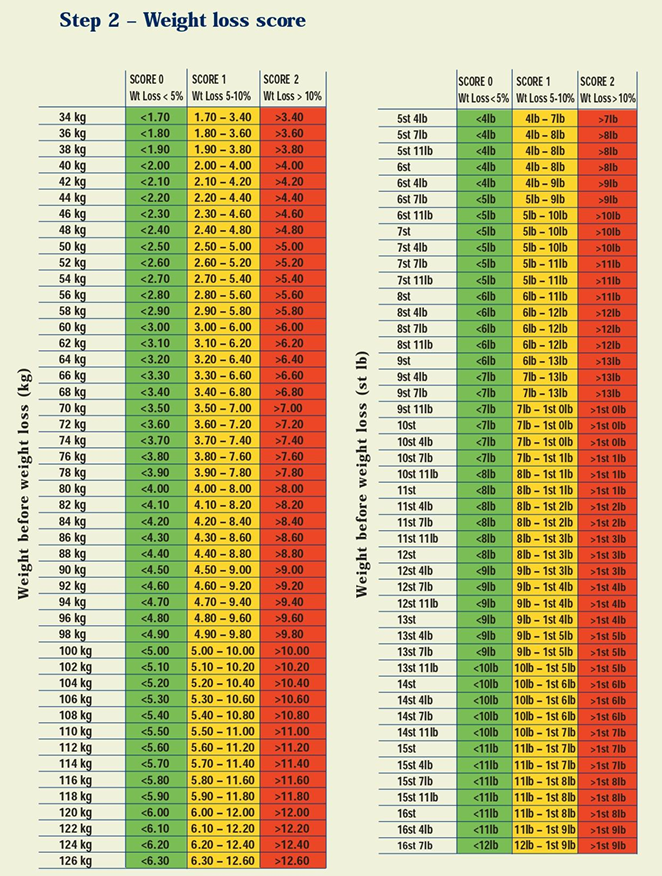
Then denote the score:
- <5% = Score 0
- 5–10% = Score 1
- 10% = Score 2
Step 3: Acute Disease Effect Score
If the patient is acutely ill and there has been or is likely to be no nutritional intake for more than 5 days:
- Add Score 2
If not:
- Score 0
Step 4: Add the Total Score
Combine all three scores:
BMI + Weight Loss + Acute Disease
This gives the final Malnutrition Score in NMC OSCE.
Step 5: Management Guidelines
Based on the total score:
- Score 0 = Low Risk
- Score 1 = Medium Risk
- Score 2 or more = High Risk
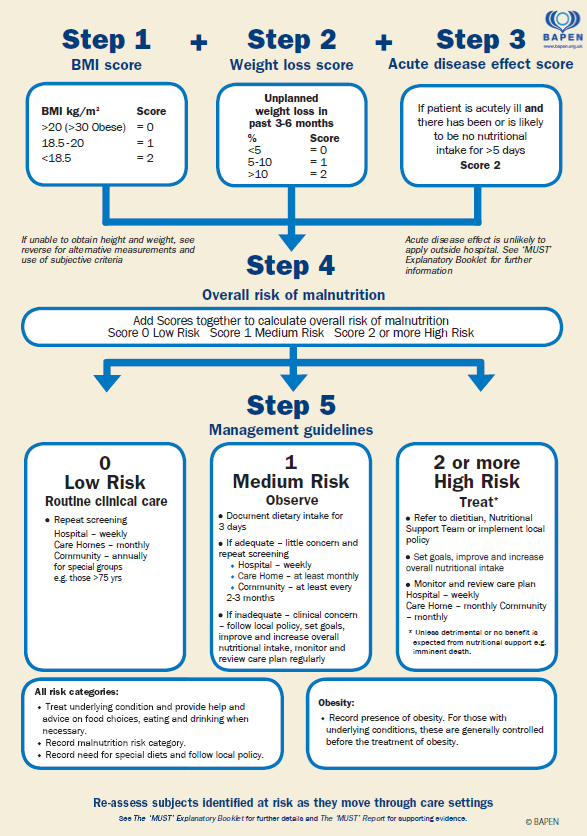
Give a handover to the assessor on the score, the patient’s condition, and required management guidelines, such as a food chart, monitoring, referral to a dietitian, or other referrals as required.
This final step is where many students miss, not because of calculation errors, but because they forget the management plan.
What Examiners Focus on MUST in OSCE
Examiner wants to see whether you can:
- Identify score correctly
- Recognise nutritional risk
- Escalate concerns appropriately
- Document according to NHS standards
- Communicate findings clearly during handover
For example, if a patient has a high MUST score and you fail to refer to the dietitian or initiate fluid balance documentation, this shows unsafe practice.
That is why understanding how to calculate the MUST score and what to verbalise in handover next is essential for passing the station confidently.
MUST Score Management Guide for NMC OSCE Success 2025
Step-by-Step Guide to Calculate Malnutrition Score in NMC OSCE
This is the most important documentation section of the station and helps students to pass this station in the exam.
In NMC OSCE nutrition station scenarios, you will be expected to calculate the MUST score using patient information provided on the assessment sheet.
The safest way to approach this station is to follow the same sequence every time. This reduces errors, improves confidence, and shows the examiner that your practice is systematic and professional.
Step 1 – Check the Patient’s Height and Weight
Start by confirming:
- Current weight (kg)
- Height (m or cm)
Always verify the values carefully before calculation. Some OSCE scenarios include weights in pounds or height in centimetres to test your attention to detail.
For example:
- Current weight = 52 kg
- Height = 1.65 m
Step 2 – Calculate BMI Score
Use the BMI formula or chart:
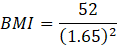
This gives:
BMI = 19.1
or Identify score from below chart.
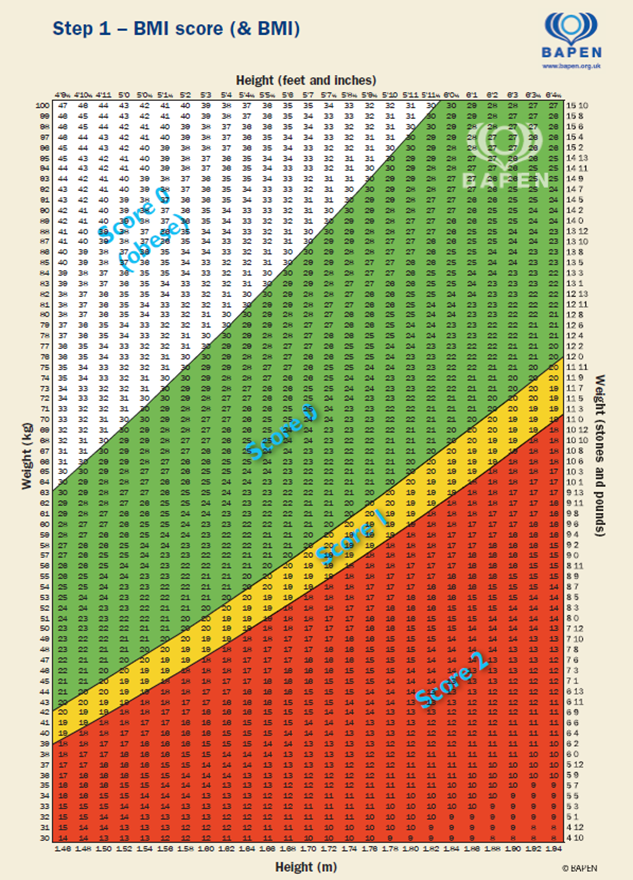
Now apply the MUST BMI scoring:
- Above 20 = Score 0
- 18.5–20 = Score 1
- Below 18.5 = Score 2
Since BMI is 19.1:
BMI Score = 1
Step 3 – Calculate Percentage Weight Loss using the chart
Next, check the recent weight loss from the scenario. If the scenario mentions 6kg weight loss in the last 3-6 months. Check current weight 52 kg then weigh before weight loss is 58kg box and 6kg falls under the red area, so score is 2
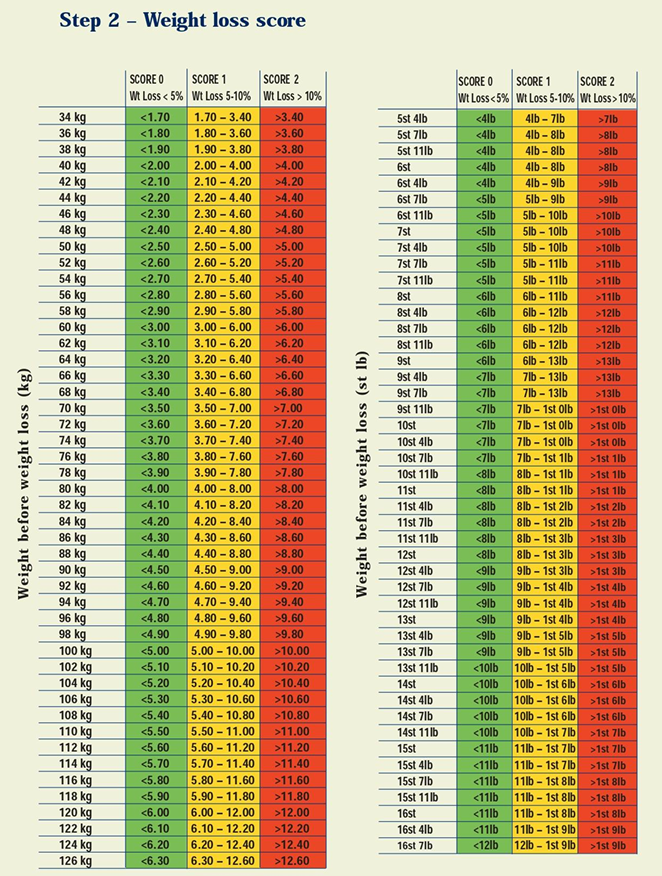
If the scenario mention weigh loss in percentage, then scoring is as below:
- Less than 5% = Score 0
- 5–10% = Score 1
- More than 10% = Score 2
Here, before weight loss, weight is 58kg and 6kg Weight Loss Score = 2
Step 4 – Assess Acute Disease Effect
Check Scenario:
Has the patient been acutely ill and had no nutritional intake for more than 5 days?
If yes:
Add Score 2
If no:
Add Score 0
Let’s say in this example, the patient has been eating small amounts of food.
Then:
Acute Disease Score = 0
Students often add this score automatically without checking the scenario. This is a common OSCE mistake.
Step 5 – Add the Final MUST Score
Now total the scores:
- BMI Score = 1
- Weight Loss Score = 2
- Acute Disease Score = 0
Total:
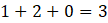
Final MUST Score = 3
This means:
High Risk of Malnutrition
This is the final Malnutrition Score in NMC OSCE.
Step 6 – Decide the Correct Nursing Action
This is where clinical judgement matters most.
For a high-risk patient, your actions may include:
- Refer to a dietitian
- Start food and fluid chart
- Monitor weekly/monthly as per hospital/community scenario
- Consider nutritional supplements
- Review if assistance is required
Quick Memory Trick for Exam Day
Use this simple sequence:
BMI → Weight Loss → Acute Disease → Total Score → Action Plan
Do not skip the final step. That mindset helps you pass.
How to Document the MUST Chart Correctly in NMC OSCE
The examiner is checking whether your NMC OSCE MUST chart documentation reflects safe, accurate, and accountable nursing practice. Even if your score is correct, poor documentation can suggest unsafe care.
What Should Be Included in the MUST Chart
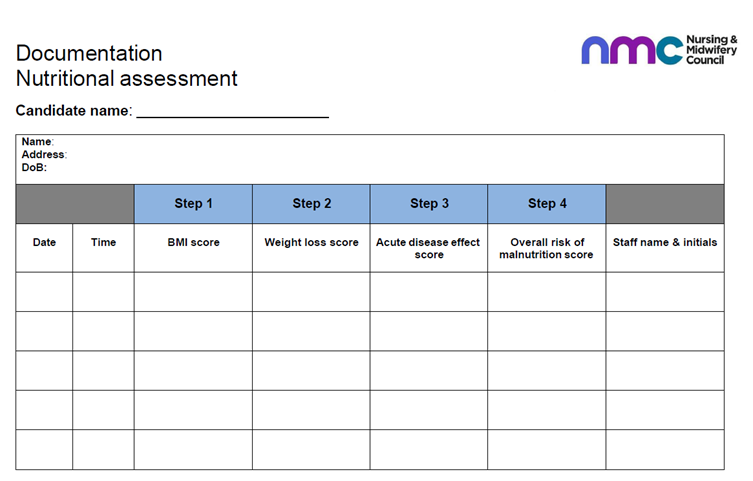
The MUST documentation should clearly show:
- Patient details on the chart
- Date and time
- Calculated BMI score (Step 1 score)
- Weight loss score (Step 2 score)
- Acute disease effect score (Step-3 score)
- Total MUST score
- Your name and initial
Every step must be clear and easy to follow.
Common Documentation Mistakes That Cause Failure
Many candidates fail because of small but important errors.
1. Writing the Final Score Without Calculations
Always identify and document BMI and weight loss score clearly.
2. Forgetting the Management Plan
A MUST score without action is incomplete.
You must state what you did next.
For example:
- Started monitoring
- Status of malnutrition
- Referred to dietitian
This shows safe practice.
3. Failed to document Acute Disease score
Some candidates forget to identify step 3 score completely.
Read scenario and identify score from patient food intake and document the same
4. No Referral for High Scores
A patient with a MUST score of 2 or more suggest high risk of Malnutrition. Refer patient to the dietician or nutritional support team.
Verbal Documentation Matters Too
Sometimes the examiner asks:
“What would you do next?”
Your spoken answer should match your written documentation.
A good handover could be:
“The patient has a MUST score of 3, indicating high risk of malnutrition. I have documented the findings, inform each step score and monitoring, commenced food and fluid monitoring, supplements if required, and would refer to the dietitian.”
Professional Tips for Cleaner Documentation
Documentation during NMC OSCE nutritional assessment station:
- Write neatly and clearly
- Avoid overwriting or messy corrections
- Follow local chart format exactly
- Give appropriate handover
Your documentation should reflect the standards expected by the Nursing and Midwifery Council and NHS clinical practice.
Tips for OSCE Documentation
Always remember:
Read scenario → Score → Management → Referral
This sequence should appear in every MUST station.
If one part is missing, your documentation becomes incomplete.
When you practise this structure repeatedly, the station becomes much easier.

Common Mistakes Candidates Make During the Nutrition Station
Many candidates assume the NMC OSCE nutrition station is an easy scoring station because the MUST chart looks easy. In reality, this station causes frequent failures because small mistakes can indicate unsafe nursing practice.
Understanding these common mistakes helps you avoid possible errors.
Mistake 1 – Rushing Straight to the Final Score
One of the most common problems is calculating the final Malnutrition Score in NMC OSCE too quickly without identifying the steps score.
Candidates often write:
MUST Score = 2
…but forget to document:
- BMI score
- Weight loss percentage score
- Acute disease assessment score
Mistake 2 – Using the Wrong BMI Units
This is a very common technical error. Use the unit on chart accurately if scenario given height in meter, then use the same to identify the score
Many candidates use height in centimetres instead of metres.
Pause and check units before writing anything.
Mistake 3 – Ignoring the Acute Disease Effect
Some candidates focus only on BMI and weight loss and completely forget Step 3.
If a patient is likely to have no nutritional intake for more than 5 days, you must add:
Acute Disease Score = 2
This is considered unsafe practice.
Mistake 4 – No Action After a High MUST Score
You calculate the score correctly – but then stop.
For example:
High-risk patient
MUST Score = 3
…and no:
- Started monitoring
- Status of malnutrition
- Referred to dietitian
The correct mindset is:
High score = Management plan
Mistake 5 – Forgetting Reassessment
Nutrition assessment is not a one-time event.
Patients should usually be reassessed if high risk:
- Weekly in hospital settings
- Monthly in community
Mentioning reassessment shows strong clinical understanding.
Mistake 6 – Panic Under Time Pressure
Students rush, forget steps, and become inconsistent.
The best solution is structure.
Use this memory framework:
BMI score→ Weight Loss score→ Acute Disease score→ Total → Action
Your Final Exam-Day Reminder
Before finishing the station, mentally ask:
Did I read scenario?
Did I calculate?
Did I document?
Did I communicate?
If the answer is yes to all our, you are performing at a strong OSCE standard.
Understanding the Malnutrition Score in NMC OSCE is not just about passing station, it helps you identify patients at risk early, prevent complications, and ensure the right nutritional support is provided at the right time. In your OSCE, this means demonstrating more than calculation skills. You must show clinical judgement, accurate documentation, and confident communication.
To succeed, always remember the core sequence:
BMI → Weight Loss → Acute Disease → Total Score → Action Plan
This structure keeps your practice safe and your exam performance consistent.
The more you practise this station using different scenarios and timed mock sessions, the easier it becomes. Confidence in OSCE does not come from memorising the action. It comes from repeated safe practice.

Frequently Asked Questions About Malnutrition Score in NMC OSCE
1. What MUST score is considered high risk?
A total score of: 2 or more = High Risk of Malnutrition
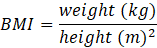
2. How do I calculate BMI for MUST score with formula?
BMI is calculating formula:
3. How to identify acute disease score?
The patient is acutely ill and there has been or is likely to be no nutritional intake for more than 5 days, then Acute Disease Effect Score = 2
If this does not apply (Having food):
Score = 0
4. How score suggest the condition of malnutrition?
- Low risk – Score (0)
- Medium risk – Score (1)
- High risk – Score (2 or more)
5. How often should MUST be reassessed if high risk of malnutrition?
In most hospital settings, MUST should be reassessed:
- Weekly in hospital
- Monthly in community
Read our recent blog – “NMC OSCE Preparation: Understanding the Exam Structure” – to ensure your journey stays on track.
Why Wait? Just Merlin It!
Free Consultation – Chat now with a Mentor.