
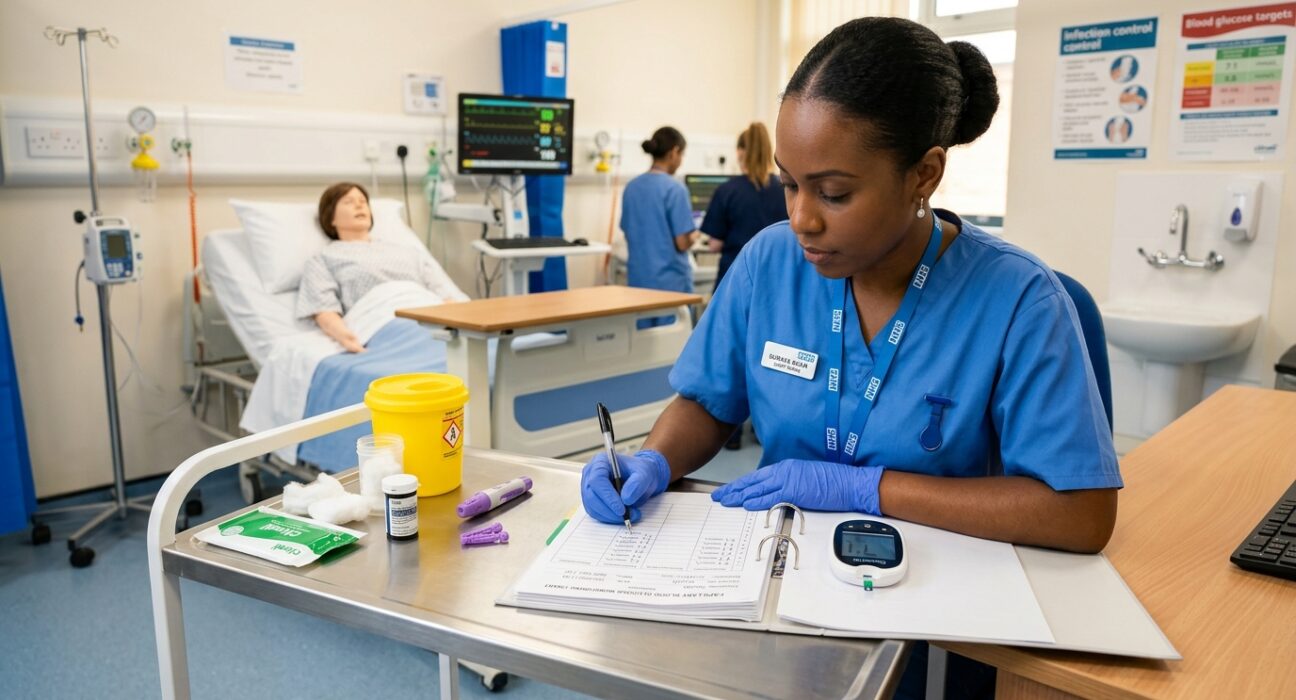
If you are preparing for the NMC OSCE, accurate documentation is just as important as performing the clinical skill correctly. In the NMC OSCE blood glucose monitoring documentation station, examiners are not only looking at whether you can obtain a capillary blood glucose reading safely. They also want to see whether you can record the result clearly, completely, and in a way that supports patient safety. A candidate may perform the finger-prick procedure well but still lose marks because the chart documentation is incomplete, the time is missing, the signature is unclear, or the unit is not documented.
This is why understanding NMC OSCE blood glucose monitoring documentation is essential for international nurses who want to pass first time. Good documentation shows that you can communicate clinical information, support continuity of care, and practise according to professional standards expected in the UK. In real NHS practice, a blood glucose result is not useful unless it is recorded correctly and acted on appropriately. The same principle applies in the OSCE.
In this guide, you will learn what examiners expect, what to document after blood glucose monitoring, common mistakes to avoid, and how to improve your confidence before exam day. We will also connect the skill to wider OSCE success strategies used in Mentor Merlin’s NMC OSCE preparation programmes, so you can practise with the right structure from the beginning.
Why documentation matters in the NMC OSCE
Many candidates think documentation is a small finishing step, but in the NMC OSCE it is part of safe nursing practice. The examiner is assessing whether you can complete a task in a professional, patient-centred, and legally safe way. When you document a blood glucose reading, you are creating a clinical record that another healthcare professional may rely on. If the record is inaccurate, incomplete, or unclear, this can affect treatment decisions and place the patient at risk.
Good documentation demonstrates several core OSCE competencies at the same time:
- accuracy in recording the measured value
- clarity about the date and time of the observation
- professional accountability through signature or initials
- clinical reasoning if the result is abnormal
- effective communication and escalation when needed
The Nursing and Midwifery Council expects nurses to keep clear and accurate records as part of the NMC Code. This means your OSCE performance should reflect the habits expected in real practice. Examiners want to see that you understand documentation not as paperwork, but as part of patient safety.
For blood glucose monitoring specifically, documentation matters because glucose levels may guide treatment such as insulin administration, dietary support, or urgent escalation. If a patient is hypoglycaemic or hyperglycaemic, delayed or poor charting may lead to delayed action. In the exam, even if no further intervention is required, your documentation must still be complete and timely.
What is blood glucose monitoring in the OSCE context?
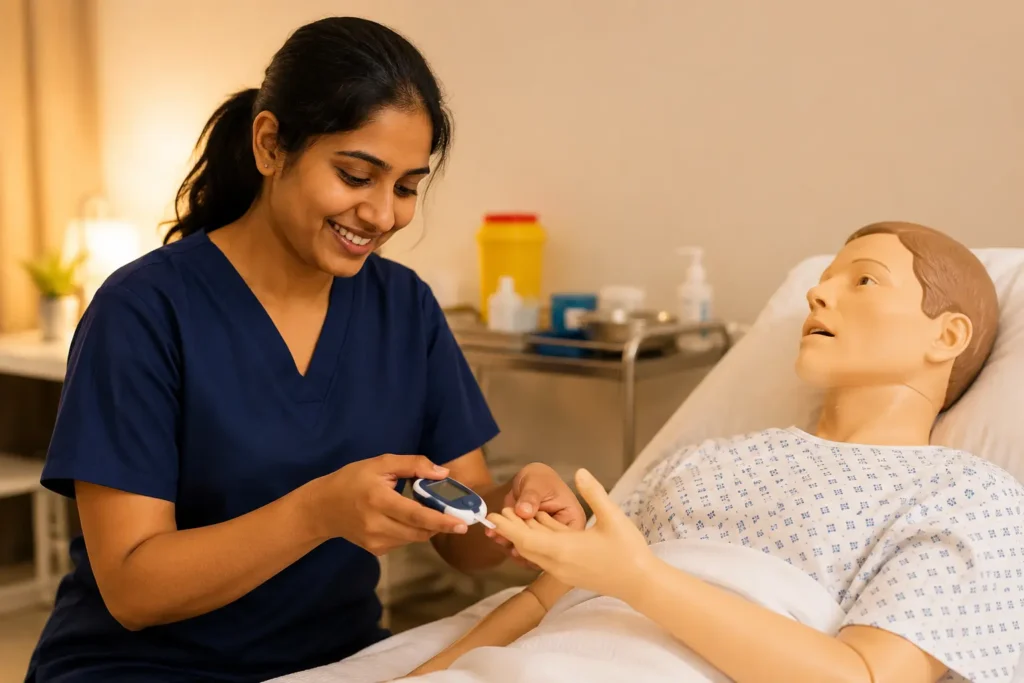
Blood glucose monitoring in the OSCE usually refers to checking a patient’s capillary blood glucose level using a glucometer. The skill often includes procedure explanation and consent, hand hygiene, equipment preparation, checking the machine and strip, performing the finger-prick safely, obtaining the sample, reading the result, and disposing of sharps correctly.
However, the skill does not end when the number appears on the machine. You must also interpret whether the value is within an expected range for the scenario, tell the patient the result in an appropriate way, and document it accurately. In some scenarios, you may need to verbalise what action you would take if the result is too low or too high.
This is where many candidates become uncertain. They may know how to perform the physical procedure, but they are less confident about the chart, the wording, and the exact details to include. Mentor Merlin often sees candidates lose easy marks because they focus heavily on the lancet technique but do not give equal importance to the written record.
What you must document after checking blood glucose
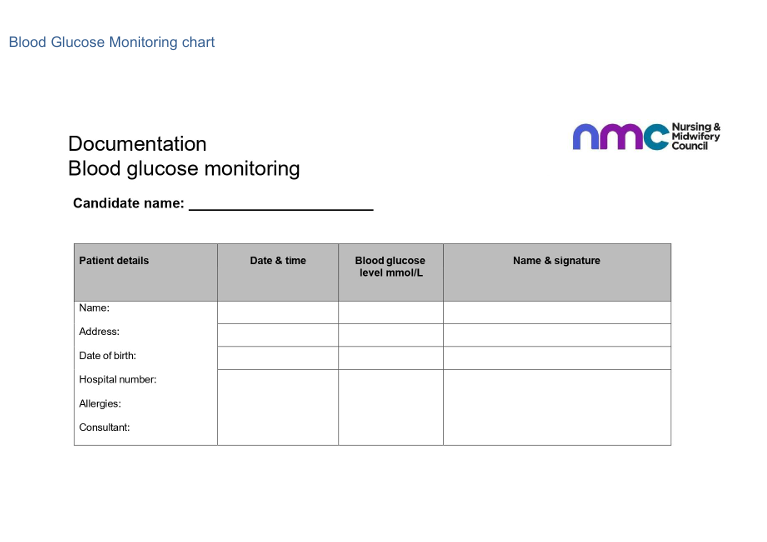
Although the exact chart format may vary in training materials or exam stations, the principles of NMC OSCE blood glucose monitoring documentation stay consistent. After completing the reading, you should record the key details accurately and neatly. The essential items usually include:
- the blood glucose value obtained
- the unit if required
- the date
- the time
- your signature or initials according to the chart requirement
- Pre-meal check or post-meal check
If you are given a paper chart in the OSCE, write clearly and place the value in the correct section. Do not squeeze information into the wrong box, and do not leave the time blank. In most exam situations, examiners care that you are safe, systematic, and aware of professional expectations.
A safe documentation sequence might sound like this: “I have obtained the patient’s capillary blood glucose reading. I will now document the reading, date, time, and my signature on the blood glucose chart, and I will escalate if the result is outside the expected range.” This kind of verbalisation shows your understanding clearly.
Document the value accurately
The blood glucose result is the core information. Even a small recording error can change the meaning significantly. For example, writing 6.2 instead of 2.6 could completely alter the response needed. Always pause, read the number carefully, and then document exactly what you see. Do not rely on memory if the chart is not directly in front of you. Read, confirm, and write.
Record the date and time
A result without time is incomplete. Blood glucose readings are meaningful in relation to meals, insulin timing, symptoms, and trends across the day. In the OSCE, forgetting the time is a common avoidable mistake. If the station includes a visible clock or you are given a scenario time, use it correctly.
Add your signature or initials
Your signature or initials show accountability. In practice, this means another clinician can identify who performed and recorded the observation. In the OSCE, signing correctly helps demonstrate professional responsibility. Do not forget this step. An unsigned entry may be considered incomplete documentation.
Document escalation when needed
If the patient’s reading is outside the normal or expected range, documentation should not stop at the number alone. You should verbalise the need to escalate according to local policy, symptoms, and the scenario. For example, if the patient is hyperglycemic and symptomatic, you would report to the doctor or appropriate clinician promptly and begin the expected response according to policy.

Step-by-step approach to NMC OSCE blood glucose monitoring documentation
Using a fixed sequence can reduce anxiety and help you avoid omissions in the exam. After obtaining the reading, use this structured approach:
- Look at the result carefully and confirm the number.
- Consider whether the reading is normal, low, or high for the patient and scenario.
- Inform the patient of the result in a calm and professional way.
- Document the result in the correct chart location.
- Add the date and time.
- Sign or initial the entry.
- Escalate and document action if required.
- Ensure sharps disposal and hand hygiene are complete.
This step-by-step method helps integrate clinical skill, communication, and documentation into one safe process. It also shows the examiner that you are thinking like a nurse working in the NHS, not simply trying to finish a checklist.
Common documentation mistakes in the blood glucose monitoring station
One of the best ways to improve your OSCE score is to recognise common errors before exam day. Mentor Merlin’s trainers often notice the same documentation mistakes in practice sessions. These are usually not caused by lack of knowledge, but by rushing, stress, or poor sequencing.
- forgetting to document the reading at all
- writing the wrong value from the glucometer
- omitting the time
- forgetting to sign or initial
- placing the reading in the wrong part of the chart
- not verbalising follow-up action
- using unclear handwriting
These errors may look small, but they can suggest unsafe practice. For example, if a result is 3.1 mmol/L and you document it without any sign of concern, the examiner may question your clinical reasoning. If you perform the skill well but leave the chart incomplete, the examiner may conclude that you have not completed the station safely.
To avoid these mistakes, practise documentation separately as well as together with the full procedure. Some candidates only rehearse finger-prick technique, but they should also rehearse saying the result aloud, interpreting it, and writing it down immediately. Repetition builds confidence.
How examiners assess safety and clinical reasoning
The OSCE is not only a technical skills exam. Examiners want to know whether you understand why you are doing each step. In blood glucose monitoring, documentation provides evidence of this understanding. When you accurately record the value and explain the next step, you demonstrate that you can connect measurement to patient care.
Clinical reasoning may include:
- recognising signs of hypo- or hyperglycaemia
- understanding when a reading needs urgent escalation
- knowing that trends are important, not just a single number
- ensuring documentation supports pre-meal or post-meal condition
- communicating clearly with the patient and Assessor
If the scenario gives an abnormal reading, you do not need to overcomplicate your response. Usually, a safe verbal statement is enough, such as: “This reading is above the expected range. I would inform the doctor immediately, assess the patient for symptoms, and follow local hyperglycemia policy.” Then complete your documentation. Simple, safe, and clear is better than trying to sound overly advanced.
Tips to practise documentation effectively before your OSCE
If you want to improve your score, practise documentation in a realistic way rather than only reading about it. Here are some useful strategies:
- Use sample charts and complete them accurately.
- Pair up with another candidate and check each other’s documentation.
- Set a timer so you become comfortable documenting under pressure.
- Practise saying the result, action, and charting sequence aloud.
- Review common abnormal glucose scenarios and your escalation response.
- Record yourself during mock OSCE practice and check whether you forgot the charting step.
Many international nurses are clinically capable but become anxious because UK documentation expectations feel unfamiliar. Structured coaching can make a major difference. Mentor Merlin’s NMC OSCE training support helps candidates practise exactly these small but important details, including verbalisation, chart handling, and examiner-friendly sequencing.
You can also strengthen your wider readiness by reviewing related stations such as observation charts and medication documentation. These stations all reward the same habits: accuracy, clarity, escalation, and accountability. For example, if you need help with observation charting, our readers often benefit from this related guide on the NMC OSCE NEWS2 chart.
Linking blood glucose documentation to the NMC Code and NHS practice
The OSCE reflects the professional environment you will enter after registration, so documentation standards are not only about passing an exam. In NHS settings, nurses are expected to document in a way that is timely, factual, legible, and relevant. Accurate charting supports safe handovers, multidisciplinary communication, and prompt intervention.
The NHS guidance on blood glucose monitoring highlights the importance of regular testing and understanding readings in context. In practice, a patient’s symptoms, food intake, result, and treatment plan all matter. Documentation helps other staff understand that context quickly.
The NMC Code also requires nurses to keep clear records and share information appropriately for safety. This means that in the OSCE, good documentation is not optional. It is evidence that you are ready for accountable UK nursing practice.

Sample verbalisation for the station
Many candidates ask what they should say while documenting. You do not need a long script, but a short structured verbalisation can help the examiner follow your thinking. For example:
- “I have checked the patient’s capillary blood glucose and obtained a reading of 5.8 mmol/L.”
- “I will inform the patient of the result.”
- “I will now document the blood glucose result, date, time, and my signature on the appropriate chart.”
- “If the reading were outside the expected range, I would escalate according to local policy.”
If the result is abnormal, adapt the statement clearly. For example: This reading is above the expected range. I would inform the doctor immediately, assess the patient for symptoms, and follow local hyperglycemia policy.”
Practise these statements until they sound natural. The goal is not to memorise a dramatic script. The goal is to show safe reasoning in simple professional English.
How Mentor Merlin helps nurses master OSCE documentation
At Mentor Merlin, we understand that passing the OSCE is not only about knowing the procedure. It is also about understanding how UK examiners expect you to communicate, document, and prioritise safety. Many candidates are very capable nurses but need focused support to adapt their existing experience to the NMC OSCE format.
Our preparation programmes guide international nurses through practical stations, common mistakes, structured verbalisation, and documentation standards. This includes detailed coaching on how to complete charts accurately, how to respond to abnormal findings, and how to avoid losing marks on small but important steps. Whether you are studying for OSCE, OET, or CBT, the same principle applies: success comes from structured practice and clear feedback.
If you are preparing for registration in the UK, explore Mentor Merlin’s healthcare preparation programmes for step-by-step support designed for international nurses. A strong pass is often built on mastering the details that others overlook.
Conclusion
Strong NMC OSCE blood glucose monitoring documentation can make the difference between an average performance and a safe, examiner-ready one. The key is to treat documentation as an essential part of the clinical skill, not as an afterthought. Record the value accurately, include the date and time, sign clearly, and show that you know when to escalate abnormal results. When these habits become routine, your confidence improves and your OSCE performance becomes more consistent.
If you want guided practice for OSCE stations, documentation, and UK nursing exam technique, Mentor Merlin’s preparation programmes can help you build the structure and confidence needed for success. Start early, practise safely, and make every mark count.

Frequently asked questions about NMC OSCE blood glucose monitoring documentation
Yes. Even a normal reading must be documented accurately with the date, time, and signature or initials as required. Normal results still form part of the patient’s clinical record and help show trends over time.
One of the most common mistakes is forgetting to include the time or signature after recording the value. Candidates also sometimes forget to document an abnormal result and immediately move on without verbalising escalation.
Post meal;
Type 1 DM- 4 to 9 is normal
Type2 DM 4 to 8.5 is normal
Pre-meal – 4-7 is normal
Practise using sample charts, repeat a fixed documentation sequence, and get feedback during mock stations. Training with structured coaching, such as Mentor Merlin’s OSCE support, can help you turn documentation into a consistent habit.
Read our detailed blog – “NMC OSCE Oral Care Plan: 4 Scenario Guide” – to ensure your journey stays on track.
Why Wait? Just Merlin It!
Free Consultation – Chat now with a Mentor.