


The Bowel Assessment Station is one of the assessment stations that tests a candidate’s ability to perform a systematic nursing assessment while demonstrating safe, compassionate, and evidence-based care. This is an 8-minute silent station during the NMC OSCE
In the NMC OSCE, examiners are not only assessing your clinical knowledge but also your ability to requiring candidates to accurately assess bowel function, complete the Bristol Stool Chart, and recommend an appropriate evidence-based plan of care.
Many candidates assume that identifying the correct Bristol Stool type is sufficient to pass this station. However, according to the assessment criteria, merely recognising the stool type is not enough. Examiners expect candidates to demonstrate sound clinical reasoning by identifying appropriate nursing interventions based on the patient’s bowel condition.
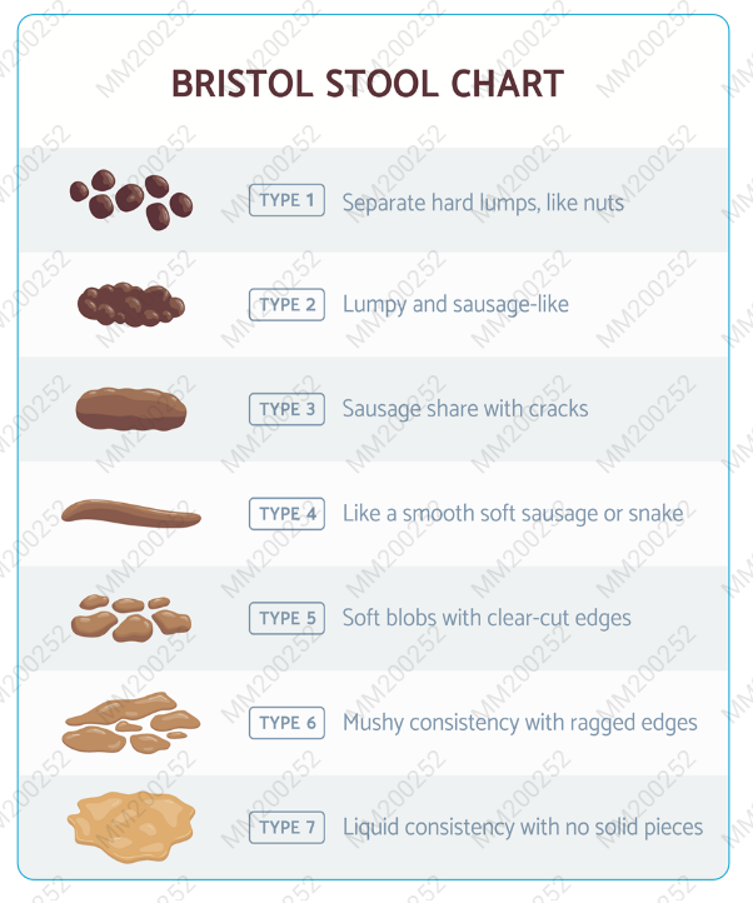
Whether the patient presents with constipation (Bristol Stool Types 1 or 2) or diarrhoea (Bristol Stool Types 6 or 7), you must recommend several relevant aspects of care to achieve full marks.
This guide explains the marking criteria in detail and provides practical tips to help first-time NMC OSCE candidates confidently approach the bowel assessment station.
Understanding the Assessment Criteria
The bowel assessment station evaluates four key areas:
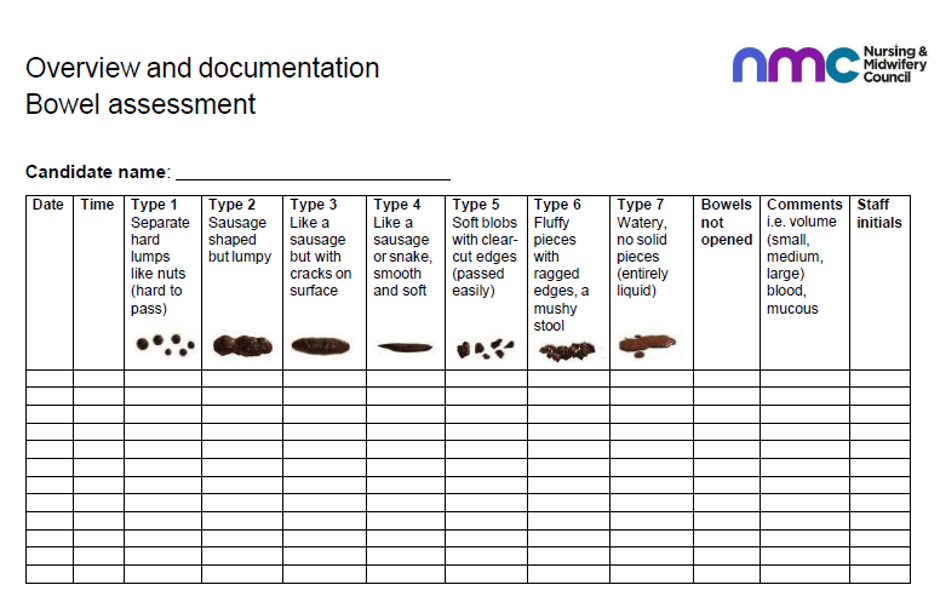
1. Accurate Completion of the Bristol Stool Chart
Candidates should correctly:
- Identify the Bristol Stool Type shown in the picture/scenario.
- Complete the chart accurately.
- Sign the documentation.
- Add the correct date.
- Record the time where required.
2. Maintain Professional Documentation Standards
The examiner will also assess documentation quality.
Candidates should ensure:
- Handwriting is clear and legible.
- Entries are easy to understand.
- Any mistakes are corrected using a single strike-through so the original text remains readable.
Messy documentation can result in unnecessary loss of marks.
3. Recommend an Appropriate Plan of Care
This is the section where many candidates lose marks.
The examiner expects candidates to recommend multiple nursing interventions, not just one.
The plan of care must be appropriate for the patient’s bowel condition.
Type 1: Constipation (Bristol Stool Types 1 and 2)
Patients presenting with Bristol Stool Type 1 or Type 2 are experiencing constipation.
Simply saying,
“The patient is constipated.”
is not sufficient.
You must explain how you would manage the patient.
First, Recognise the Stool Type
You should identify that:
- Type 1 consists of separate hard lumps.
- Type 2 is sausage-shaped but lumpy.
Both indicate constipation.
Know more.

What Should You Include in Your Plan of Care?
According to the assessment criteria, candidates should identify at least five appropriate aspects of care to achieve full marks.
Below are the recommended interventions.
1. Consider Possible Causes of Constipation
Always think about why the patient is constipated.
Possible causes include:
- Opioid medication
- Iron tablets
- Poor diet
- Inadequate fluid intake
- Reduced mobility
- Recent surgery
- Neurological conditions
2. Offer Dietary Advice
Increasing dietary fibre is one of the first-line nursing interventions.
Advise the patient to increase intake of:
- Fruits
- Vegetables
- Whole grains
- High-fibre cereals
- Pulses
A balanced diet supports regular bowel movements.
3. Encourage Adequate Hydration
Increasing fibre without increasing fluid intake may worsen constipation.
Advise patients to:
- Drink adequate fluids throughout the day, unless medically contraindicated.
- Prefer water over sugary drinks.
Hydration helps soften stool and supports normal bowel function.
4. Discuss the Need for Laxatives
If lifestyle measures are insufficient, patients may require laxatives prescribed by an authorised prescriber.
5. Encourage Physical Activity
Reduced mobility slows bowel motility.
Where appropriate, encourage:
- Walking
- Sitting out of bed
- Gentle exercises
- Regular movement
Even light activity can improve bowel function.
6. Encourage Prompt Response to the Urge to Defecate
Some patients ignore the urge to use the toilet.
This can worsen constipation.
Advise patients:
- Not to delay bowel emptying.
- To use the toilet when they first feel the urge.

7. Promote Positive Toilet Habits
Simple behavioural advice can make a significant difference.
Discuss:
- Privacy
- Comfortable positioning
- Avoiding rushing
- Spending adequate time on the toilet
These measures support easier bowel evacuation.
8. Continue Ongoing Bowel Assessment
Assessment does not end after one bowel movement.
Explain that you would continue monitoring:
- Frequency
- Stool consistency
- Patient comfort
- Response to interventions
Ongoing assessment helps determine whether the care plan is effective.
Type 2: Diarrhoea (Bristol Stool Types 6 and 7)
The second possible scenario involves diarrhoea.
Candidates must first recognise:
- Bristol Stool Type 6
- Bristol Stool Type 7
Both indicate loose or watery stools.
Recognise Possible Causes
Diarrhoea has many potential causes.
The assessment criteria include:
- Food poisoning
- Overflow diarrhoea
- Antibiotic-associated diarrhoea
- Healthcare-associated infections
- Norovirus
- Clostridioides difficile infection
- Malabsorption
Showing awareness of these causes demonstrates clinical understanding.
Appropriate Plan of Care for Diarrhoea
Again, candidates should identify at least five nursing interventions.
1. Consider Infection Control Measures
Patients with diarrhoea may have an infectious cause.
Appropriate interventions include:
- Isolating the patient if indicated.
- Following local infection prevention and control policies.
- Sending a stool sample for microbiological culture if required.
Protecting other patients is a key nursing responsibility.
2. Encourage Adequate Hydration
Diarrhoea increases the risk of dehydration.
Advise the patient to:
- Increase oral fluid intake if appropriate.
- Monitor for signs of dehydration, such as dry mouth, dizziness, or reduced urine output.
Hydration remains one of the most important nursing interventions.
3. Offer Appropriate Dietary Advice
During episodes of diarrhoea, patients may benefit from temporarily avoiding foods that aggravate symptoms.
The marking criteria specifically include reducing:
- Fruit
- Vegetables
until symptoms improve, while following local clinical guidance and individual patient needs.
4. Consider Medication Review
If diarrhoea is suspected to be non-infectious, you may include antimotility medication as per prescription.
5. Assess Perianal Skin Integrity
Frequent loose stools can cause:
- Skin irritation
- Moisture-associated skin damage
- Pain
- Excoriation
Regular skin assessment and appropriate skin care are important nursing responsibilities.
6. Promote Safe Toilet Habits
Patients should have:
- Easy access to the toilet or commode.
- Privacy.
- Adequate time.
- Assistance if mobility is impaired.
This promotes dignity and reduces the risk of falls.
7. Continue Ongoing Monitoring
Continue assessing:
- Stool frequency
- Stool consistency
- Fluid balance
- Signs of dehydration
- Response to treatment
Regular reassessment ensures timely escalation if the patient’s condition deteriorates.

Documentation Tips That Examiners Expect
Accurate documentation is just as important as the assessment itself.
Remember to:
- Record the correct Bristol Stool Type.
- Sign your documentation.
- Add the date.
- Record the time where required.
- Write clearly.
- Correct mistakes using a single strike-through.
- Avoid abbreviations unless approved.
- Document objectively.
Common Mistakes That Cost Marks
Many candidates lose marks for avoidable errors.
Common mistakes include:
- Forgetting to complete the Bristol Stool Chart.
- Recording the wrong stool type.
- Providing only limited intervention.
- Missing infection control advice in diarrhoea scenarios.
- Forgetting hydration advice.
- Omitting bowel monitoring.
- Not signing or dating documentation.
- Illegible handwriting.
OSCE Tips for Success
Before finishing the station, ask yourself:
- Did I correctly identify the stool type?
- Did I complete the documentation accurately?
- Did I recommend at least five appropriate nursing interventions?
- Did I recognise potential causes?
- Did I consider hydration?
- Did I mention ongoing assessment?
If the answer is yes, you are likely demonstrating the level of practice expected in the NMC OSCE.
The bowel assessment station is designed to assess far more than your ability to identify a Bristol Stool Type. Examiners want to see that you can think like a registered nurse by recognising abnormal bowel patterns, considering possible underlying causes, and recommending a safe, patient-centred plan of care.
For constipation scenarios, focus on identifying contributing factors, encouraging dietary fibre and hydration, promoting mobility and healthy toileting habits, considering prescribed laxatives where appropriate, and continuing bowel assessment. For diarrhoea scenarios, prioritise infection prevention and control, hydration, dietary advice, skin integrity, appropriate escalation regarding medication, and ongoing monitoring.
Finally, remember that accurate documentation is essential. Complete the Bristol Stool Chart correctly, sign, date, and time your entries where required, maintain legible handwriting, and use a single strike-through for any corrections. By combining accurate assessment, clear documentation, and a comprehensive plan of care with at least five relevant interventions, you will maximise your chances of achieving full marks in the NMC OSCE bowel assessment station.

FAQ’s
1. How Many Interventions Are Required?
Ans. According to the marking criteria:
- Full marks: Minimum five appropriate aspects of care.
- Partial marks: Minimum three appropriate aspects of care.
Therefore, always aim to document at least five interventions.
2. How to write problem while writing the bowel assessment care plan?
In a bowel assessment care plan, write the problem by:
Stating the patient’s name. Describing the specific bowel issue (e.g., diarrhoea or constipation).
Mentioning potential causes if known. Including any evidence, such as stool type or frequency.
For example: “Rachel is experiencing severe diarrhoea, as evidenced by Bristol stool type 7, as a result of food poisoning, overflow, side effects of medication, norovirus infection, and Clostridium difficile infection.
3.What all we need to document in bowel assessment chart?
In a bowel assessment chart, you need to document:
Date and time, tick the appropriate stool type using the Bristol stool chart.
Frequency of bowel movements, i.e volume (small, medium, large), blood, mucus and staff initials.
4. Which are the commonly asked stool types for NMC OSCE?
Type 1, 2 (Constipation) or 6, 7 (diarrhoea) are commonly asked stool types in NMC OSCE
5.What is the allocated time for the bowel assessment station in an OSCE?
Bowel assessment is the 8 minutes silent station during OSCE.
Read our detailed blog – “8 Essential steps of NMC OSCE Two Inhaled Medication Techniques for Confident Success” – to ensure your journey stays on track.
Why Wait? Just Merlin It!
Free Consultation – Chat now with a Mentor.