

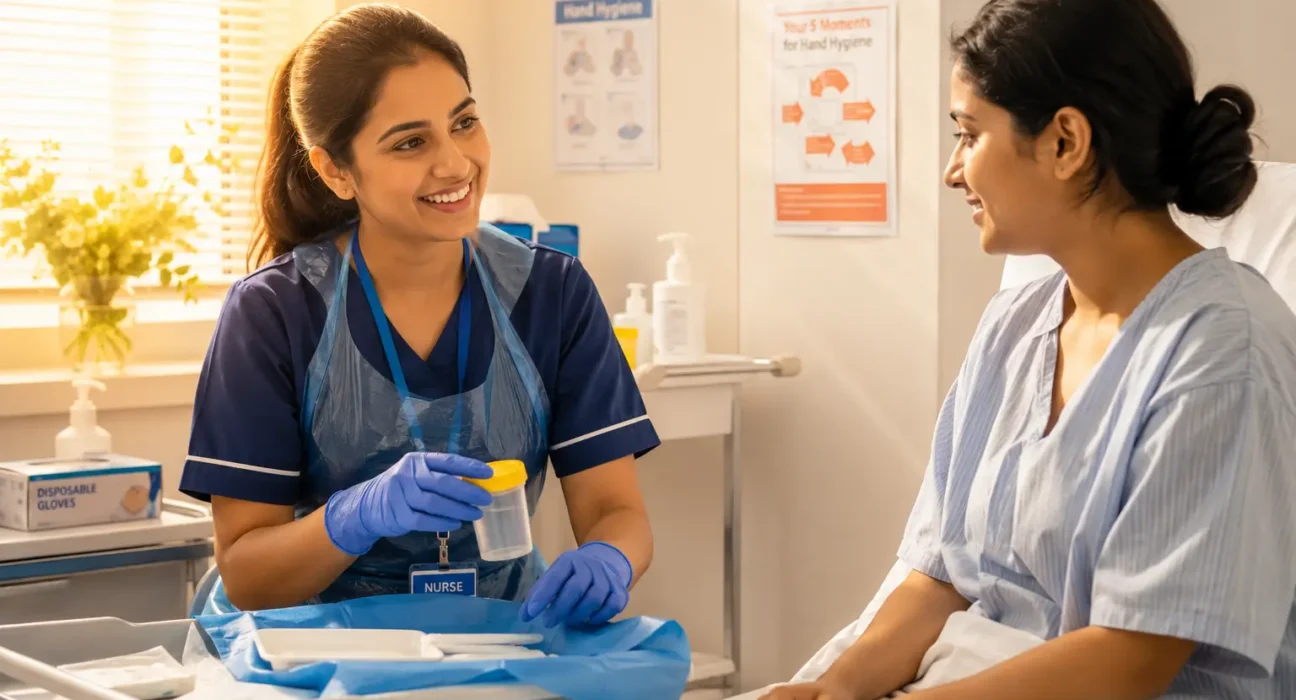
If you are preparing for the NMC OSCE, understanding accurate and aseptic collection of urine specimen during NMC OSCE is essential. This station tests far more than your ability to collect a sample. It also assesses your communication, consent, infection prevention practice, specimen handling, and professionalism under pressure. Many candidates lose marks not because they do not know the procedure, but because they miss small details such as hand hygiene, maintaining privacy, collecting sample using correct method, or verbalising what happens after collection.
For internationally educated nurses aiming to join the NHS, this is a common clinical skill that must be performed safely and confidently. In this guide, we explain the step-by-step method, common mistakes to avoid, and how to approach the station in a way that matches NMC expectations. If you are training with Mentor Merlin’s NMC OSCE preparation programme, this article will help you strengthen both your technical knowledge and your exam performance.
Why urine specimen collection matters in the NMC OSCE
In clinical practice, urine samples are often used for microscopy, culture, and sensitivity testing to help identify infection and guide treatment. In the OSCE, the examiner wants to see that you understand both the practical procedure and the reason for each step.
This is why aseptic awareness is so important. If the sample becomes contaminated, it may produce misleading laboratory results. That could lead to delayed diagnosis, unnecessary antibiotic use, or repeated testing for the patient. In the OSCE context, contamination also shows poor understanding of infection prevention principles. A strong candidate demonstrates that the sample must be collected correctly, labelled immediately, and sent to the laboratory promptly.
From an assessment point of view, this skill also links directly with the NMC Code. You are expected to prioritise people, practise effectively, preserve safety, and promote professionalism and trust. So even though this looks like a simple clinical task, it is actually a station where many core nursing standards are being observed at the same time.
Equipment needed for accurate and aseptic collection of urine specimen during NMC OSCE
One of the easiest ways to make a good first impression in the OSCE is to check your equipment carefully and verbalise that it is clean, intact, and appropriate. For the catheter specimen of urine, the usual equipment includes:
- Personal protective equipment as required
- A sterile specimen container with a secure lid
- Alcohol Wipes
- Syringe (Needle if required with sharp bin)
- Microbiology bag
- Specimen label or means of patient identification
- Clinical waste disposal facilities
In the OSCE, you may not physically have every item in front of you, but you should still state what you would use. Examiners often reward safe verbalisation, especially when you explain that the sterile container must be unopened, within expiry date, and closed securely after collection. This shows that you understand how to preserve sample quality.
Step-by-step guide to the procedure
1. Prepare the environment and introduce yourself
Begin with standard precautions. Perform hand hygiene, introduce yourself, explain purpose of visit and explain your role. Ask the patient if this is a good time and whether they are comfortable.
At this stage, explain why the urine sample is needed. For example, you may say that the sample is being collected to investigate possible urinary infection. Use clear, simple language and gain valid consent before proceeding. Good communication is especially important in the OSCE because it demonstrates respect, dignity, and patient-centred care.
2. Clamp the catheter
Clamp the catheter few centimeters away from the sampling port and ensure enough urine collected before collecting the sample.
In the OSCE, if you explain the steps well, you show both technical knowledge and understanding ability.

3. Collect Urine sample
Collect all required equipment, check its integrity, and perform hand hygiene. Wear an apron and gloves. Ensure there is a sufficient volume of urine in the catheter tubing before collecting the sample. Clean the sampling port with an alcohol wipe for 30 seconds, then allow it to air dry for 30 seconds. Using ANTT (Aseptic Non-Touch Technique), attach the syringe to the sampling port and withdraw the required urine sample.
OSCE tip:
- If only a syringe is provided, insert the needle at a 90° angle.
- If a needle and syringe are provided, insert at a 45° angle.
- If a needle is used, dispose of it immediately into a sharps bin.
Transfer the urine into a sterile specimen container, taking care not to touch the inside of the container or lid. Secure the lid firmly. Place the specimen container into a microbiology specimen bag. Check that the sample is correctly labelled with the patient’s details before sending it to the laboratory. Unclamp the sampling port, then clean the port again with an alcohol wipe for 30 seconds and allow it to air dry for a further 30 seconds.
4. Label the sample immediately
One of the most important safety steps is immediate and accurate labelling. In the OSCE, never leave the container unlabeled. State that you would confirm the patient details according to local policy, check the label correctly.
Accurate labelling protects the patient from sample mix-ups and supports correct diagnosis. This is a simple step, but missing it can significantly reduce your score because it relates directly to patient safety and professional accountability.
5. Send the sample promptly
After collection, the sample should be sent to the laboratory as soon as possible. If immediate transport is not possible, local policy may require refrigeration to preserve the sample. In many nursing references, prompt transport is emphasised because delays can allow organisms to multiply and alter the test result. In OSCE, you verbally acknowledged to send the sample immediately to the laboratory.
Finally, document the procedure in the patient record. Include that the urine specimen was collected, the method used, the patient’s tolerance of the procedure, and that the sample was labelled and sent to the laboratory. In the OSCE, verbalising documentation is often sufficient.
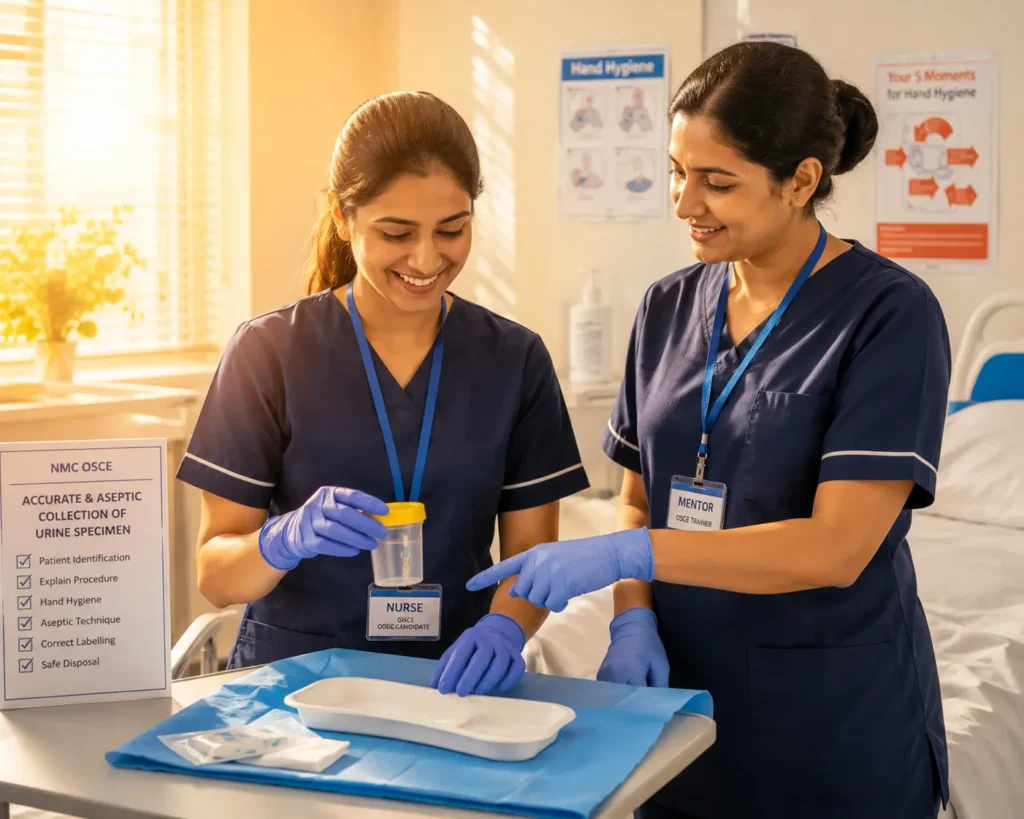
How to demonstrate aseptic awareness in the OSCE
Many candidates ask whether urine collection is a fully sterile procedure. A better way to think about it in the OSCE is this: you must maintain an aseptic approach to protect the specimen from contamination. That means:
- Performing hand hygiene at the correct times
- Using a sterile specimen container
- Avoiding contact with the inside of the container or lid
- Closing the sample immediately after collection
- Labelling and transporting it without delay
You do not need to overcomplicate the station by adding unnecessary sterile fields or dramatic actions. What matters is safe, clean, logical technique. In OSCE marking, calm and organised performance often scores better than rushing through the steps. If you speak clearly and explain your rationale where needed, you make it easy for the examiner to award marks.
Common mistakes candidates make
Understanding common errors can improve your score quickly. Some of the most frequent mistakes in accurate and aseptic collection of urine specimen during NMC OSCE include:
- Forgetting to gain consent before starting
- Failed to clamp catheter
- Not emphasising hand hygiene
- Touching the inside of the specimen container or lid
- Forget to unclamp
- Leaving the sample unlabelled or labelling it late
- Not mentioning prompt transport to the laboratory
- Ignoring privacy, dignity, or patient comfort
Another common issue is sounding mechanical. The OSCE is not only about memorising steps. You are being assessed as a safe, compassionate nurse. This means your voice, body language, and communication style also matter. Take a structured approach: introduction, explanation, consent, preparation, collection, labelling, disposal, documentation, and reassurance.

Exam tips to help you score higher
If you want to perform well in this station, practise the wording you will use with patients. Many candidates know the procedure in theory but become unsure when explaining it aloud. Rehearsing patient-friendly language can make a major difference.
It is also helpful to use a mental checklist:
- Safety and privacy
- Hand hygiene
- Introduction
- Explanation and consent
- Clamp the catheter
- Equipment check
- collect the sample
- Aseptic sample handling
- Immediate labelling
- Laboratory dispatch
- patient comfort
With Mentor Merlin’s OSCE study guides and tips, candidates can practise these steps repeatedly until they feel natural. Repetition is especially useful for internationally educated nurses who are adjusting to UK clinical language and OSCE marking expectations.
How Mentor Merlin helps you prepare for NMC OSCE skills stations
Preparing for the OSCE can feel overwhelming because each station tests both knowledge and performance. At Mentor Merlin, we support nurses with structured training designed for international candidates aiming for UK registration. Our NMC OSCE preparation programme focuses on clinical accuracy, communication, examiner expectations, and the confidence needed to perform under timed conditions.
For skills like urine specimen collection, we help learners break the station into manageable parts. You learn not only the sequence of actions, but also the language to use, the rationale behind the steps, and the common pitfalls that cost marks. This approach is especially valuable when preparing for stations that look simple but require strong professional judgement.
If you are also preparing for other parts of UK registration, Mentor Merlin offers support across the journey, including OET preparation, CBT guidance, and practical OSCE coaching. The goal is not just to pass the exam, but to help you enter NHS practice with confidence.

Conclusion
Mastering accurate and aseptic collection of urine specimen during NMC OSCE is about combining technical skill with safe professional practice. You need to communicate well, protect patient dignity, support correct sample collection, avoid contamination, label the specimen immediately, and ensure timely laboratory handling. These details matter because they reflect the standards expected of nurses entering UK practice.
If you want expert support as you prepare for the OSCE, Mentor Merlin can help you build both knowledge and confidence through structured coaching, practical guidance, and exam-focused training. Explore our NMC OSCE, OET, and CBT programmes to move one step closer to your NHS career.
Frequently asked questions
Why is a Catheter Specimen of Urine (CSU) collected?
A Catheter Specimen of Urine (CSU) is collected to:
Diagnose urinary tract infections (UTIs).
Monitor renal function.
Assess for electrolyte imbalances.
Detect the presence of blood or protein in urine.
It provides a sterile urine sample directly from the bladder, reducing contamination.
How to clamp the catheter?
To clamp the catheter: Identify the Clamping Point: Locate a few centimeters distal to the sampling port.
Use the Appropriate Clamp: If the catheter has a built-in clamp, use it. Otherwise, apply a non-traumatic clamp.
Do we have to wear gloves while clamping the catheter?
Yes, it is preferable to wear non-sterile gloves when clamping the catheter to maintain hygiene and prevent contamination.
Do I need to mention sending the sample to the lab?
Yes. You should state that the sample will be labelled immediately and sent to the laboratory as soon as possible. This shows understanding of specimen integrity and patient safety, both of which are important in OSCE marking.
How can I improve my confidence for this OSCE station?
Practise the full sequence aloud, including what you would say to the patient and examiner. Focus on structure, calm communication, and rationale. Training programmes like Mentor Merlin’s NMC OSCE coaching can help you refine your technique and avoid common mistakes.
Read our detailed blog – “NG Tube Insertion: Best Practice for NMC OSCE 2026” – to ensure your journey stays on track.
Why Wait? Just Merlin It!
Free Consultation – Chat now with a Mentor.