

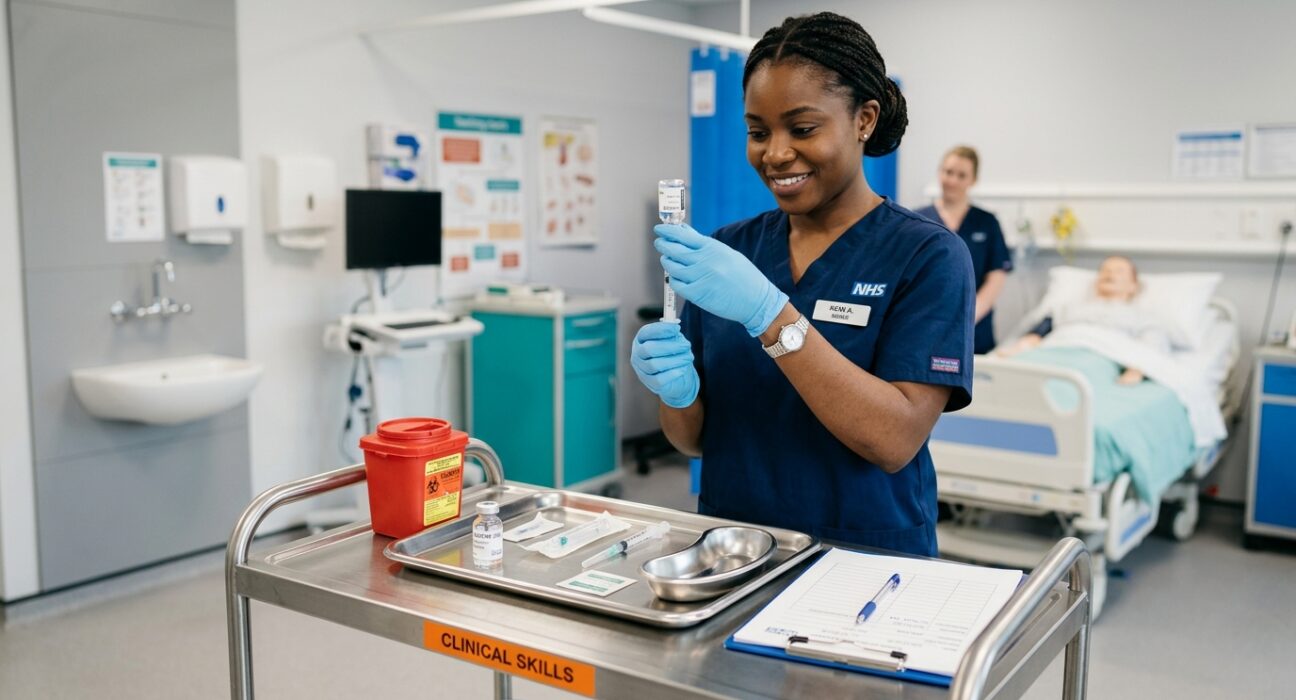
If you are preparing for the NMC OSCE, the intramuscular injection station can feel stressful because it tests more than just a technical procedure. Examiners want to see safe preparation, correct administration, clear communication, accurate documentation, and professional infection control throughout the station. That is why understanding NMC OSCE IM injection properly is essential if you want to perform with confidence on exam day.
Many international nurses already have experience giving injections, but the NMC OSCE assesses whether you can follow UK expectations in a structured, patient-centred way. Small mistakes such as missing allergy checks, poor verbalisation, incorrect dose, or forgetting post-procedure documentation can cost valuable marks. The good news is that with the right method and repeated practice, this is a station you can prepare for systematically.
In this complete guide, you will learn what the NMC OSCE IM injection station involves, how to prepare safely, how to administer the injection step by step, what examiners are looking for, common mistakes to avoid, and how Mentor Merlin programmes can help you build confidence before your test.
What is the NMC OSCE IM injection station?

The NMC OSCE IM injection station assesses your ability to prepare and administer an intramuscular injection safely in line with nursing standards expected in the UK. In most cases, the examiner is not only checking whether you know where to insert the needle. They are assessing your thorough approach to patient safety, aseptic technique, communication, consent, medicine checks, sharps disposal, and aftercare.
In this station, you will be asked to administer a prescribed medication by the intramuscular route using the information given in the scenario. You are expected to verify the prescription, identify the patient, check allergies, explain the procedure, select the correct equipment, prepare the medicine, choose and verbalise the correct site, administer the injection safely, and document the procedure correctly.
This means the station is as much about judgement and sequence as it is about technical skill. A calm, systematic performance usually scores better than a rushed performance that focuses only on the injection itself.
Why the IM injection station feels difficult for many candidates
The intramuscular injection station often feels difficult because it combines several safety steps into a short time frame. Candidates need to remember the medication checks, maintain aseptic non-touch technique, communicate clearly with the patient, select an appropriate injection site, verbalise rationale, and document correctly at the end. Under exam pressure, even capable nurses can forget one or two steps.
Another challenge is that many international nurses have performed IM injections in practice, but not always according to the exact wording, sequencing, and documentation style expected in the NMC OSCE. The NMC exam rewards a structured method. So, if your previous experience was more flexible or local policy differed, you may need to adapt your technique to match OSCE expectations.
This is why repeated mock practice matters. When your sequence becomes automatic, you can focus on demonstrating safety rather than trying to remember each step under pressure.
Before you begin: checks you must never miss
Preparation is a major part of safe intramuscular injection administration. Before touching any equipment, you should complete the foundational checks that show the examiner you understand medication safety.
- Perform hand hygiene.
- Introduce yourself to the patient and confirm identity and allergy using the appropriate identifiers.
- Check the prescription chart carefully.
- Confirm the right patient, right medicine, right dose, right route, right time, and right documentation.
- Explain the procedure in simple language and gain consent.
- Assess the patient’s comfort, privacy, and dignity needs.
- Check the medication expiry date and integrity of packaging.
These early checks are often where candidates lose marks. If you forget to ask about allergies or fail to explain the procedure before preparing the injection, the examiner may see this as a serious safety gap. It is far better to move slightly slower and demonstrate a safe sequence than to rush.
Equipment needed for NMC OSCE IM injection
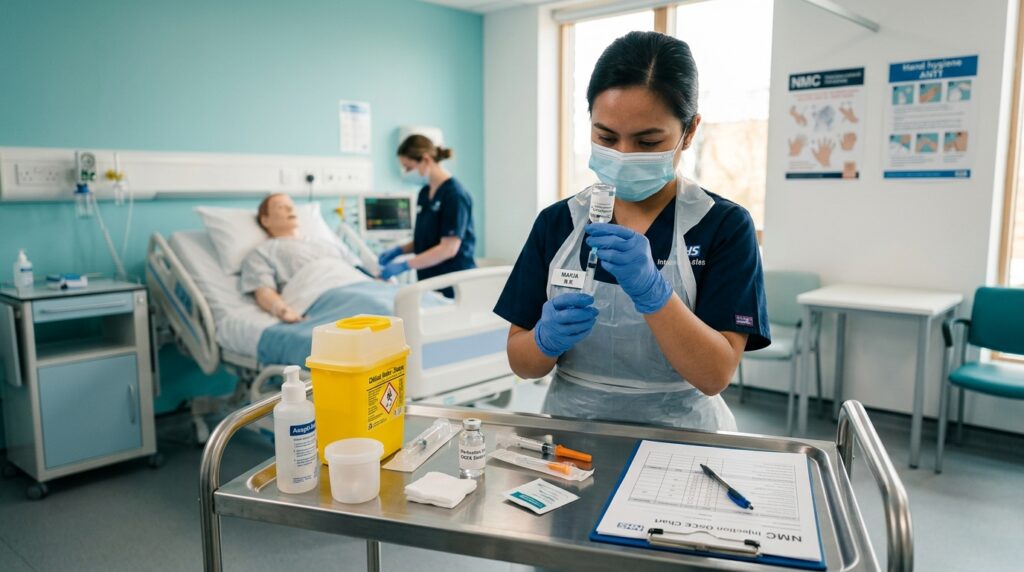
You should be familiar with the equipment commonly used in an intramuscular injection station. The exact setup may vary, but you will usually need the prescribed medication, syringe, drawing-up needle, administration needle of appropriate size, alcohol hand rub or access to handwashing, alcohol wipes, gauze or cotton wool, a sharps bin, and the medication administration record for documentation.
Verbalising equipment checks can help. For example, you may state that you are selecting the correct syringe and needle size based on the medicine and route. This shows that you are thinking beyond a memorised script.
Step-by-step preparation of the medication
A safe medication preparation sequence is essential in the NMC OSCE IM injection station. Begin by checking the prescription against the medication label carefully. If you are drawing up medication from an ampoule or vial, inspect it first and prepare it using aseptic non-touch technique. Avoid contaminating key parts such as the syringe tip, needle, vial top after cleaning, or the medication itself.
- Check the medication name, dose, route, and expiry date.
- Prepare the medication using ANTT principles.
- Draw up the exact prescribed dose.
- Discard loading needle immediately to the sharp bin
- Remove air bubbles carefully if required.
- Change to the administration needle.
Examiners may not expect just narration, but clear verbalisation of key safety actions helps them follow your reasoning. If something in the scenario is unclear, it is safer to verbalise how you would check it rather than make assumptions.
Choosing the correct IM injection site
Site selection is one of the most important parts of the station. You should know the commonly used intramuscular sites and be able to explain which one is suitable for the patient and medication. In UK practice, common IM sites include the deltoid muscle, the vastus lateralis, and the ventrogluteal site. Site choice depends on factors such as medication volume, patient age, muscle mass, mobility, and the purpose of the injection.
For OSCE purposes, you must verbalise you will ask patient preferred site after educating which sites can be use clearly. If you are using a mannequin or simulated patient, explain the landmarking process even if you cannot fully expose or position the site in the same way as real practice.
Deltoid site
The deltoid is often used for smaller-volume injections such as some vaccines. You should identify the acromion process and select the central thickest part of the muscle below it. However, because the deltoid has limited muscle mass and is close to important structures, it is not always the best choice for larger volumes.
Vastus lateralis site
The vastus lateralis is located on the lateral thigh and is a useful option in many scenarios. It is often considered a safe site because it has good muscle mass and fewer major nerves and vessels than some other areas. In the OSCE, clear verbalisation of the lateral middle third of the thigh can help demonstrate site knowledge.
Ventrogluteal site
The ventrogluteal site is widely regarded as a safe site for many intramuscular injections because it is away from the sciatic nerve and major blood vessels. Many OSCE trainers encourage candidates to know this site well. You should be able to explain the bony landmarks and why the site may be preferable in adult patients for certain medication volumes.
How to administer the IM injection step by step
Once the medication is prepared and the site has been selected, you are ready to administer the injection. The goal is to show a smooth, safe, and patient-centred technique.
- Reconfirm the patient and explain that you are about to give the injection.
- Expose the site appropriately while preserving dignity.
- Inspect the skin for redness, swelling, bruising, or injury.
- Clean the site if required by local policy and allow it to dry if used.
- Stretch the skin or use the appropriate technique for the selected site.
- Insert the needle at the correct angle, typically 90 degrees for an IM injection.
- Administer the medication steadily over 10 seconds and wait another 10 seconds.
- Withdraw the needle smoothly and apply gentle pressure with gauze if needed.
- Dispose of the needle immediately into the sharps bin.
Some policies and training models differ on points such as aspiration before injection. In the OSCE, the safest approach is to follow the training standard given by your preparation provider and the test centre guidance where applicable. Do not invent extra steps unless you are confident they align with current best practice and your training materials.
Communication during the procedure
Communication is not a separate part of the station. It should run through everything you do. Good communication helps the patient feel safe and also shows the examiner that you can practise in a compassionate, professional way.
Tell the patient what medicine you are giving in simple terms, what they may feel, and what to do if they feel pain, dizziness, or discomfort. Ask whether they are ready before insertion. During the injection, keep your language calm and brief. After the procedure, check how they are feeling and provide any immediate advice relevant to the scenario.
This matters because the OSCE is designed around patient-centred care. A technically correct injection with poor communication is not an excellent performance.
What to document after administering an IM injection
Documentation is part of completing the station safely. After administration, you should document the medication clearly on the chart or medication administration record. This usually includes the name of the medicine, dose, route, date, time, site if required, and your signature or initials according to the format used.
If there was any difficulty, refusal, reaction, or delay, this should also be documented and escalated according to policy. In the OSCE, verbalising that you would monitor the patient for any immediate adverse reaction can further support your clinical reasoning.
Common mistakes in the NMC OSCE IM injection station
Many candidates lose marks for avoidable errors rather than lack of basic knowledge. Common mistakes include:
- forgetting to check allergies
- not confirming the prescription properly
- poor aseptic technique during preparation
- choosing the wrong site for the medication volume
- weak patient communication or no consent
- unsafe sharps disposal
- forgetting documentation at the end
- rushing and missing the sequence of safety checks
These problems are usually preventable with structured rehearsal. If you practise the same safe sequence repeatedly, you are much less likely to skip a step in the exam.
What examiners are really looking for
Examiners are looking for safe, accountable nursing practice. They want to see that you can connect the prescription, the patient, the route, the technique, and the documentation into one clear process. Your performance should show:
- patient identification and consent
- safe medication checks
- infection prevention and ANTT awareness
- appropriate site selection and anatomy knowledge
- safe injection technique
- effective communication
- professional documentation and aftercare
In short, they are assessing whether you are ready to work safely in an NHS setting. The strongest candidates are not always the fastest. They are usually the ones who stay calm, organised, and safety-focused from beginning to end.

How to practise for the IM injection OSCE effectively
If you want to improve quickly, practise the station in layers. First, learn and understand the sequence. Next, practise medication checks aloud. Then practise site preference separately. After that, combine the steps into a full mock station with timing. Finally, rehearse documentation and verbal escalation points.
- Use a checklist during mock practice.
- Record yourself and review missed steps.
- Practise with a peer acting as patient and examiner.
- Repeat verbal explanations until they sound natural.
- Study UK standards for documentation and consent.
Mentor Merlin’s NMC OSCE preparation programmes help international nurses build this exact confidence through structured station training, feedback, and exam-focused coaching. If you are also working on related medication and clinical skills stations, you may find it useful to review broader guidance on NMC OSCE documentation skills and practical safety habits.
Why this skill matters beyond the exam
The IM injection station is not only an exam task. It reflects real nursing responsibilities in the UK. Safe medication administration protects patients from harm and supports trust in nursing care. The principles you demonstrate in the OSCE are the same principles expected in clinical practice: accuracy, accountability, communication, infection control, and clear records.
The NMC Code requires nurses to practise effectively, preserve safety, and keep clear records. Guidance from organisations such as the NHS also reinforces safe medication practice, patient identification, and prompt response to adverse reactions. So when you master this station, you are not only preparing to pass the OSCE. You are strengthening skills you will use in real UK nursing care.
Conclusion
Mastering NMC OSCE IM injection requires more than knowing how to hold a syringe. You need a complete approach that includes safe preparation, correct medication checks, appropriate site selection, confident administration, professional communication, and accurate documentation. When you practise the station in a structured way, your performance becomes calmer, clearer, and much safer.
If you want expert support, Mentor Merlin programmes are designed to help international nurses prepare for OSCE, OET, and CBT with practical strategies and guided feedback. With the right preparation, you can approach the IM injection station with confidence and give yourself a stronger chance of first-time success.
Frequently asked questions about NMC OSCE IM injection
1. What is the most important safety step in the NMC OSCE IM injection station?
The most important safety step is not just one action. It is the full sequence of patient identification, allergy check, prescription verification, consent, safe medication preparation, administration and documentation. Missing any of these can affect patient safety and your OSCE score.
2. Which site is best for an intramuscular injection in the OSCE?
The best site depends on the medication, volume, and patient factors. Common sites include the deltoid, vastus lateralis, and ventrogluteal area. In the OSCE, what matters most is choosing a suitable site and verbalising correctly.
3. Do I need to document the injection in the OSCE?
Yes. Documentation is part of safe completion of the station. You should record the medicine, date, time, and your signature or initials according to the chart format provided in the scenario.
4. Is wearing apron and gloves mandatory for intramuscular injection station?
No, it’s not mandatory to wear apron and gloves
5. How can I improve my confidence for the IM injection station?
Use repeated mock practice, site landmarking drills, verbal medication checks, and feedback from experienced trainers. Structured support from Mentor Merlin can help you turn the full sequence into a reliable exam habit.
Read our detailed blog – “NMC OSCE Blood Glucose Monitoring Documentation Guide” – to ensure your journey stays on track.
Why Wait? Just Merlin It!
Free Consultation – Chat now with a Mentor.