

Supporting documentation plays a significant role in the Nursing and Midwifery Council (NMC) Objective Structured Clinical Examination (OSCE). Many first-time candidates concentrate on clinical skills and communication while overlooking the importance of accurately completing or interpreting the supporting charts provided during the examination. However, incorrect documentation or misinterpretation of these charts can result in the loss of valuable marks.
During the NMC OSCE, examiners assess whether you can use supporting documentation correctly, recognise abnormal findings, escalate concerns appropriately, and provide safe patient-centred care.
This complete revision guide explains the five most commonly encountered supporting charts during Assessment station:
- National Early Warning Score (NEWS2)
- Glasgow Coma Scale (GCS)
- Six-Item Cognitive Impairment Test (6CIT)
- Malnutrition Universal Screening Tool (MUST)
- 2-Level Wells Score for Deep Vein Thrombosis (DVT)
Mastering these charts will improve both your confidence and your OSCE performance.
Why Supporting Charts Matter in the NMC OSCE
Supporting documentation is more than paperwork—it reflects your clinical judgement. Every chart helps nurses make evidence-based decisions while maintaining patient safety.
During the OSCE, examiners look for candidates who can:
- Interpret assessment findings correctly.
- Complete documentation clearly and legibly.
- Identify abnormal results.
- Escalate concerns using appropriate communication.
- Deliver safe, patient-centred care.
Even if you perform a skill perfectly, poor documentation or failure to recognise an abnormal score may affect your overall performance.
Remember these four key principles throughout your OSCE:
- Clear verbalisation
- Effective time management
- Accurate demonstration of skills
- Clear and legible documentation
Keeping these principles in mind will help you perform confidently in every station.
NEWS2 (National Early Warning Score)
What is NEWS2?
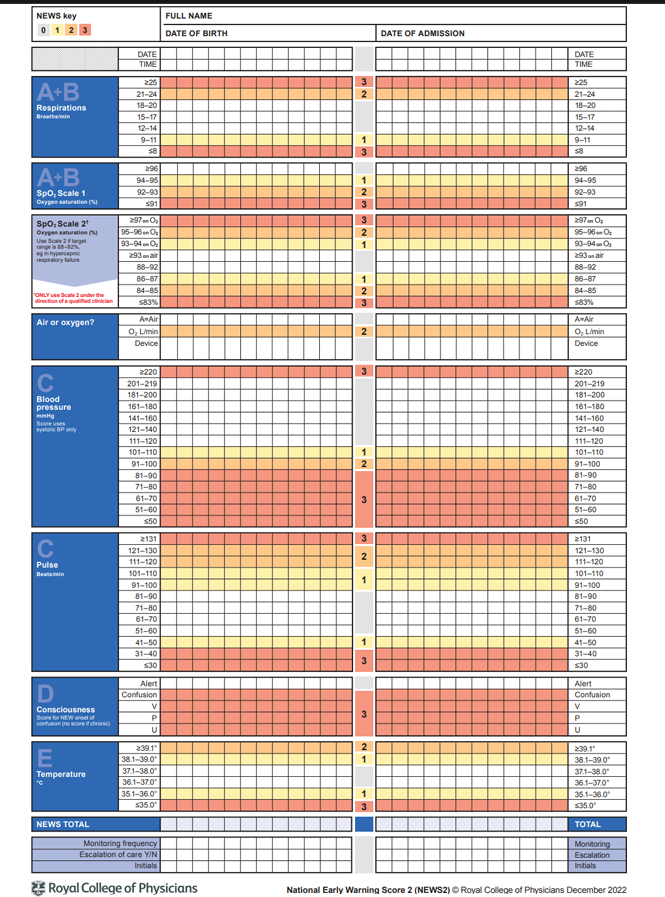
The National Early Warning Score (NEWS2) is a standardised clinical assessment tool used throughout the UK to identify patients who may be deteriorating.
Rather than relying on one abnormal observation, NEWS2 combines several physiological measurements into a total score that indicates the patient’s clinical risk.
The higher the score, the greater the likelihood that the patient requires urgent review or escalation.
During the NMC OSCE, NEWS2 may be used in assessment stations or documentation exercises where you are expected to record observations and determine the patient’s overall condition.
Parameters Included in NEWS2
Candidates should document the seven parameters:
- Respiratory rate
- Oxygen saturation
- Air/Oxygen
- Temperature
- Blood pressure
- Pulse rate
- Level of consciousness (ACVPU)
Each parameter receives an individual score based on the patient’s observations.
These individual scores are then added together to obtain the total NEWS2 score.
Examiner Expectations
During the OSCE, examiners expect candidates to:
- Record observations accurately.
- Document values in the correct boxes.
- Calculate the NEWS2 score correctly.
- Recognise abnormal findings.
- Escalate concerns appropriately.
- Continue monitoring when indicated.
Patient safety always takes priority over completing paperwork.
Documentation Tips
When documenting NEWS2:
- Write clearly and legibly.
- Record each observation in the correct section.
- Avoid overwriting or crossing out unnecessarily.
- Ensure calculations are accurate.
- Document the total NEWS2 score.
- Record your signature and the time if the chart requests it.
If the patient’s condition is concerning, verbalise that you would escalate according to the policy.
Common NEWS2 Mistakes
Many candidates lose marks because they:
- Forget to calculate the total score.
- Miss documenting oxygen saturation.
- Record observations in the wrong section.
- Forget to verbalise escalation.
- Leave documentation incomplete.
Remember: identifying deterioration is just as important as recording observations.
Glasgow Coma Scale (GCS)
What is the Glasgow Coma Scale?
The Glasgow Coma Scale is an internationally recognised neurological assessment tool used to measure a patient’s level of consciousness.
It is particularly useful in patients with:
- Head injury
- Stroke
- Reduced consciousness
- Neurological deterioration
- Brain injury
Within the NMC OSCE, candidates may be asked to assess, calculate, or document a patient’s GCS score.
Three Components of GCS
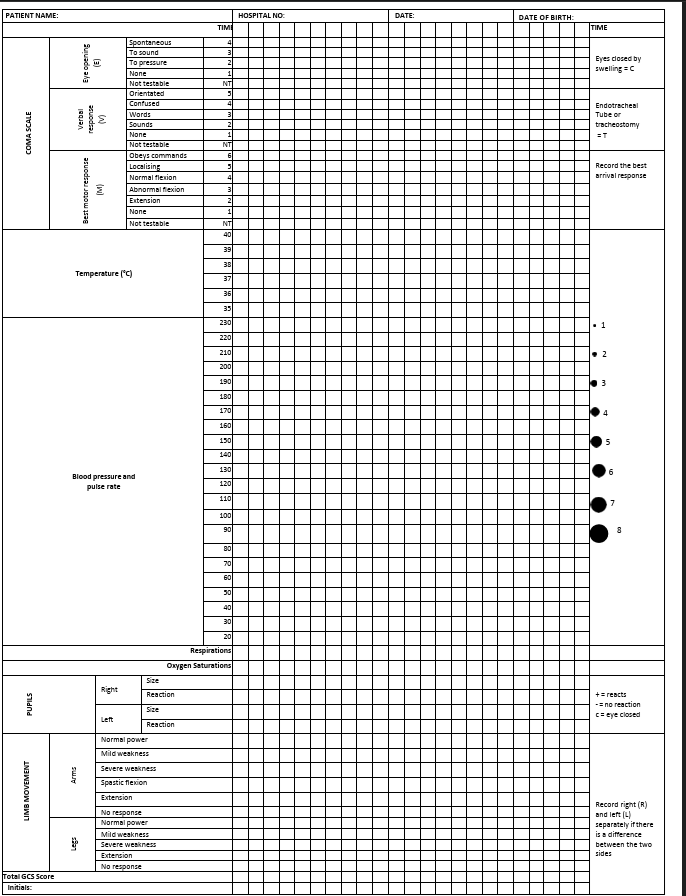
The assessment is divided into three sections:
1. Eye Opening (E)
Assesses whether the patient’s eyes open:
- Spontaneously
- To speech
- To pain
- No response
2. Verbal Response (V)
Assesses communication and orientation.
Patients may be:
- Fully orientated
- Confused
- Speaking inappropriate words
- Producing incomprehensible sounds
- Giving no verbal response
3. Motor Response (M)
Assesses movement following commands or painful stimuli.
Responses range from obeying commands to having no motor response.
Total GCS Score
The three components are added together to obtain the total Glasgow Coma Scale score.
A higher score indicates better neurological function, while a lower score suggests reduced consciousness and requires urgent assessment.
During the OSCE, always ensure each component is documented individually before recording the total score.
Examiner Expectations
Candidates should demonstrate that they can:
- Assess each GCS component systematically.
- Document Eye, Verbal, and Motor responses separately.
- Record the total score accurately.
- Recognise abnormal neurological findings.
- Record vitals on chart
- Escalate deterioration appropriately.
The examiner is assessing both your technique and your clinical judgement.
Common GCS Mistakes
Frequently observed errors include:
- Recording only the total score without documenting the individual components.
- Forgetting to assess motor response.
- Confusing verbal response categories.
- Failing to recognise neurological deterioration.
- Forgetting documentation after completing the assessment.
Accurate neurological assessment is a key component of safe nursing practice and is closely observed during the OSCE.
6CIT (Six-Item Cognitive Impairment Test)
What is the 6CIT?
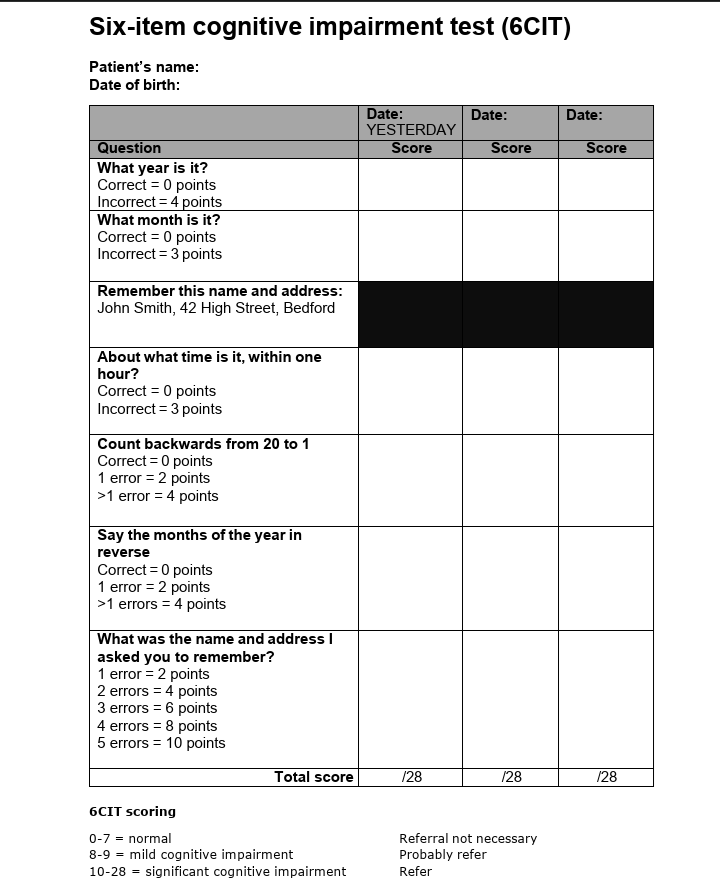
The Six-Item Cognitive Impairment Test (6CIT) is a brief, validated cognitive screening tool used to identify patients who may have cognitive impairment, confusion, or dementia. It is commonly used in hospitals, community settings, and care homes because it is quick to perform and easy to interpret.
In the NMC OSCE, the 6CIT chart may be included in assessment stations where the patient presents with confusion, memory problems, altered mental status, or suspected cognitive decline. Your role is to carry out the assessment professionally, document the patient’s responses accurately, and calculate the total score correctly.
Remember that the 6CIT is a screening tool, not a diagnostic test. A high score suggests that further assessment may be required but does not confirm a diagnosis of dementia.
Purpose of the 6CIT
The 6CIT helps healthcare professionals to:
- Screen for possible cognitive impairment.
- Assess orientation and short-term memory.
- Evaluate attention and concentration.
- Identify patients who require further assessment.
- Support clinical decision-making and multidisciplinary care.
During the OSCE, the examiner wants to see that you understand both the assessment process and the importance of documenting the results accurately.
In the OSCE, you are not expected to:
- Calculate the total score accurately.
- Acknowledge impairment.
- Escalate concerns if appropriate.
Always follow the scoring guide provided on the chart.
Documentation Tips
When completing the 6CIT chart:
- Calculate the score carefully.
- Write clearly and legibly.
- Record your name, signature, and date if required.
- Report any concerns according to local policy.
Good documentation reflects safe and accountable nursing practice.

MUST (Malnutrition Universal Screening Tool)
What is the MUST Chart?
The Malnutrition Universal Screening Tool (MUST) is a nationally recognised screening tool used to identify adults who are malnourished, at risk of malnutrition, or obese.
It is widely used throughout NHS hospitals, community services, and care homes.
Within the NMC OSCE, candidates may be required to complete or interpret the MUST chart using information such as:
- Height
- Weight
- Body Mass Index (BMI)
- Recent weight loss
- Acute illness
The purpose is to identify nutritional risk early so that appropriate interventions can be implemented.
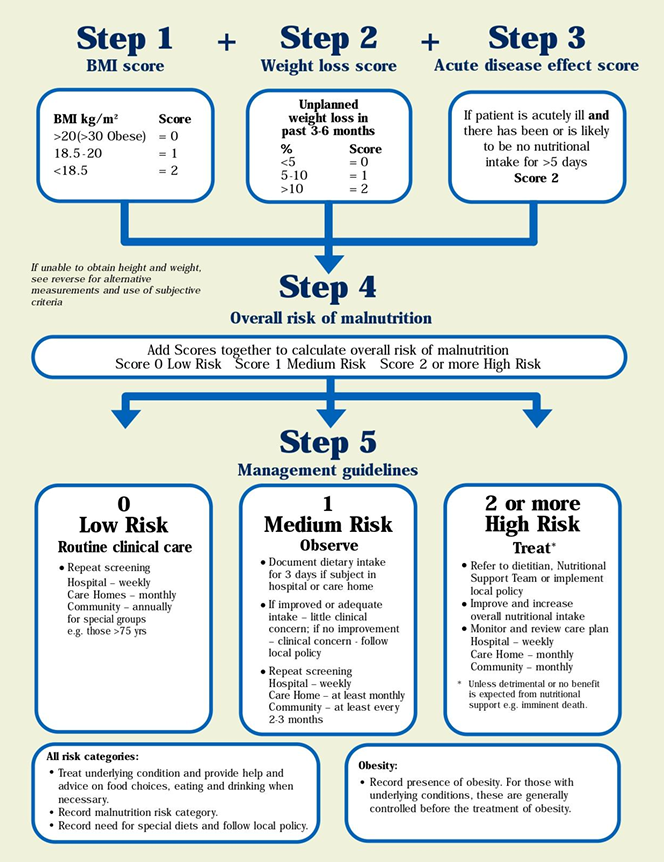
Five Steps of MUST
The MUST assessment follows five structured steps.
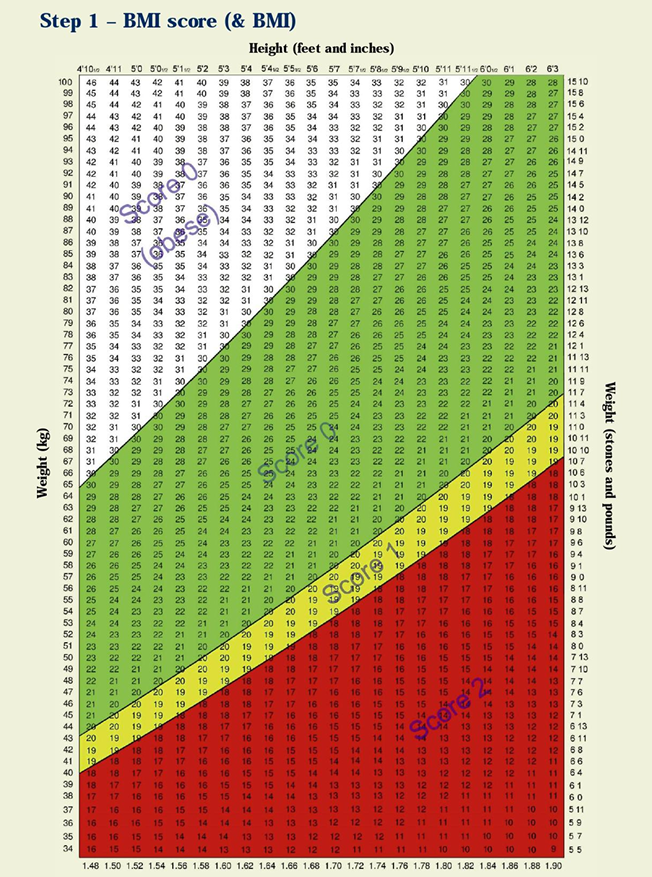
Step 1 – BMI Score
Calculate or identify the patient’s Body Mass Index.
Assign the appropriate BMI score according to the chart.
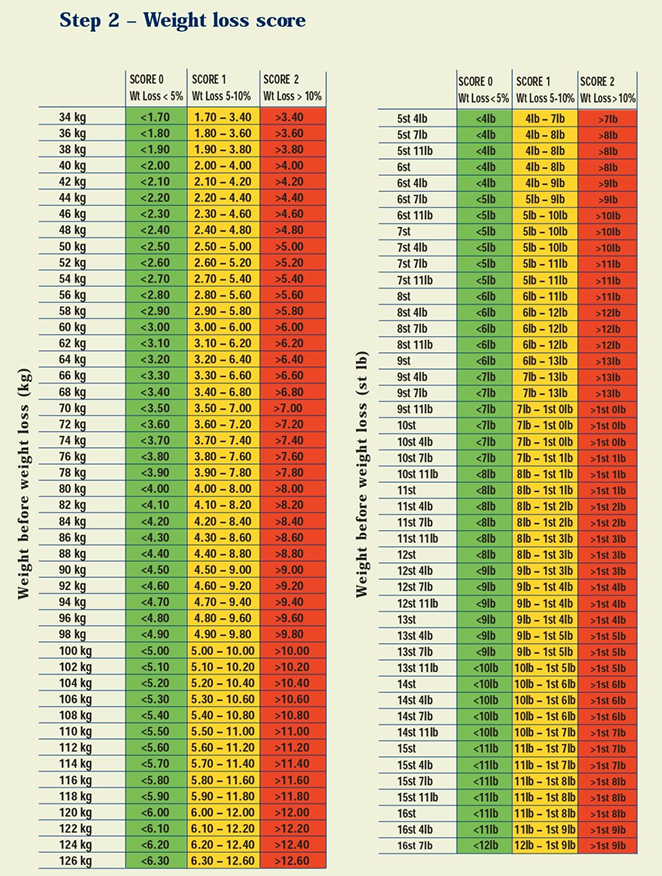
Step 2 – Weight Loss Score
Determine whether the patient has experienced unplanned weight loss over the past three to six months.
Assign the appropriate score.
Step 3 – Acute Disease Effect
Consider whether the patient is acutely unwell and has had, or is likely to have, no nutritional intake for more than five days.
If applicable, add the acute disease score.
Step 4 – Calculate Overall Risk
Add together:
- BMI score
- Weight loss score
- Acute disease score
This produces the overall MUST score.
Step 5 – Management Plan
Based on the total score, determine the patient’s nutritional risk category and follow the recommended management plan outlined on the chart.
Examiner Expectations
During the OSCE, examiners expect candidates to:
- Use the chart systematically.
- Calculate the score accurately.
- Interpret the nutritional risk correctly.
- Recommend appropriate follow-up actions.
- Document findings clearly.
You may also be expected to verbalise actions such as monitoring food intake, referring to a dietitian.
Documentation Tips
Good documentation should include:
- Correct height and weight.
- Accurate BMI or BMI score.
- Correct weight-loss calculation.
- Acute disease assessment.
- Final MUST score.
- Nutritional risk category.
- Signature and date if required.
Always complete every section of the chart before finishing the station.
Common MUST Mistakes
Frequent OSCE errors include:
- Forgetting to include the acute disease effect.
- Incorrect BMI calculation.
- Incorrect addition of scores.
- Failure to identify the patient’s nutritional risk category.
- Ignoring the management plan.
These errors are easily avoided by working through the chart one step at a time.
Practical OSCE Tips for MUST
- Read every section carefully before writing.
- Use the BMI table provided on the chart where applicable.
- Double-check all calculations.
- Work methodically from Step 1 to Step 5.
- Do not skip any section.
- Always verbalise the appropriate nutritional management plan.
- Remember that the MUST chart assesses nutritional risk, not just body weight.

2-Level Wells Score for Deep Vein Thrombosis (DVT)
What is the 2-Level Wells Score?
The 2-Level Wells Score is an evidence-based clinical assessment tool used to estimate the likelihood of Deep Vein Thrombosis (DVT). Rather than confirming a diagnosis, it helps clinicians determine whether DVT is likely or unlikely, guiding the next steps in patient management.
Following the recent NMC OSCE updates, candidates should be familiar with the 2-Level Wells Score chart, as it may be included in assessment or documentation stations involving a patient with suspected DVT.
Why is the Wells Score Important?
DVT is a potentially life-threatening condition because a blood clot in a deep vein can travel to the lungs, causing a pulmonary embolism (PE). Early recognition and timely escalation are therefore essential.
The Wells Score helps healthcare professionals:
- Assess the likelihood of DVT.
- Decide whether further investigations are required.
- Prioritise urgent medical review.
- Promote safe, evidence-based patient care.
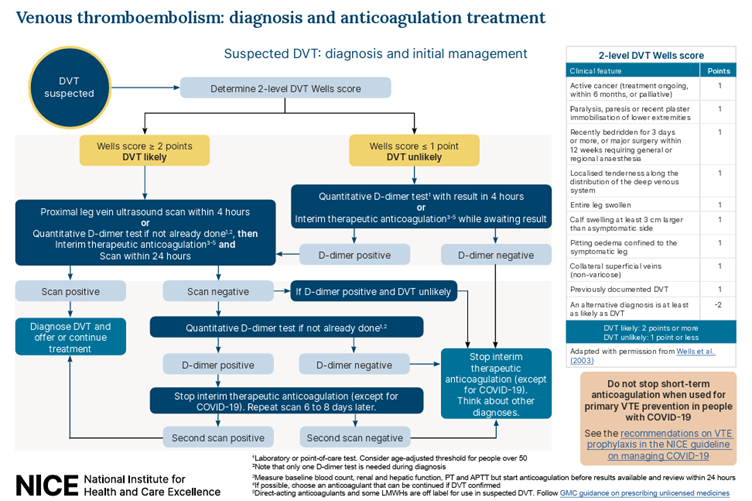
Interpreting the Total Score
After adding the scores, the patient is classified into one of two categories:
- DVT likely
- DVT unlikely
Examiner Expectations
During the OSCE, assessors expect candidates to:
- Record the total score clearly.
- Interpret whether DVT is likely or unlikely.
- Recognise when escalation is required.
- Communicate findings using safe clinical reasoning.
The examiner is assessing your ability to apply the chart appropriately, not simply your ability to complete arithmetic.
Documentation Tips
When completing the Wells Score chart:
- Calculate the total accurately.
- Write legibly.
- Sign and date the documentation if required.
- Verbalise any necessary escalation.
Avoid making assumptions that are not supported by the scenario.
Comparison of the Five Charts
Each chart has a different purpose, but all support safe clinical decision-making.
| Chart | Main Purpose | Candidate Focus |
| NEWS2 | Detect patient deterioration | Record observations, calculate score, escalate abnormal findings |
| GCS | Assess level of consciousness | Document Eye, Verbal, Motor responses and total score |
| 6CIT | Screen cognitive function | Calculate score, document accurately |
| MUST | Assess nutritional risk | Complete BMI, weight loss, acute disease assessment, management plan |
| 2-Level Wells Score | Assess likelihood of DVT | Complete criteria, calculate score, interpret findings, provide patient advice |
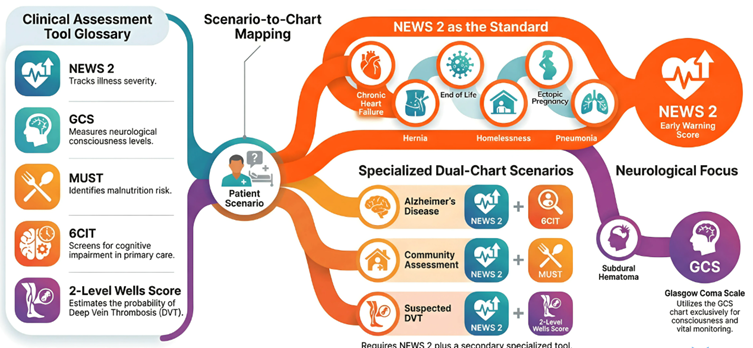
Understanding the purpose of each chart helps you select the correct approach during the examination.
Common Documentation Mistakes Across All Charts
Many first-time candidates lose marks because of avoidable errors.
Common mistakes include:
- Illegible handwriting.
- Incomplete documentation.
- Recording information in the wrong section.
- Missing signatures or dates.
- Incorrect calculations.
- Failure to verbalise escalation.
- Forgetting to communicate findings to the appropriate healthcare professional.
- Ignoring abnormal results.
- Rushing due to poor time management.
Developing a structured routine during practice can help prevent these mistakes.

Final OSCE Success Tips
Success in the NMC OSCE is not achieved by memorising charts alone. It comes from combining clinical knowledge with safe practice, effective communication, accurate documentation, and sound clinical judgement.
When approaching any supporting chart:
- Read the scenario carefully before writing.
- Work through the chart in a sequence.
- Double-check all calculations.
- Do not guess information that has not been provided.
- Verbalise your clinical reasoning where appropriate.
- Escalate abnormal findings promptly.
- Keep the patient’s safety at the centre of every decision.
The more you practise using authentic OSCE documentation, the more confident and efficient you will become on examination day.
Supporting charts such as NEWS2, GCS, 6CIT, MUST, and the 2-Level Wells Score are an essential part of nursing practice and feature prominently within the NMC OSCE. Although each chart serves a different purpose, they all share the same objective: helping nurses assess patients systematically, identify risks early, and deliver safe, evidence-based care.
For first-time OSCE candidates, Examiners are looking for a structured approach that combines effective communication, accurate documentation, sound clinical judgement, and timely escalation of concerns. By understanding the purpose of each chart, practising how to complete them correctly, and becoming familiar with common pitfalls, you can approach these stations with confidence.
As you continue your preparation, remember the four key principles that underpin every successful OSCE performance:
- Clear verbalisation
- Effective time management
- Accurate demonstration of skills
- Clear and legible documentation
Mastering these principles—along with regular practice using the supporting charts—will strengthen your performance and help you demonstrate the safe, professional standards expected of a registered nurse in the UK.
With consistent preparation and confidence in using these assessment tools, you will be well equipped to succeed in the NMC OSCE and take the next step towards your nursing career.
- Which chart do I get for subdural haematoma scenario
Ans. For subdural haematoma scenario, you will get GCS chart.
- Will I get an actor or mannequin for assessment station?
Ans. In OSCE assessment stations, you may encounter either a trained actor who simulates a real patient or a mannequin
- Which chart do I get for malnutrition scenario?
Ans. For Malnutrition scenario- you will get NEWS + MUST chart during OSCE
- Is NEWS chart monitoring frequency remaining same in hospital and community setting both?
Ans. Yes, Monitoring frequency depends on the NEWS score regardless of setting.
- What is the time duration to conduct assessment station
Ans. You will get 20minutes to perform assessment station during OSCE
Read our recent blog – “PQRST Pain Assessment Checklist for the NMC OSCE” – to ensure your journey stays on track.
Why Wait? Just Merlin It!
Free Consultation – Chat now with a Mentor.