


Shared decision-making in nursing is an essential part of safe, respectful, and person-centred care. In UK healthcare settings, nurses are expected to involve patients in choices about their treatment, daily care, and ongoing support whenever possible. This approach is not only good professional practice, but also closely linked to communication, consent, dignity, and the values of the Nursing and Midwifery Council (NMC). For nurses preparing for the NMC CBT, understanding shared decision-making in nursing can also help with scenario-based questions and professional judgement.
In simple terms, shared decision-making means the nurse and patient work together. The nurse brings clinical knowledge, safety awareness, and evidence-based guidance. The patient brings personal preferences, values, goals, beliefs, and lived experience. When these two perspectives come together, care becomes more individual, more realistic, and often more effective. This matters in hospitals, community care, care homes, mental health services, and outpatient settings across the NHS.
This guide explains what shared decision-making in nursing means, why it matters, practical examples from everyday care, common challenges, and how to approach related questions in the CBT. If you are working towards UK registration, Mentor Merlin’s CBT study guides and tips and broader preparation support can help you connect theory with real nursing practice.
What Is Shared Decision-Making in Nursing?
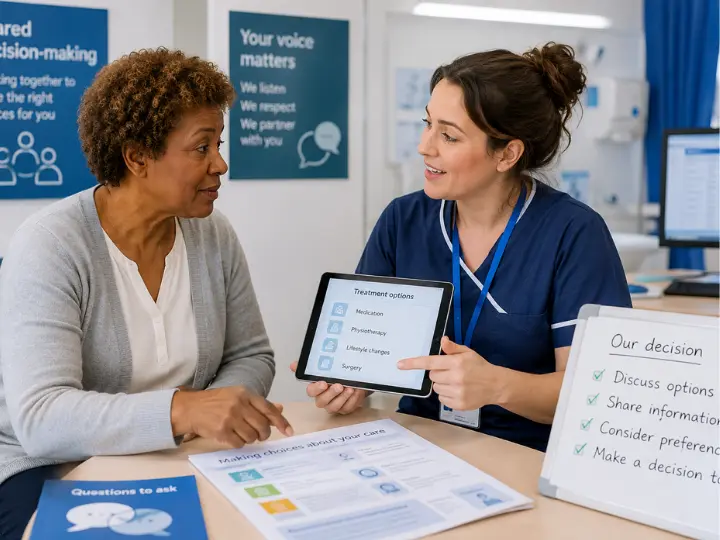
Shared decision-making in nursing is a collaborative process in which nurses support patients to understand their options and take part in decisions about care. It is based on partnership, respect, informed consent, and clear communication. Rather than telling a patient what will happen, the nurse explains choices, checks understanding, explores concerns, and helps the patient make an informed decision wherever they have capacity and it is clinically appropriate.
This does not mean the patient is left alone to decide complex medical issues without support. It also does not mean every request must be accepted without question. Instead, the nurse has a professional duty to give accurate information, identify risks and benefits, protect safety, and respect the patient’s right to be involved. In practice, that may include discussing treatment preferences, agreeing mobility goals, selecting education strategies, planning discharge, or adapting communication for a patient who is anxious, in pain, or unfamiliar with the UK healthcare system.
Shared decision-making connects strongly with the NMC Code, especially the principles of prioritising people, practising effectively, preserving safety, and promoting professionalism and trust. It also aligns with NHS values around patient involvement and personalised care. For international nurses, this concept is especially important because UK practice places strong emphasis on autonomy, consent, documentation, and partnership with patients and families.

Why Shared Decision-Making Matters in UK Nursing Practice
Shared decision-making matters because healthcare is not only about treating disease. It is also about understanding what matters to the person receiving care. Two patients with the same diagnosis may want very different things. One may prioritise independence at home. Another may focus on pain control. Another may value spiritual needs, family involvement, or returning to work quickly. Good nursing care recognises these differences instead of assuming that one plan fits everyone.
When nurses involve patients in decisions, several positive things happen. Patients often feel respected and heard. They are more likely to understand their treatment plan. They may become more engaged in self-care and follow agreed advice more consistently. Trust can improve because the relationship feels less one-sided. Communication errors may reduce because the nurse checks understanding rather than making assumptions. This is especially important in multicultural healthcare settings, where language differences, anxiety, unfamiliar systems, or previous healthcare experiences may affect the patient’s confidence to speak up.
It is also important to remember that patient involvement supports safety. For example, a patient may share that a medication schedule is unrealistic at home, that a cultural practice affects diet choices, or that a previous side effect makes them fearful of treatment. Without that information, the care plan may fail. With it, the nurse can escalate concerns, offer alternatives, or involve the wider multidisciplinary team. For CBT preparation, these are the types of practical judgement points that often separate a safe answer from an unsafe one.

Core Principles of Shared Decision-Making
To apply shared decision-making well, nurses should understand its core principles. First, the patient must receive clear and honest information. This includes the purpose of care, available options, likely benefits, possible risks, and what may happen if no action is taken. Second, communication should be adapted to the patient’s needs. Nurses may need simple language, an interpreter, visual aids, repetition, or extra time.
Third, the nurse should explore what matters to the patient. This may involve asking about goals, worries, routines, support systems, beliefs, and previous experiences. Fourth, the nurse should check understanding rather than assuming the patient has understood. Techniques like teach-back can be useful. Fifth, decisions should be documented properly, especially when consent, refusal, discharge planning, or risk discussions are involved.
Finally, shared decision-making must always operate within legal and professional boundaries. Capacity matters. Safeguarding matters. Escalation matters. A patient can be involved in decision-making, but the nurse must still act if there is significant risk, lack of capacity, immediate danger, or a concern that requires senior review. This balanced thinking is exactly what the CBT tests in many professional and ethical scenarios.
Examples of Shared Decision-Making in Nursing
1. Pain Management after Surgery
A postoperative patient reports pain but seems reluctant to take strong analgesia. Instead of simply insisting, the nurse explores the reason. The patient explains they are worried about nausea and drowsiness because they want to mobilise early. The nurse discusses pain relief options, explains the importance of managing pain for recovery, and considers antiemetic support or alternative timing. Together, they agree on a plan that balances comfort, mobility, and safety.
2. Diabetes Self-Management Education
A patient with newly diagnosed diabetes receives education about diet, glucose monitoring, and medication. Shared decision-making means the nurse does not give generic advice only. Instead, the nurse asks about the patient’s daily routine, food preferences, work pattern, finances, and confidence level. Education is then adapted to what is realistic and culturally relevant. This makes adherence more likely and respects the patient’s circumstances.
3. Discharge Planning for an Older Adult
An older patient is medically fit for discharge, but the nurse notices concern when home support is discussed. Rather than rushing the process, the nurse asks about the home environment, mobility, family support, and worries about coping. The patient shares fear of falling and difficulty managing stairs. This information supports a safer plan, such as referral to occupational therapy, community services, or a delayed discharge review. The patient becomes an active participant, not a passive recipient.
4. Wound Care and Dressing choices
A patient requiring regular dressing changes says one type of dressing causes discomfort and affects sleep. The nurse listens, assesses the wound, explains available dressing options within local policy, and liaises with the wider team if needed. The patient’s experience is part of the decision. This improves comfort and often supports better engagement with treatment.
5. Mental Health Nursing Conversations
In mental health settings, shared decision-making may include discussing coping strategies, medication concerns, therapy preferences, or relapse planning. A patient may say they want greater control over how and when support is offered during periods of distress. The nurse works with the patient to develop a care plan that respects autonomy while keeping clear safety measures in place.
6. Communication with Family members
Sometimes shared decision-making includes family or carers, but only in appropriate ways. For example, a patient may wish to involve a spouse in discharge teaching or medication understanding. The nurse should ask the patient’s permission, maintain confidentiality, and support inclusive discussion. This is often relevant in UK practice, where family support can influence home care success.
Benefits of Shared Decision-Making in Nursing
The benefits of shared decision-making in nursing are wide-ranging. One major benefit is better patient experience. Patients who feel listened to are more likely to report satisfaction with care. Even when outcomes are uncertain, respectful communication improves trust. Another benefit is improved understanding. When nurses explain options and confirm comprehension, patients are less likely to feel confused about medication, follow-up, or self-care instructions.
Shared decision-making can also improve adherence. Patients are more likely to follow a plan they helped create. This is especially relevant in long-term conditions, where daily behaviour matters just as much as clinic appointments. In addition, involving patients can reduce conflict. If a patient refuses an intervention, the nurse has a better chance of understanding why and addressing the concern safely.
From a professional perspective, shared decision-making supports accountability, communication, and documentation. It helps nurses justify care decisions more clearly because the rationale is transparent and person-centred. It also supports ethical practice by respecting autonomy and dignity. In multicultural environments, this approach can strengthen inclusion and reduce the risk of stereotyping or paternalistic care.
For healthcare systems, shared decision-making may also contribute to more realistic care planning, reduced avoidable readmissions, and better use of services. When patients understand what to expect and agree with the plan, transitions in care can become smoother. For this reason, shared decision-making is not just a communication skill. It is part of quality and safety.
Common Barriers and How Nurses Can Overcome Them
Although the idea sounds simple, shared decision-making is not always easy in real practice. Time pressure is a common barrier. Busy wards, staff shortages, and urgent workloads can make conversations feel rushed. However, even short interactions can be more person-centred if the nurse asks focused questions, listens carefully, and checks understanding before moving on.
Another barrier is language or health literacy. Some patients may not understand medical vocabulary, while others may agree politely without fully understanding. Nurses should use plain English, avoid jargon, and arrange interpreting support where needed. The NHS and local services often emphasise accessible communication as part of patient-centred care.
Some patients may prefer a more passive role, especially if they come from healthcare systems where professionals make most decisions. In such cases, the nurse should still offer involvement, but not force it. A respectful question such as “Would you like me to explain the options so we can decide together?” can help. Anxiety, pain, fatigue, or cognitive impairment may also affect participation, so timing matters.
Another challenge is when patient preferences appear to conflict with safe care. This is where professional judgement is essential. The nurse should listen carefully, explain risks honestly, explore alternatives, and escalate where needed. Shared decision-making does not remove the nurse’s duty to preserve safety. Instead, it strengthens safe practice by making concerns visible and discussable.

Shared Decision-Making and the NMC CBT
The NMC CBT may test shared decision-making directly or indirectly through questions on communication, consent, dignity, professionalism, safeguarding, or patient-centred care. You may not always see the exact phrase “shared decision-making,” but the principle is often present in the safest answer. Usually, the best option is the one that respects the patient, gives clear information, checks capacity and understanding, and escalates appropriately when risk exists.
For example, if a question asks what a nurse should do when a patient refuses treatment, the correct answer is rarely to ignore the patient or force the intervention. A safer approach may include assessing understanding, explaining consequences, documenting the discussion, and informing the appropriate senior clinician if required. Likewise, if a patient is anxious about a care plan, the nurse should communicate, clarify, and involve them rather than making assumptions.
If you are preparing for exam scenarios, it helps to revise themes such as consent, capacity, confidentiality, escalation, documentation, and communication with vulnerable adults. Mentor Merlin’s CBT exam overview resources can help you understand how these professional concepts appear in practice-based questions.
CBT Tips for Answering Questions on Shared Decision-Making
- Look for the most patient-centred safe answer. Good CBT answers usually respect the patient while also maintaining safety and policy.
- Check capacity and consent. If the patient has capacity, their choices matter. If there are concerns about capacity, follow proper assessment and escalation.
- Prioritise communication. Answers that include explaining, clarifying, listening, and confirming understanding are often stronger than answers based only on instruction.
- Avoid assumptions. Do not assume refusal means non-compliance, lack of knowledge, or difficult behaviour. Explore the reason first.
- Think documentation and escalation. When decisions involve risk, refusal, incidents, or changes in condition, accurate documentation and appropriate escalation are important.
- Use the NMC Code as your mental framework. Ask yourself which answer best prioritises people, practises effectively, preserves safety, and promotes trust.
- Read scenario wording carefully. Words like immediate danger, confusion, safeguarding concern, or lack of capacity change the safest response.
Practical Ways to Build This Skill in Real Life
If you want to strengthen your shared decision-making skills before the CBT or OSCE, start with everyday communication habits. Ask open questions such as “What matters most to you today?” or “How do you feel about this plan?” Summarise what the patient says. Offer options clearly. Check understanding by asking the patient to repeat key points in their own words. Notice non-verbal cues, especially when patients say “yes” but still look uncertain.
It is also useful to reflect after patient interactions. Did the patient really have a chance to participate? Did you explain the reason for the intervention? Did you adapt your language? Did you document the conversation properly? Reflection improves both exam readiness and real clinical confidence. If you are also preparing for practical assessments, Mentor Merlin’s OSCE study guides and tips can help you apply compassionate communication in structured clinical scenarios.
You can also review official UK guidance on patient involvement and professional standards. Reliable sources such as the GOV.UK Department of Health and Social Care and NMC standards reinforce the expectation that care should be safe, inclusive, and respectful.

Conclusion
Shared decision-making in nursing is more than a communication technique. It is a professional approach that respects patient autonomy, improves trust, supports safer care, and reflects UK nursing values. Whether you are discussing pain relief, discharge plans, self-management, or treatment concerns, involving the patient leads to better understanding and more realistic care decisions.
For nurses preparing for UK registration, this topic is especially important because it appears across CBT and OSCE thinking. If you want structured support with professional scenarios, communication, and exam strategy, explore Mentor Merlin’s CBT, OET, and OSCE preparation programmes. The stronger your understanding of person-centred care, the more confident you can become in both exams and real NHS practice.
FAQ: Shared Decision-Making in Nursing
Is shared Decision-Making the same as Informed Consent?
Not exactly. Informed consent is part of the process, but shared decision-making is broader. It includes discussion, listening, values, options, and joint planning. Consent focuses on permission, while shared decision-making focuses on partnership.
Why is shared Decision-Making important for the CBT?
It matters because many CBT questions test patient-centred communication, consent, safety, and professionalism. Understanding shared decision-making helps you choose answers that respect autonomy while following safe nursing practice.
What if a Patient Refuses treatment?
The nurse should not react with pressure or judgement. A safer response is to explore the reason, explain the risks and benefits, assess understanding and capacity, document the discussion, and escalate appropriately when needed.
Can family members take part in shared Decision-Making?
Yes, if the patient wants this and confidentiality is respected. Family involvement can support understanding and discharge planning, but the patient’s wishes remain central unless capacity or legal issues require a different approach.
How can International Nurses improve this skill?
Practice clear communication, use plain English, ask open questions, check understanding, and reflect on patient interactions. Studying the NMC Code and practising scenario-based questions can also improve confidence.
Read our detailed blog – “Avoid These Common Pitfalls After the UK NMC CBT in 2026” – to ensure your journey stays on track.
Why Wait? Just Merlin It!
Free Consultation – Chat now with a Mentor.