

If you are preparing for the NMC CBT, one topic that can easily confuse even good candidates is the difference between Alzheimer’s disease and dementia. Many nurses use the two words as if they mean the same thing, but in exam questions, that mistake can cost marks. Understanding Alzheimer’s vs dementia in NMC CBT is important because the test often checks whether you can recognise basic definitions, identify common symptoms, and apply safe, person-centred nursing care.
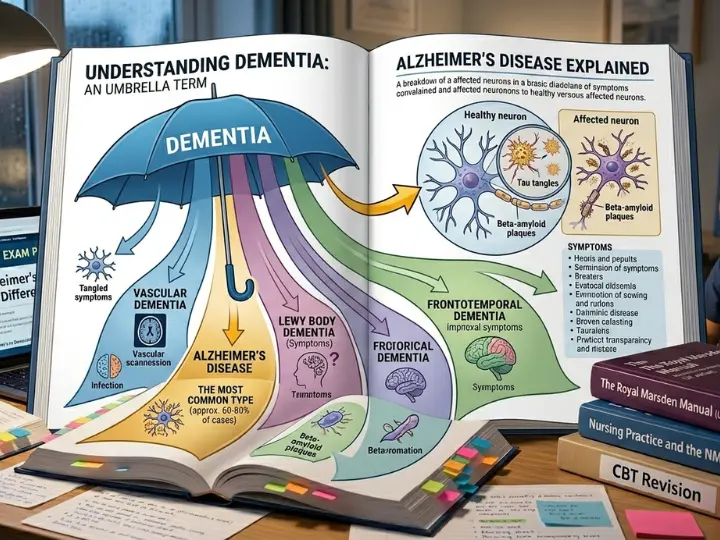
The simple rule is this: dementia is an umbrella term, while Alzheimer’s disease is one type of dementia. Once you understand that relationship, many CBT questions become easier. You will also be better prepared for real clinical practice in the UK, where nurses support people living with memory loss, confusion, communication difficulties, reduced independence, and changing behaviour.
Here, Mentor Merlin breaks down the topic into simple language for international nurses. You will learn the key definitions, common symptoms, nursing implications, common CBT traps, and quick memory aids to help you answer with confidence.

What is Dementia?
Dementia is not one single disease. It is a general term for a group of symptoms linked to a progressive decline in brain function. These symptoms may affect memory, thinking, reasoning, communication, judgement, behaviour, and the ability to carry out daily activities. In practice, a person with dementia may struggle to remember recent events, follow conversations, manage familiar tasks, or stay oriented to time and place.
For the NMC CBT, the important point is that dementia describes the overall syndrome. It can be caused by several different illnesses. This means that if a question asks whether dementia and Alzheimer’s disease are the same, the correct answer is no: dementia is the wider category, and Alzheimer’s disease sits inside that category.
From Mentor Merlin’s CBT learning material, dementia is associated with an ongoing decline in brain functioning and can affect memory, thinking skills, and other mental abilities. This core definition is exactly the kind of simple exam wording candidates should remember.
What is Alzheimer’s disease?
Alzheimer’s disease is a specific disease and the most common cause of dementia in the UK. It is progressive, which means symptoms usually develop slowly over time and then become more severe. Alzheimer’s commonly begins with mild memory problems, especially difficulty remembering recent conversations, recent events, or the names of people and places.
As the condition progresses, the person may develop increasing confusion, disorientation, speech and language problems, difficulty planning or making decisions, reduced ability to manage self-care, mood changes, and behavioural symptoms. In later stages, they may become highly dependent on others for support with personal care, nutrition, mobility, and communication.
So if you are comparing Alzheimer’s vs dementia in NMC CBT, remember this one-line answer: Alzheimer’s disease is a type of dementia. That exact logic appears in many exam-style multiple-choice questions.
Alzheimer’s vs Dementia in NMC CBT: The Simplest Difference
If you only remember one sentence before your exam, let it be this: Dementia is the overall condition, and Alzheimer’s is a type of dementia. This is the simplest and most accurate answer for basic CBT questions.
- Dementia = a syndrome or umbrella term
- Alzheimer’s disease = a specific disease and a common cause of dementia
- Not all dementia is Alzheimer’s
- But Alzheimer’s is dementia
This difference matters because exam questions may ask about definitions, symptoms, causes, communication, or nursing interventions. If you confuse the broader term with the specific diagnosis, you may choose the wrong option.
Common Symptoms Nurses should know
People living with dementia may show a wide range of symptoms. These often include memory loss, difficulty concentrating, problems carrying out familiar daily tasks, trouble finding words, confusion about time and place, mood changes, and changes in social behaviour. Some people may also experience hallucinations or behavioural distress, especially as the condition progresses.
In Alzheimer’s disease, the early sign is often minor memory loss, especially short-term memory problems. As it progresses, symptoms can include confusion, getting lost in familiar places, poor judgment, difficulty making decisions, language problems, personality changes, anxiety, low mood, hallucinations, and delusions. Later on, the person may need help with eating, washing, dressing, toileting, and mobility.
For CBT purposes, it helps to understand that Alzheimer’s disease often has a gradual, progressive pattern. Questions may present a person who first forgets recent events and later becomes more disoriented and dependent. That pattern should make you think of Alzheimer’s disease as a common cause of dementia.
Early signs often tested in CBT questions
- Forgetting recent conversations or events
- Repeating questions or statements
- Difficulty finding the right word
- Becoming confused about time or place
- Reduced ability to plan or decide
- Changes in mood or personality

Stages of Alzheimer’s disease
Although every patient is different, Alzheimer’s disease is often described in early, middle, and late stages. Knowing these stages can help you understand how care needs change over time.
Early stage
The person may forget recent events, repeat themselves, lose the thread of a conversation, take longer to learn new information, or show reduced judgment. At this stage, they may still manage many activities independently, but they need patience, support, and clear communication.
Middle stage
Symptoms become more obvious. The person may ask the same question repeatedly, fail to recognise familiar people, become upset or aggressive, need help with washing, dressing, eating, or toileting, and become lost or confused about time. Nurses may need to use structured routines and reassurance.
Late stage
At this stage, the person may lose speech, become frail, experience incontinence, lose weight, become bedbound or wheelchair dependent, and require full nursing care. Communication becomes more challenging, but person-centred care remains essential.

Why this Topic matters in Real Nursing practice
This is not only an exam topic. In UK care settings, nurses often support older adults with cognitive impairment. People living with dementia are more likely to be admitted to the hospital and can have poorer health outcomes if their care is not well planned. This is why nurses must understand both the condition and the care approach.
Nurses should communicate clearly, avoid rushing, use simple sentences, support orientation, involve family appropriately, maintain safety, and encourage independence wherever possible. A clutter-free environment, clear signage, a visible clock and calendar, and continuity of care can reduce confusion and support dignity.
These ideas connect directly to safe NHS practice and may also appear in CBT questions that test values, communication, safeguarding, consent, and person-centred care.
Alzheimer’s, Dementia, Delirium and Depression: Do not confuse them
Another reason this topic is important is that nurses must not confuse dementia with other conditions. Clinical materials used in training emphasise that delirium and depression can sometimes look similar to dementia, especially in older adults. However, they are not the same and may need different treatment.
Dementia is usually progressive and develops gradually. Delirium is often sudden in onset and may fluctuate throughout the day. Depression may affect concentration, mood, motivation, and memory, but the cause and management are different. In a CBT question, if symptoms appear suddenly or after infection, surgery, or medication changes, think carefully before choosing dementia.
Nursing care points that strengthen CBT answers
Even when the question is about definitions, understanding care principles helps you choose safer answers. Here are some high-value points nurses should know.
1. Use person-centred communication
People with dementia may have word-finding difficulties, slower processing, or trouble understanding complex language. Speak calmly, use short, clear sentences, allow time for response, and use non-verbal communication where helpful. Avoid excluding the person from conversations about their own care.
2. Involve family and carers appropriately
Family members may understand the patient’s usual communication style, triggers, routines, and preferences. Their input is valuable, but it should not replace direct communication with the patient.
3. Promote independence and dignity
Care plans should support the person’s independence in mobility, washing, dressing, eating, and toileting as far as possible. Do not assume total incapacity just because a person has dementia.
4. Assess capacity properly
Under the Mental Capacity Act, capacity is decision-specific. A person with dementia must not automatically be treated as lacking capacity. Nurses should begin with the presumption of capacity and assess only when needed.
5. Create a supportive environment
Good lighting, clear signage, reduced clutter, orientation cues, routine, and continuity can reduce distress and help patients function more safely.

Common NMC CBT mistakes on Alzheimer’s vs Dementia
- Choosing “they are the same condition”
- Forgetting that Alzheimer’s is the most common cause of dementia
- Assuming everyone with dementia lacks mental capacity
- Ignoring the need for person-centred communication
- Confusing gradual dementia symptoms with sudden delirium
- Focusing only on memory loss and missing behaviour, language, and functional decline
A useful exam technique is to ask yourself, ‘Is the question asking about the general syndrome or the specific disease?’ That quick check often prevents the most common error.
Quick memory tools for International Nurses
If English is not your first language, short memory tools can make revision easier.
- Dementia = definition umbrella
- Alzheimer’s = one answer under the umbrella
- Gradual decline = think dementia/Alzheimer’s
- Sudden confusion = think delirium until assessed
- Capacity is specific, not automatic
Another simple memory line is ‘All Alzheimer’s is dementia, but not all dementia is Alzheimer’s.’ This sentence is one of the best fast-recall tools for CBT.
How to answer Alzheimer’s vs Dementia questions in the CBT
When you see a multiple-choice question on this topic, try this approach:
- Read the stem carefully and identify whether it asks for a definition, symptom, or care action.
- Look for words like general term, type of, most common cause, or progressive.
- Rule out answers that treat Alzheimer’s and dementia as identical.
- Choose the safest nursing option if the question is about communication or care.
- Remember person-centred principles and legal safeguards such as capacity assessment.
If you want more structured support for CBT revision, Mentor Merlin’s NMC CBT preparation resources can help you turn complex topics into clear, exam-friendly learning. Candidates preparing for the next stage of registration can also explore Mentor Merlin’s NMC OSCE preparation support and broader OET guidance for nurses.
Why Mentor Merlin teaches this topic simply
International nurses often already understand patient care well, but exam success also depends on recognising how questions are framed. Topics like Alzheimer’s and dementia can feel difficult because the words are used loosely in everyday conversation. Mentor Merlin simplifies them into the exact level of understanding you need for NMC CBT success: clear definitions, likely distractors, safe care choices, and memory-friendly revision points.
That same approach supports your journey beyond the CBT. Strong theoretical understanding also improves communication, documentation, safeguarding decisions, and person-centred care in NHS settings.
Conclusion: Learn the difference and gain easy marks
When reviewing Alzheimer’s vs dementia in NMC CBT, keep the core idea simple. Dementia is the broad term for progressive decline in cognitive functioning, while Alzheimer’s disease is a specific condition and the most common cause of dementia. Once you understand that relationship, many exam questions become clearer.
Just as importantly, this knowledge helps you deliver safer, more respectful care. Nurses who understand cognitive conditions can communicate better, support independence, assess capacity more fairly, and reduce distress for patients and families.
If you want guided support for your UK registration journey, Mentor Merlin can help you prepare with confidence through our NMC CBT, NMC OSCE, and OET preparation programmes. Study smart, stay calm, and build the knowledge that supports both exam success and excellent nursing care.
Frequently Asked Questions
Is Alzheimer’s disease the same as dementia?
No. Dementia is a general term for symptoms that affect memory, thinking, behaviour, and daily functioning. Alzheimer’s disease is one specific type of dementia and the most common cause of dementia.
What is the easiest way to remember Alzheimer’s vs dementia in NMC CBT?
Use this sentence: Dementia is the umbrella term, and Alzheimer’s is one type under the umbrella. This helps you answer definition-based CBT questions quickly and accurately.
What are the early symptoms of Alzheimer’s disease?
Early symptoms often include forgetting recent events, repeating questions, difficulty finding words, confusion, and reduced ability to plan or make decisions. Symptoms usually become worse gradually over time.
Can a person with dementia still have mental capacity?
Yes. Capacity is decision-specific. A diagnosis of dementia does not automatically mean the person lacks capacity. Nurses must begin with the presumption of capacity and assess only when needed.
Why does this topic matter for UK nursing practice?
It matters because nurses in the UK regularly care for people with dementia. Understanding definitions, communication needs, safety, consent, and person-centred support helps both in the CBT and in real NHS practice.
Read our detailed blog – “Avoid These Common Pitfalls After the UK NMC CBT in 2026” – to ensure your journey stays on track.
Why Wait? Just Merlin It!
Free Consultation – Chat now with a Mentor.