

If you are preparing for the NMC CBT, one of the most important topics you must understand is the NMC Code for CBT. Many candidates focus heavily on clinical facts, calculations, and procedures, but the CBT also tests your professional judgement. That is where the NMC Code becomes essential. It is not just a document to memorise. It is the professional foundation that guides safe, effective, and compassionate nursing practice in the UK.
For international nurses, the NMC Code can feel broad at first. The language is professional, and some statements may seem similar to each other. However, when you break it down into its four pillars, it becomes much easier to understand and apply in exam questions. These four pillars are: prioritise people, practise effectively, preserve safety, and promote professionalism and trust.
In this guide, we will explain each pillar in a simple way, connect it to what the CBT expects, and explore exam-style scenarios that help you think like a safe nurse working in the NHS. By the end, you should feel more confident answering professional practice questions and linking your decisions back to the standards expected by the Nursing and Midwifery Council.
What is the NMC Code and why does it matter in the CBT?
The NMC Code is the set of professional standards for nurses, midwives, and nursing associates in the UK. It tells registrants how they are expected to behave, communicate, make decisions, and protect the people in their care. In real clinical practice, the Code supports ethical and safe nursing. In the CBT, it helps shape many of the questions related to professional values, patient-centred care, accountability, confidentiality, escalation, communication, documentation, and safeguarding.
The CBT is not only asking, “Do you know the right clinical action?” It is also asking, “Do you understand what a professional nurse should do in this situation?” This is why candidates who study the NMC Code for CBT often perform better in questions about delegation, consent, dignity, patient safety, raising concerns, and team communication.
A useful way to revise is to connect every scenario to one of the four pillars. Ask yourself: Is this question mainly about putting the patient first? Is it about communication and teamwork? Is it about reducing harm? Or is it about acting professionally and maintaining trust? This habit can help you choose the safest and most professional answer.
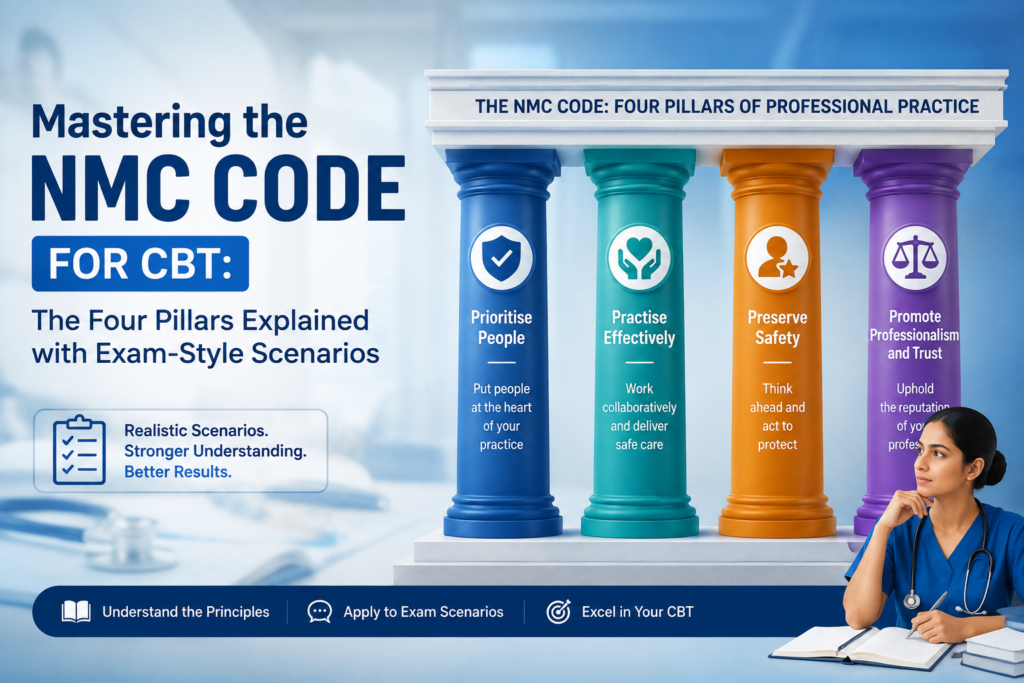
The four pillars of the NMC Code at a glance
- Prioritise people – Put the interests of people using healthcare services first.
- Practise effectively – Communicate clearly, work cooperatively, and keep your knowledge and skills up to date.
- Preserve safety – Recognise risk, act without delay if there is danger, and work within your competence.
- Promote professionalism and trust – Uphold the reputation of the profession through honest, respectful, and accountable behaviour.
Now let us explore each pillar in more detail, with practical explanations and exam-style scenarios.
1. Prioritise people
The first pillar of the NMC Code reminds nurses that people must always come first. This includes respecting dignity, listening to concerns, involving patients in decisions, meeting physical and emotional needs, and recognising that every person has the right to safe and compassionate care. In the CBT, this pillar often appears in questions about consent, privacy, equality, cultural sensitivity, person-centred care, and advocacy.
To prioritise people means more than being kind. It means making decisions that genuinely protect the patient’s wellbeing. For example, if a patient is in pain, frightened, or confused, the nurse should respond promptly and respectfully. If a patient’s wishes are ignored, or if their dignity is compromised, that is not consistent with the Code.
In CBT questions, the best answer is often the one that shows respect for the patient as an individual. This may involve gaining valid consent before a procedure, protecting confidentiality during conversations, or making reasonable adjustments when communication is difficult.
Exam-style scenario: privacy and dignity
A nurse is preparing to assist a patient with personal hygiene on a busy ward. The curtains are partly open, and another staff member begins discussing the patient’s condition loudly near the bed. What should the nurse do first?
- A. Continue with care because the ward is busy.
- B. Ask the staff member to stop the discussion and ensure the patient’s privacy is protected.
- C. Tell the patient that privacy cannot be guaranteed on a ward.
- D. Wait until the next shift to provide hygiene care.
Best answer: B. This reflects the duty to protect dignity, privacy, and confidentiality. The nurse should create a respectful environment before giving care. A common CBT mistake is choosing an answer that seems efficient but does not fully protect the patient’s rights.
Exam-style scenario: consent and patient choice
A patient refuses a routine dressing change and says they want to wait until a family member arrives. The wound is not bleeding heavily, and there is no immediate emergency. What is the most appropriate nursing action?
- A. Perform the dressing change anyway because it is clinically necessary.
- B. Document the refusal, explore the patient’s concerns, and respect their choice while monitoring the situation.
- C. Ask another nurse to persuade the patient firmly.
- D. Record the patient as non-compliant and leave.
Best answer: B. Prioritising people includes respecting autonomy. The nurse should communicate, assess for risk, provide information, and document clearly. Unless there is an immediate threat to life or serious harm, forced care would not be appropriate.
When revising this pillar, remember these question triggers: dignity, respect, compassion, consent, communication needs, cultural awareness, vulnerable patients, and advocacy. If a CBT question asks what matters most to the patient, this pillar is usually central.
2. Practise effectively
The second pillar focuses on communication, teamwork, record keeping, evidence-based care, and maintaining competence. Nurses are expected to share information clearly, collaborate with colleagues, keep accurate documentation, and always aim to improve the quality of care they provide.
For the CBT, this pillar is very important because many questions test whether you can work safely in a team. You may need to identify the best handover practice, understand when to escalate to a senior colleague, or choose the most accurate way to document an event. The exam may also test delegation. Nurses can delegate tasks, but they remain accountable for making sure the delegation is appropriate and safe.
Practising effectively also means recognising the value of clear, kind, and timely communication. Poor communication can lead to medication errors, duplication of work, misunderstanding, and unsafe care. In the NHS, structured communication tools such as SBAR are commonly used to support safe handover and escalation.
Exam-style scenario: documentation
A nurse notices that a patient developed a red rash shortly after receiving a new antibiotic. The doctor is informed, and the medication is stopped. What is the best documentation practice?
- A. Write a short note at the end of the shift if time allows.
- B. Record the rash, timing, action taken, who was informed, and the patient’s response as soon as possible.
- C. Only document if the rash becomes worse.
- D. Ask the next shift to record it because they will continue observation.
Best answer: B. Accurate and timely documentation is a core part of effective practice. The record should be factual, clear, and complete. The CBT often rewards answers that show immediate, accountable communication rather than delayed or incomplete notes.
Exam-style scenario: delegation
A registered nurse is caring for several patients. One healthcare assistant offers to take a set of observations for a stable patient. What should the nurse consider before delegating?
- A. Whether the healthcare assistant is available, competent, and clear about when to report concerns.
- B. Whether the nurse feels too busy to do the task personally.
- C. Whether the patient prefers only doctors to take observations.
- D. Whether the task can be delegated without any further supervision.
Best answer: A. Delegation under the NMC Code requires the nurse to consider the other person’s competence and the complexity of the task. The nurse remains responsible for overall care and must ensure the task is appropriate.
To master this pillar, review scenarios involving handover, notes, escalation, teamwork, interpreter use, patient education, and referral pathways. Good CBT answers often include accurate communication, clear records, and collaborative working.

3. Preserve safety
The third pillar is often the easiest to recognise in the exam because it is directly linked to risk, errors, deterioration, infection prevention, medicines management, and safeguarding. To preserve safety means taking action quickly when there is danger, staying within your competence, raising concerns immediately, and reducing the chance of harm.
This pillar is especially important for international nurses because the CBT expects you to think in a proactive and accountable way. If something is unsafe, you should not ignore it. If a patient is deteriorating, you should not delay escalation. If you are unsure how to perform a task safely, you should seek support instead of pretending to know.
Preserving safety also includes being open and honest when mistakes happen. In UK practice, nurses are expected to report incidents appropriately and learn from them. The exam may present a situation where an error has occurred and ask what the nurse should do next. The correct answer usually includes immediate patient safety, escalation, documentation, and honest reporting.
Exam-style scenario: patient deterioration
A post-operative patient becomes increasingly breathless and confused. Their oxygen saturation has dropped, and their respiratory rate is rising. What is the nurse’s priority action?
- A. Reassure the patient and repeat observations later.
- B. Escalate immediately according to local protocol and begin appropriate immediate nursing actions.
- C. Wait for the next medication round before taking action.
- D. Ask a family member whether the patient is usually anxious.
Best answer: B. Preserving safety means recognising deterioration and acting without delay. The nurse should use early warning systems and follow local escalation policy. In the CBT, delayed action is rarely the safest answer when signs of deterioration are clear.
Exam-style scenario: medicine error
A nurse realises that they have given a medication one hour earlier than prescribed. The patient is currently stable. What should the nurse do?
- A. Say nothing because no harm has happened.
- B. Monitor the patient, report the error promptly, document it accurately, and follow local policy.
- C. Change the documentation so it matches the time given.
- D. Ask a colleague to keep the mistake private.
Best answer: B. This answer protects the patient and reflects professional accountability. The wrong answers involve concealment, which goes against both safety and trust.
Exam-style scenario: working within competence
A newly appointed nurse is asked to perform a specialised procedure they have never done before without supervision. What is the best response?
- A. Perform the procedure to show confidence.
- B. Refuse rudely and walk away.
- C. Explain honestly that supervision or guidance is needed and seek support from an appropriate colleague.
- D. Watch a quick online video and then attempt it alone.
Best answer: C. Safe nursing includes recognising your limits. The CBT often tests whether you understand that asking for help is a sign of professionalism, not weakness.
When studying this pillar, pay close attention to words such as risk, concern, incident, unsafe, deterioration, safeguarding, allergy, infection, falls, and error. These usually signal a preserve safety question.

4. Promote professionalism and trust
The fourth pillar focuses on how nurses represent the profession through their behaviour. This includes honesty, integrity, respect, confidentiality, accountability, and maintaining professional boundaries. Patients and the public must be able to trust nurses, and that trust depends on consistent professional conduct.
In the CBT, this pillar may appear in questions about social media, confidentiality breaches, discrimination, duty of candour, attendance, appropriate behaviour with colleagues, and responding honestly after an incident. You may also see questions about upholding public confidence in the profession.
Professionalism is not only about serious misconduct. It also includes everyday habits such as being respectful in conversation, protecting patient information, following policy, and speaking up if something is wrong. In exam questions, the best answer usually reflects honesty, accountability, and clear boundaries.
Exam-style scenario: confidentiality
A nurse sees a friend’s relative admitted to the ward and looks at the patient’s record out of curiosity, even though they are not involved in the patient’s care. Which statement is most accurate?
- A. This is acceptable because the nurse works in the hospital.
- B. This is acceptable if the nurse does not tell anyone.
- C. This is a breach of confidentiality and professional trust.
- D. This is allowed if the patient is well known in the community.
Best answer: C. Accessing records without a legitimate professional reason is inappropriate and undermines trust. The NMC Code is clear that confidentiality must be respected at all times.
Exam-style scenario: social media and professionalism
A nurse wants to post online about a difficult shift and includes details that could indirectly identify a patient or colleague. What is the most appropriate action?
- A. Post it if no names are included.
- B. Share it only in a private group.
- C. Do not post identifiable clinical details and maintain professional boundaries online.
- D. Post it later after the shift ends.
Best answer: C. Professional standards apply online as well as offline. Even indirect identifiers can damage confidentiality and trust.
To revise this pillar well, practise questions involving honesty, public confidence, confidentiality, records access, respectful conduct, and openness after an incident. If an answer seems secretive or misleading, it is unlikely to align with the Code.

How to answer CBT questions using the four pillars
Understanding the NMC Code for CBT is not about memorising long paragraphs. It is about developing a reliable thinking process. When you face a scenario question, use these steps:
- Identify the main issue. Is the question about dignity, communication, safety, or professionalism?
- Look for the patient-centred answer. The best option usually protects the patient’s rights, safety, and wellbeing.
- Choose action over delay. If there is a clear risk, prompt escalation is usually expected.
- Value honesty and documentation. Accurate records and truthful reporting matter.
- Stay within competence. Safe nurses ask for help when needed.
Sometimes two answer options may both sound reasonable. In these cases, ask which answer reflects the Code more completely. For example, reassuring a patient may be kind, but if the patient is deteriorating, escalation is more important. Documentation is essential, but immediate action comes first when safety is at risk.
Another helpful revision method is to summarise each pillar in one sentence:
- Prioritise people: Put the patient first.
- Practise effectively: Communicate clearly and work well with others.
- Preserve safety: Notice risk and act quickly.
- Promote professionalism and trust: Be honest, respectful, and accountable.
If you can apply these four short ideas in practice questions, you are already strengthening your CBT performance.
Common mistakes candidates make when studying the NMC Code
One common mistake is treating the Code as theory only. In reality, the CBT expects you to apply it. Another mistake is choosing answers that are efficient but not patient-centred. A third mistake is forgetting that communication and documentation are part of safe care, not separate from it.
Some candidates also assume that asking for help shows weakness. In UK nursing practice, recognising your limits is a professional strength. Finally, many candidates underestimate how often confidentiality and professional boundaries appear in exam scenarios.
The best way to avoid these mistakes is to revise with scenario-based questions and always ask, “Which option most closely reflects the NMC Code?” This approach is far more effective than memorising definitions alone.
How Mentor Merlin can help you prepare
At Mentor Merlin, we support international nurses with structured preparation for UK registration exams, including the CBT Preparation Programme, OET Preparation, and OSCE Preparation Programme. If you are finding professional practice questions difficult, guided learning can make a major difference. Many candidates know the clinical content but need help applying UK standards, exam logic, and safe decision-making.
Targeted support can help you understand how the NMC Code is tested, how to approach scenario questions, and how to avoid common traps in multiple-choice exams. With the right strategy, you can revise more confidently and build the judgement expected of a nurse entering UK practice.
For more support, you can explore Mentor Merlin’s guidance on CBT preparation, professional standards, and the wider UK nurse registration journey.
FAQ’s about the NMC Code for CBT
1. Do I need to memorise the full NMC Code for the CBT?
You do not need to memorise every line word for word, but you should understand the meaning of the four pillars and know how to apply them to common exam scenarios. Application is more important than memorisation alone.
2. What kinds of CBT questions are linked to the NMC Code?
Questions on consent, confidentiality, documentation, delegation, safeguarding, patient dignity, communication, escalation, and professional boundaries are often connected to the NMC Code. These are common areas where professional judgement is tested.
3. Which pillar appears most often in the CBT?
All four pillars matter, but preserve safety and prioritise people often appear strongly in scenario-based questions. However, practise effectively and promote professionalism and trust are also essential for choosing the best answer.
4. How can I improve my answers to professional practice questions?
Practise with realistic scenarios, review why each answer is right or wrong, and link the best option back to one of the four pillars. This helps you build the decision-making style expected in UK nursing practice.
5. Where can I read the official NMC Code?
You can read the official Code on the Nursing and Midwifery Council website. It is helpful to study the original source alongside practice questions so that you understand both the wording and the real-life application.
Reference Link – Know More.
Read our detailed blog – “What Is Postpartum Depression? A Nurse’s Primer for the NMC CBT” – to ensure your journey stays on track.
Why Wait? Just Merlin It!
Free Consultation – Chat now with a Mentor.