
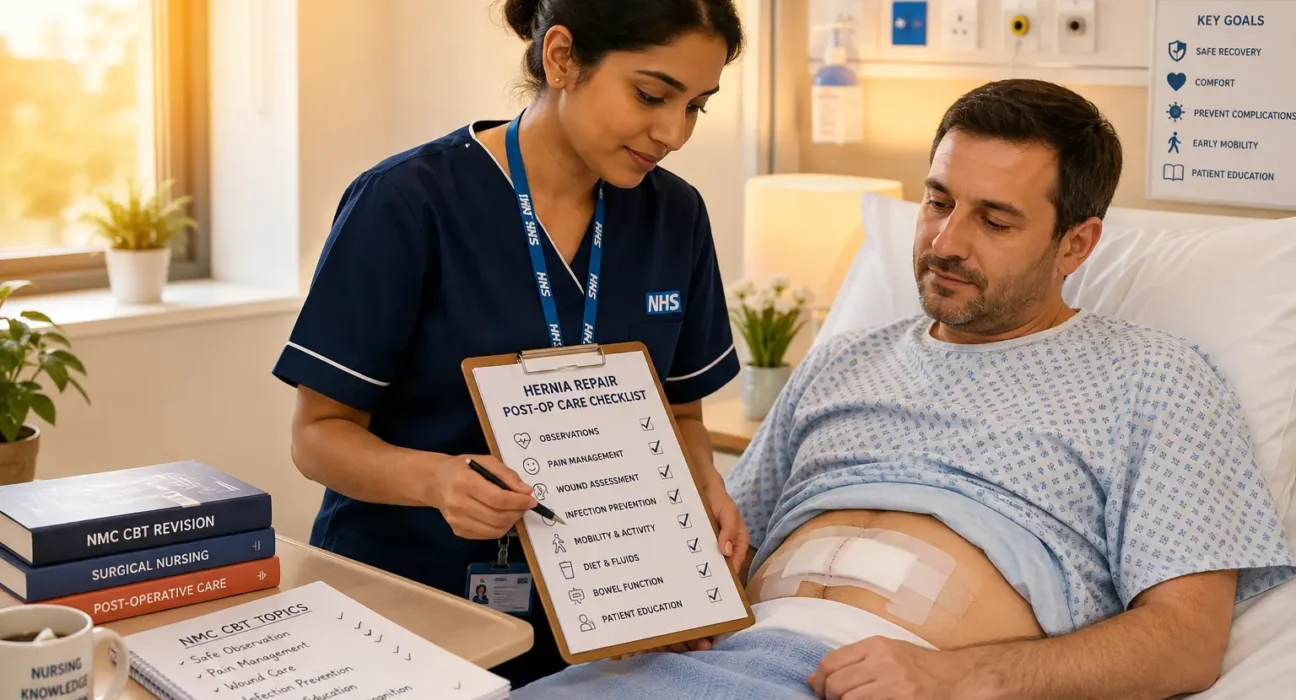
If you are preparing for the UK nursing exam, understanding a hernia repair post-op care checklist for NMC CBT revision can help you answer surgical nursing questions with more confidence. Post-operative care is a high-value topic because the CBT often tests safe observation, pain management, wound care, infection prevention, patient education, and early recognition of complications.
For international nurses, this topic is especially important because it links theoretical knowledge to real clinical priorities used in UK practice. After hernia surgery, nurses must monitor recovery closely, support comfort, promote mobility, and teach patients how to recover safely at home. In this guide, we break the topic into a practical, exam-friendly format you can revise quickly and remember clearly. We also connect the checklist to wider NMC CBT revision strategies so you know what examiners expect from safe, patient-centred nursing care.
Why Hernia Repair Post-Op Care Matters in NMC CBT Revision
Hernia repair is a common surgical procedure, so it makes sense that post-operative nursing care around this condition appears in revision resources and CBT-style questions. The exam may not always ask directly for a “hernia repair checklist”, but it often assesses your understanding of safe care after surgery. This includes monitoring vital signs, assessing pain, checking the wound, preventing infection, encouraging breathing exercises, and identifying red flags that require urgent escalation.
From Mentor Merlin’s, post-operative care planning emphasises regular observations, pain assessment, documentation, patient teaching, and review of condition changes. Those principles fit closely with hernia repair recovery. In clinical practice, a patient who has just returned from theatre needs structured nursing support during the first few hours and continued education before discharge.
For CBT revision, it helps to think in a simple order: observe, assess, manage, prevent, educate, and document. If you remember that sequence, you can answer many surgical nursing questions more accurately.
What Is a Hernia Repair?
A hernia happens when an internal organ or tissue pushes through a weak area in muscle or surrounding tissue. Hernia repair surgery corrects this weakness, often using sutures and sometimes mesh. Common types include inguinal, femoral, umbilical, and incisional hernias. Some repairs are performed as day surgery, while others require a longer stay depending on the patient’s condition and the type of procedure.
From a CBT perspective, you do not need to become a surgical specialist. What matters is knowing the main priorities after surgery. The patient may experience pain, reduced mobility, drowsiness from anaesthesia, nausea, and risk of complications such as wound infection, bleeding, urinary retention, constipation, chest complications, or recurrence if advice is not followed.
This is why a structured hernia repair post-op care checklist for NMC CBT revision is so useful. It organises what you need to recall under exam pressure.

Hernia Repair Post-Op Care Checklist for NMC CBT
Below is a practical checklist you can use for revision. In real practice, local policy and the patient’s condition will guide care, but these are the core nursing priorities commonly expected in CBT-style scenarios.
1. Confirm safe handover and immediate recovery status
When the patient arrives from theatre or recovery, receive a clear handover. Confirm the patient’s identity, type of surgery, allergies, observations, pain level, wound status, fluids, medications given, and any specific concerns. This first step helps you continue care safely and recognise what needs close monitoring.
In CBT questions, this links to patient safety, communication, and accountability. Never assume information; confirm it.
2. Monitor vital signs and overall condition
Post-operative patients need regular observations. Mentor Merlin’s revision material highlights frequent monitoring in the immediate post-op period, then ongoing review according to NEWS2 or local policy. Check temperature, pulse, respirations, blood pressure, oxygen saturation, and level of consciousness. Also observe skin colour, comfort, and any signs of deterioration.
For hernia repair, stable observations suggest recovery is progressing well. Abnormal findings such as tachycardia, hypotension, low oxygen saturation, fever, or increasing drowsiness need urgent assessment and escalation.
3. Assess pain and manage it effectively
Pain is one of the most expected nursing concerns after hernia surgery. Use an appropriate pain scale, ask about location and severity, and assess whether the pain is improving or worsening. From Mentor Merlin’s care plan format, pain management includes assessment, prescribed analgesia, review of effectiveness, comfortable positioning, and patient reassurance.
Do not just give pain relief and move on. Reassess the patient after analgesia to see if it worked. Severe or increasing pain may indicate complications and should not be ignored. In a CBT scenario, a safe nurse always evaluates the response to treatment.
4. Check the wound dressing and monitor for bleeding
Observe the surgical site dressing for bleeding, swelling, discharge, or signs that the wound is not intact. Keep the dressing clean and dry unless there is a clinical reason or prescription to change it. Be alert for excessive bleeding, rapidly increasing swelling, or offensive discharge, as these findings need escalation.
For revision, remember that wound assessment is not only about infection. It also includes bleeding, inflammation, and healing progress. Documentation of the wound appearance is an important part of safe post-operative nursing care.

5. Prevent infection with aseptic care and hygiene support
Any surgical wound carries a risk of infection. Maintain hand hygiene, use aseptic technique when indicated, and keep the wound area clean. Monitor for redness, warmth, swelling, pus, fever, or increasing pain. Mentor Merlin also reinforces the importance of dressing care, observation for infection, and accurate record-keeping.
In CBT questions, infection prevention may also include teaching the patient not to touch the wound unnecessarily, to keep follow-up appointments, and to report concerns early after discharge.
6. Support breathing and reduce chest complications
After surgery, especially if the patient is in pain, breathing may become shallow. This can increase the risk of atelectasis and chest infection. Encourage deep breathing exercises, coughing if appropriate, early movement, and good pain control so the patient can breathe effectively. Monitor respiratory rate and oxygen saturation, and escalate concerns if breathing becomes difficult.
This is a key link between general surgical nursing and hernia repair care. Even if the procedure seems minor, respiratory complications can still happen, especially in older adults or patients with existing health conditions.
7. Encourage safe mobility and prevent venous thromboembolism
Early mobilisation is important after hernia repair because it supports circulation, reduces the risk of deep vein thrombosis, improves lung expansion, and helps bowel function return. Assist the patient according to their condition and local guidance. Check for dizziness before standing, especially after anaesthesia or analgesia.
You may also need to ensure anti-embolism stockings are used correctly or that prescribed thromboprophylaxis is given. In CBT revision, think about both safety and rationale: mobility is not just about walking; it is about preventing post-op complications.
8. Monitor urine output and bladder function
Some patients experience urinary retention after surgery, especially after anaesthesia, pain, or certain medications. Ask whether the patient has passed urine, observe for discomfort, and report concerns promptly. A full bladder, lower abdominal discomfort, or inability to void may require further assessment.
For CBT purposes, urinary elimination is a common post-op concern that can easily be forgotten. Including it in your revision checklist helps you think holistically.
9. Assess bowel function, nausea, and constipation risk
After hernia repair, bowel function may be temporarily reduced. Ask about nausea, vomiting, abdominal distension, passage of flatus, and bowel movements. Encourage fluids if appropriate, promote mobility, and administer prescribed antiemetics or laxatives when needed.
Constipation is especially relevant because straining can increase discomfort and place pressure on the surgical site. In many exam questions, prevention is as important as treatment. Teaching patients how to avoid constipation is part of good discharge planning.
10. Review nutrition and hydration
Ensure the patient can tolerate oral intake as prescribed. Monitor nausea, vomiting, fluid balance, and appetite. Adequate hydration supports circulation, bowel function, and healing. Some patients may start with small sips and progress gradually depending on the type of surgery and local instructions.
For revision, connect hydration to wider recovery goals. A dehydrated patient may feel weaker, heal more slowly, and become more vulnerable to complications.
11. Teach the patient how to protect the wound during movement
Patient education is essential after hernia repair. Show the patient how to move carefully, how to support the area when coughing if advised, and how to avoid sudden strain. Reinforcing education after surgery is supported, as it notes that patients may forget pre-operative information because surgery is stressful.
Good teaching improves independence and reduces risk. For CBT scenarios, this shows person-centred care and discharge readiness.
12. Provide discharge advice and red flag education
Before discharge, the patient should understand wound care, pain relief instructions, activity restrictions, return-to-work advice if relevant, and warning signs that require urgent medical review. Red flags may include fever, increasing wound redness, swelling, severe pain, vomiting, inability to pass urine, bleeding, or signs of infection.
This is one of the strongest areas for CBT revision because discharge teaching reflects safe nursing practice. The nurse should confirm understanding, not simply give information quickly.
13. Document all assessments, interventions, and responses
Accurate documentation is a professional duty. Record observations, pain scores, wound condition, medications administered, mobility progress, patient education, and any escalation to the medical team. Mentor Merlin’s resources repeatedly highlight documentation as a core nursing responsibility and an important exam principle.
In CBT questions, the safest answer usually includes monitoring, action, reassessment, and documentation. Do not leave documentation out of your thinking.

Common Complications to Remember for CBT Questions
When revising post-operative care for hernia repair, it is helpful to group complications into simple categories. This improves recall in multiple-choice questions.
- Pain-related complications: uncontrolled pain, limited movement, shallow breathing
- Wound complications: bleeding, haematoma, infection, delayed healing
- Respiratory complications: low oxygen saturation, atelectasis, chest infection
- Circulatory complications: DVT risk due to immobility
- Elimination problems: urinary retention, constipation
- General concerns: nausea, vomiting, dehydration, poor understanding of discharge advice
In some cases, patients may also develop recurrence later if recovery advice is not followed. Although this is not always an immediate post-op issue, patient teaching still matters.
How to Answer a Hernia Repair Nursing Question in the NMC CBT
If you see a surgical scenario in the CBT, use a structured approach. First, identify the priority problem. Second, choose the safest immediate nursing action. Third, consider monitoring and escalation. Fourth, think about comfort, prevention, and education.
For example, if a patient has increasing pain and a rising pulse after hernia repair, the best answer is not simply “reassure the patient.” A safer response would include assessment, observations, review of the wound, pain management, and escalation if indicated. The CBT rewards safe judgement, not guesswork.
A useful memory line is: Assess first, act safely, review response, and document clearly. This approach fits many post-operative questions.
Revision Tips to Remember the Hernia Repair Post-Op Care Checklist
Many international nurses find surgical topics difficult because there are many steps to remember. A simple memory framework can make revision easier. Try grouping the checklist into the following headings:
- A: Airway, breathing, observations
- P: Pain and positioning
- W: Wound and warning signs
- M: Mobility and monitoring elimination
- E: Education and escalation
- D: Documentation
You can also create short case scenarios for yourself. Ask: What would I do if the patient has pain? What would I do if the dressing is soaked? What would I teach before discharge? This active revision style builds confidence faster than passive reading.
If you are studying with Mentor Merlin’s NMC CBT preparation support, focus on linking theory to practice. That is how exam questions are often designed.
How Mentor Merlin Can Help with NMC CBT Preparation
Preparing for the CBT is not only about memorising facts. You also need to understand how safe nursing decisions are made in UK practice. Mentor Merlin supports international nurses through structured NMC CBT preparation programmes designed to make revision more practical, targeted, and confidence-building.
When you revise topics such as hernia repair post-operative care, you should practise recognising priorities, matching symptoms to nursing actions, and understanding what needs escalation. This kind of guided revision can make a major difference to exam performance.
If you are also planning your full UK registration journey, Mentor Merlin can help with OSCE, OET, and CBT preparation so you can move forward with a clear study plan.

Conclusion
A strong hernia repair post-op care checklist for NMC CBT revision should cover immediate observations, pain management, wound care, infection prevention, breathing support, mobility, elimination, discharge teaching, and documentation. These are not just exam points. They are core nursing responsibilities that protect patient safety and support recovery.
If you are preparing for the CBT, revise this topic in a structured way and focus on the reason behind each action. Safe nursing care is always about assessment, prevention, early recognition, and clear communication. If you want guided support, Mentor Merlin’s CBT, OET, and OSCE preparation programmes can help you build confidence for UK registration and NHS practice.
Frequently Asked Questions
What should a nurse monitor first after hernia repair?
A nurse should first monitor vital signs, level of consciousness, pain, oxygenation, and the surgical wound. Immediate post-operative observations help identify early complications such as bleeding, respiratory problems, or deterioration after anaesthesia.
Why is pain assessment important after hernia surgery?
Pain assessment is important because uncontrolled pain affects breathing, mobility, comfort, and recovery. It can also be a sign of complications. Nurses should assess pain regularly, give prescribed analgesia, and reassess its effectiveness.
What discharge advice is important after hernia repair?
Patients should understand wound care, pain relief use, activity limits, signs of infection, hydration, constipation prevention, and when to seek urgent help. Clear discharge education supports safer recovery at home and reduces avoidable complications.
Can hernia repair post-op care appear in the NMC CBT?
Yes. The NMC CBT may include general surgical nursing questions that test post-operative observations, infection prevention, patient safety, escalation, and discharge teaching. Hernia repair is a useful example for revising these core principles.
How can I remember post-operative care points for the CBT?
Use a simple framework such as observations, pain, wound, mobility, elimination, education, and documentation. Practising short clinical scenarios also helps you remember how to apply knowledge in real nursing situations.
Reference Here.
Read our detailed blog –“Shared Decision-Making in Nursing: Benefits and CBT Tips” – to ensure your journey stays on track.
Why Wait? Just Merlin It!
Free Consultation – Chat now with a Mentor.