


For many international healthcare professionals, NMC dual pin registration 2026 is an important topic because it can open more than one professional pathway in the UK. If you are already registered with the Nursing and Midwifery Council (NMC), or you plan to become registered soon, you may be wondering whether you can hold more than one registration, how the process works, and what it means for your long-term career in the NHS or wider UK healthcare sector.
In simple terms, the NMC does allow some professionals to hold more than one registration. This is commonly called dual registration or dual pin registration. It is most often used for people who are registered both as a nurse and as a midwife, although the NMC also recognises situations involving multiple nursing fields and even triple registration in some cases. The exact route depends on whether your additional qualification was gained in the UK or outside the UK.
This guide explains what dual pin registration means in 2026, who may be eligible, what the NMC says about subsequent registration, fees, Test of Competence requirements, and what to think about before starting. We will also show how Mentor Merlin can support international nurses through the wider UK registration journey, especially for CBT, OET and NMC OSCE preparation.
What is NMC Dual Pin Registration?
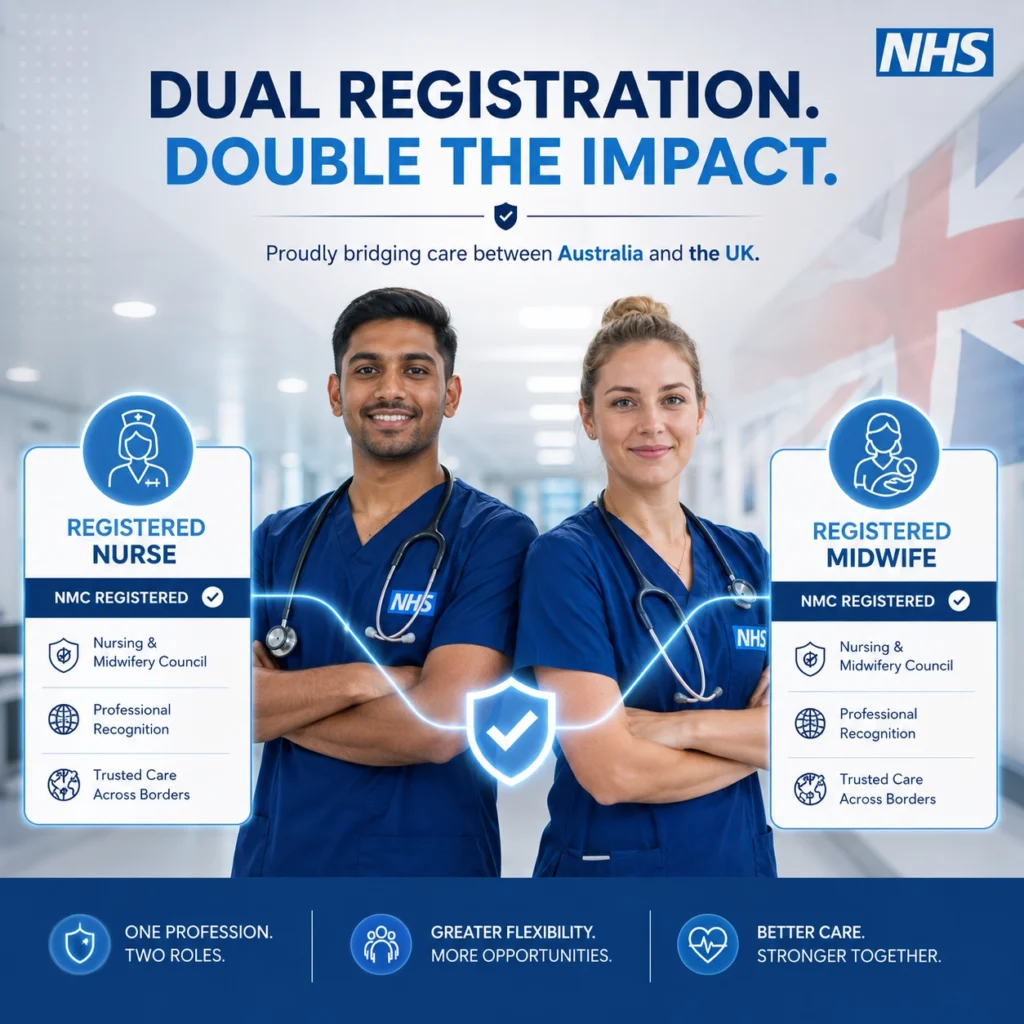
NMC dual pin registration usually refers to holding two entries on the NMC register. In the NMC’s own wording, people who have two registrations are often called dual registrants. The most common example is a professional who is registered both as a nurse and as a midwife.
It is important to understand that dual pin registration is not simply about adding a job title. It is about being professionally registered in more than one regulated capacity. According to NMC guidance on multiple registrations, the regulator oversees separate professions such as nurse, midwife and nursing associate. Because of that, holding more than one registration comes with separate professional responsibilities.
In practice, this can be valuable for professionals whose education, experience and scope of practice genuinely cover both areas. For example, a person may have first qualified in nursing and later completed an approved midwifery qualification. Once accepted by the NMC, that person may be able to maintain both registrations if they continue to meet the regulator’s standards.
Why NMC Dual Pin Registration Matters in 2026
Interest in NMC dual pin registration 2026 is growing for several reasons. First, more internationally educated professionals are exploring long-term UK careers rather than only short-term relocation. Second, workforce flexibility matters more than ever in healthcare. Third, the NMC has updated and clarified parts of its registration guidance, including information on adding another qualification to the register and registering another qualification gained outside the UK.
For candidates who want to build a broader career in the UK, dual registration can seem attractive. It may support wider professional options, access to mixed practice settings, and stronger career progression in some roles. However, it is not the right decision for everyone. The NMC is clear that you should only maintain registrations that reflect your real scope of practice.
That point is especially important in 2026, because employers increasingly expect registrants to understand the legal and professional implications of the qualification they hold. Having two registrations is not just an advantage on paper. It creates an ongoing duty to meet revalidation and practice requirements for each registration.
Who can Apply for Dual Registration with the NMC?
Your route depends on your current status and where your additional qualification was gained.
If you trained in the UK
The NMC states that once you are registered, you can study for additional qualifications that may also be recorded on the register. If your additional qualification is a UK qualification relevant to the register, your university may upload your course completion details to the NMC database, and you will then complete the recording process in MyNMC.
For recordable UK qualifications, the NMC notes an application fee of £25. For subsequent registration qualifications in the UK, the fee stated by the NMC is £23, and the process follows the same route as initial UK registration for that qualification.
If you gained another qualification outside the UK
The NMC has a specific subsequent registration pathway for people who want to add another qualification gained outside the UK. According to the NMC’s 2026 guidance, you must already have an active NMC registration, a MyNMC account, and a qualification that would allow you to register in your country of training.
The NMC explains that you can apply to add another nursing, midwifery or nursing associate qualification to your existing registration record. For example, someone already on the register as an adult nurse may apply to add another field or a different professional qualification if eligible. However, the NMC also makes clear that you cannot add clinical specialisms such as cancer nursing, critical care nursing or neonatal nursing through this route.
You also cannot use the same qualification you used previously to join another part of the register. The additional qualification must be a different course that would allow registration in the country of training.
NMC Subsequent Registration in 2026: Step-by-step Overview
Based on the NMC website, the process for registering another qualification gained outside the UK is similar to the initial overseas registration journey, but it is designed for applicants who are already on the register.
- Log in to your MyNMC account.
- Select Add an Overseas Qualification from the My Registration menu.
- Complete the eligibility and qualification application.
- Provide identity evidence.
- Provide qualification and registration details.
- Pay the qualification evaluation fee.
- Wait for the NMC to evaluate the qualification.
- If required, take the Test of Competence, including CBT and OSCE.
- Complete the subsequent registration application.
- Wait for final application evaluation and outcome.
For many international candidates, the most important part of this pathway is understanding that additional registration may still require formal assessment. It is not simply an administrative add-on. If the NMC requires you to demonstrate the relevant knowledge and skills, you may need to complete the Test of Competence for the field or profession you want to add.
Fees for NMC Dual Pin Registration 2026
Fees are a major planning point, especially for international nurses who are already investing in language tests, relocation and exam preparation.
According to the NMC’s 2026 guidance for subsequent registration gained outside the UK, the total cost of fees and tests is £1,040. This includes:
- £140 qualification evaluation fee
- £83 CBT fee
- £794 OSCE fee
- £23 subsequent registration fee
The NMC notes that this total does not include the cost of resits, so your actual budget may be higher if you need to retake any part of the Test of Competence. For UK-based recordable qualifications, the fee may be different depending on the exact type of qualification being added.
Before applying, it is wise to budget not only for NMC fees but also for exam support, study materials, travel, accommodation for OSCE, and possible time away from work.

Do you need CBT and OSCE for Dual Pin Registration?
In many overseas subsequent registration cases, yes, you may need to complete the Test of Competence. The NMC states that if you are adding a nursing qualification, your qualification does not necessarily need to be specific to the field you are applying for, but you will need to complete the specific Test of Competence to show you have the relevant knowledge and skills for that field.
That means candidates should not assume that having one NMC registration automatically removes the need for further examination. If you want to add another field or professional qualification, the NMC may still require objective evidence of competence.
This is where preparation becomes critical. Mentor Merlin supports candidates through structured preparation for the NMC CBT, NMC OSCE and English language pathways such as OET. If your second registration route includes a competence assessment, targeted preparation can save time, money and stress.
Dual Registration as a Nurse and Midwife
One of the best-known examples of dual registration is being registered as both a nurse and a midwife. The NMC explains that in the UK, midwifery programmes usually take at least three years, although a registered level 1 adult nurse can undertake a reduced training course of 18 months for dual registration.
This matters because some professionals incorrectly assume that working in maternity care is the same as being a registered midwife. It is not. The NMC requires completion of an approved midwifery programme before midwifery registration can be granted.
So if you are already a nurse and want to become dual registered as a midwife, your first question should be educational: do you hold, or can you obtain, a qualification that meets the NMC’s requirements for midwifery registration? Only then can you consider the correct registration route.
Revalidation Rules for Dual Registrants
One of the most important sections of the NMC guidance relates to revalidation. According to the NMC’s guidance sheet on multiple registrations and additional qualifications, people with multiple registrations must complete a minimum of 450 practice hours for each registration over the three-year period since renewal or joining the register.
That means:
- Dual registrants must complete at least 900 practice hours in total.
- Triple registrants must complete at least 1,350 practice hours in total.
- Hours cannot be double-counted across registrations.
The NMC also explains that other revalidation requirements are broadly the same as for single registrants. For example, a dual registrant still provides five pieces of practice-related feedback and five reflective accounts overall, but should think carefully about reflecting practice across their roles.
This is a crucial reality check. Dual pin registration is not just about getting another pin. It also means ongoing evidence, reflection and professional accountability. If your current role only relies on one registration, you may need to think carefully about whether keeping both registrations is necessary.
Should you Maintain both Registrations?
The NMC makes a practical and honest point: if you are working in one role and are only relying on one professional registration, it may not be necessary to maintain multiple registrations. The decision depends on your actual scope of practice, not simply your ambition or job title.
For example, the NMC notes that someone registered as both a nurse and a midwife who has worked solely as a general practice nurse for the last three years should specify nursing as their scope of practice and cannot use isolated tasks to maintain midwifery registration. By contrast, a dual registrant working in a role where both nursing and midwifery knowledge, skills and experience are genuinely used may be able to renew both registrations, provided the full hour requirements are met and clearly evidenced.
This means that dual pin registration is most suitable for professionals who have a clear career reason and realistic practice exposure to maintain both parts of the register over time.
Common Misconceptions about NMC Dual Pin Registration 2026
1. “If I already have one NMC PIN, the second one is automatic”
Not true. The NMC may require a new application, qualification evaluation, evidence checks and the Test of Competence depending on your route.
2. “Any clinical experience can maintain both registrations”
No. The NMC says you must rely on the knowledge, skills and experience of each profession in your practice, and you cannot double-count practice hours.
3. “Specialist experience is the same as a new registration”
No. Clinical specialisms such as critical care or neonatal nursing are not the same as adding another NMC registration category through subsequent registration.
4. “Dual registration is always the best career move”
Not always. It can be beneficial, but it also creates extra regulatory responsibility. The best choice depends on your career path, education and real scope of practice.
How to prepare strategically for Dual Registration
If you are seriously considering NMC dual pin registration 2026, preparation should start before you open the application portal. A strong plan usually includes:
- Checking whether your second qualification is actually eligible for registration.
- Confirming whether your route is a UK recordable qualification or overseas subsequent registration.
- Reviewing NMC guidance pages carefully for the latest fees and evidence requirements.
- Budgeting for CBT, OSCE, document preparation and travel.
- Assessing honestly whether you will be able to maintain both registrations through revalidation.
- Building an exam preparation plan if a Test of Competence is required.
This is also the stage where professional coaching can help. Mentor Merlin supports international nurses with CBT preparation, OET preparation and NMC OSCE preparation programmes designed to reduce confusion and improve exam readiness. Even if your goal is a second registration, the same exam discipline, evidence organisation and UK practice understanding remain essential.
How Mentor Merlin can Support your Registration Journey
At Mentor Merlin, we understand that UK registration is rarely a one-step process. Many professionals begin with one registration pathway and later explore career expansion through another field or profession. That is why strong foundations matter.
Our programmes are built to help international nurses and healthcare professionals move forward with confidence. If your dual registration pathway includes language proof, our OET preparation programmes can help strengthen healthcare communication. If your route includes knowledge testing, our CBT preparation programmes can support focused revision. If you need to demonstrate clinical competence, our NMC OSCE preparation programmes are designed to help you understand expectations, practise safely and build confidence for exam day.
Most importantly, we help candidates understand the bigger picture. Passing an exam is important, but so is knowing why you are choosing a route and whether it matches your long-term UK career goals.
Final thoughts on NMC Dual Pin Registration 2026
NMC dual pin registration 2026 can be an excellent opportunity for the right candidate, but it needs careful planning. The most important questions are not only whether you can add another registration, but whether your qualification is eligible, whether you are ready for the assessment process, and whether your long-term practice will support revalidation for both roles.
The NMC’s current guidance shows that dual registration is possible, structured and regulated. It can involve application fees, evidence checks, CBT, OSCE and ongoing revalidation responsibilities. For that reason, candidates should approach it with clarity rather than urgency.
If you are preparing for any part of the UK registration pathway, Mentor Merlin is here to support you through OET, CBT and NMC OSCE preparation programmes tailored for international nurses. A well-planned registration journey is always stronger than a rushed one.
Frequently Asked Questions about NMC Dual Pin Registration 2026
1.Can I have two NMC PINs at the same time?
You can hold dual registration on the NMC register if you meet the regulator’s requirements. This most commonly applies to people registered both as a nurse and a midwife. The exact route depends on your qualification and where it was gained.
2.What is subsequent registration?
Subsequent registration is the NMC process used when someone already on the register wants to add another nursing, midwifery or nursing associate qualification. There is a specific pathway for qualifications gained outside the UK.
3.How much does NMC dual pin registration cost in 2026?
For an overseas subsequent registration route, the NMC states a total cost of £1,040 including qualification evaluation, CBT, OSCE and the subsequent registration fee. Resit costs are not included in that total.
4.Do I need 900 practice hours to revalidate as a dual registrant?
Yes, according to NMC guidance, dual registrants must complete at least 450 practice hours for each registration over the three-year revalidation period, which means at least 900 hours in total.
5.Can an adult nurse become a midwife in the UK?
Yes. The NMC states that a registered level 1 adult nurse can undertake a reduced midwifery training course of 18 months for dual registration, provided the programme is NMC approved.
Why Wait? Just Merlin It!
Free Consultation – Chat now with a Mentor.