


If you are preparing for the NMC OSCE suppository insertion station, it is normal to feel nervous about the sequence, communication, and marking criteria. Many international nurses know the procedure in theory but lose marks because they miss small verbal steps, rush the introduction, or forget the patient instructions at the end.
This walkthrough explains the station in a clear, exam-focused way. Using Mentor Merlin’s guidance, we will break down what to say, what to do, what the assessor is looking for, and how to avoid common mistakes. By the end, you should feel more confident about approaching the suppository insertion station in a safe, structured, and patient-centred manner.

What is the NMC OSCE suppository insertion station?
NMC OSCE suppository insertion is a clinical skills station where you are assessed on your ability to safely and effectively administer medication via the rectal route while maintaining patient dignity, communication, and safe administration. The suppository insertion station is a 10-minute skills station in the NMC OSCE. In this station, you are usually asked to administer a glycerol suppository to relieve constipation. Because this is a medication-related station, you must combine safe medicine administration with dignity, consent, positioning, clear explanation, and correct documentation.
According to Mentor Merlin, the station follows a simple structure:
- Introduction
- Article collection
- Procedure
- Conclusion and documentation statement
Keeping this structure in mind helps you stay calm and avoid missing essential steps. It also helps you manage your time better, which is important in a short OSCE station.
Keyword station goal: Safe, dignified, step-by-step care
The assessor is not only checking whether you can insert a suppository. They are also checking whether you practise in a professional, patient-centred, and safety-focused way. That means you must show:
- Safe medicine administration
- Patient identification and allergy checks
- Privacy and dignity
- Correct positioning
- Clear communication and consent
- Appropriate aftercare and health education
- Awareness of documentation and waste disposal
In other words, the NMC OSCE suppository insertion station is about both technical skill and professional behaviour.
Before you begin: Read the scenario carefully
The timer starts when you begin reading the scenario, so use that time wisely. Identify the medication, the purpose, and whether the setting is in hospital. In most OSCE scenarios for this station, you will be administering one glycerol suppository for constipation.
From Mentor Merlin, an important exam reminder is that this is a medication station. That means you must validate the prescription, confirm the patient’s identity, and check allergy status. Missing these points can cost important marks.
Step 1: Start with scene safety, privacy, and hand hygiene
As you enter, begin with scene safety and privacy. Make sure the area is safe to approach. Then close the door and draw the curtains to protect the patient’s dignity. After that, perform hand hygiene using the WHO technique.
Your introduction should sound calm and professional. Greet the patient according to the scenario time, introduce yourself as one of the registered nurses, and explain why you are there. A simple phrase could be:
“Today, I am here to administer a glycerol suppository as prescribed by the doctor to help relieve your constipation.”
You should also explain possible side effects in simple language. Glycerol suppository has common side effects like loose stool, abdominal cramps, or diarrhoea. Reassure the patient that a bedpan, commode, or toilet will be available if needed. Then ask for consent to proceed.
Step 2: Check patient identity and allergies correctly
Because this is a medication station, you must complete an ID and allergy check. Ask the patient to state their full name and date of birth. Then cross-check with the ID band and prescription chart. In a hospital scenario, you should also confirm the hospital number. Ask about allergies and, if there is an allergy, ask what reaction the patient had.
This is a common area where candidates lose marks by being too brief. Do not just say, “I checked the ID.” Show the process clearly. At the end, confirm verbally that you are with the right patient.
Mentor Merlin training also emphasises keeping the introduction part brief and organised. Ideally, complete it within about two minutes so you have enough time for the rest of the station.
Step 3: Validate the prescription and collect equipment
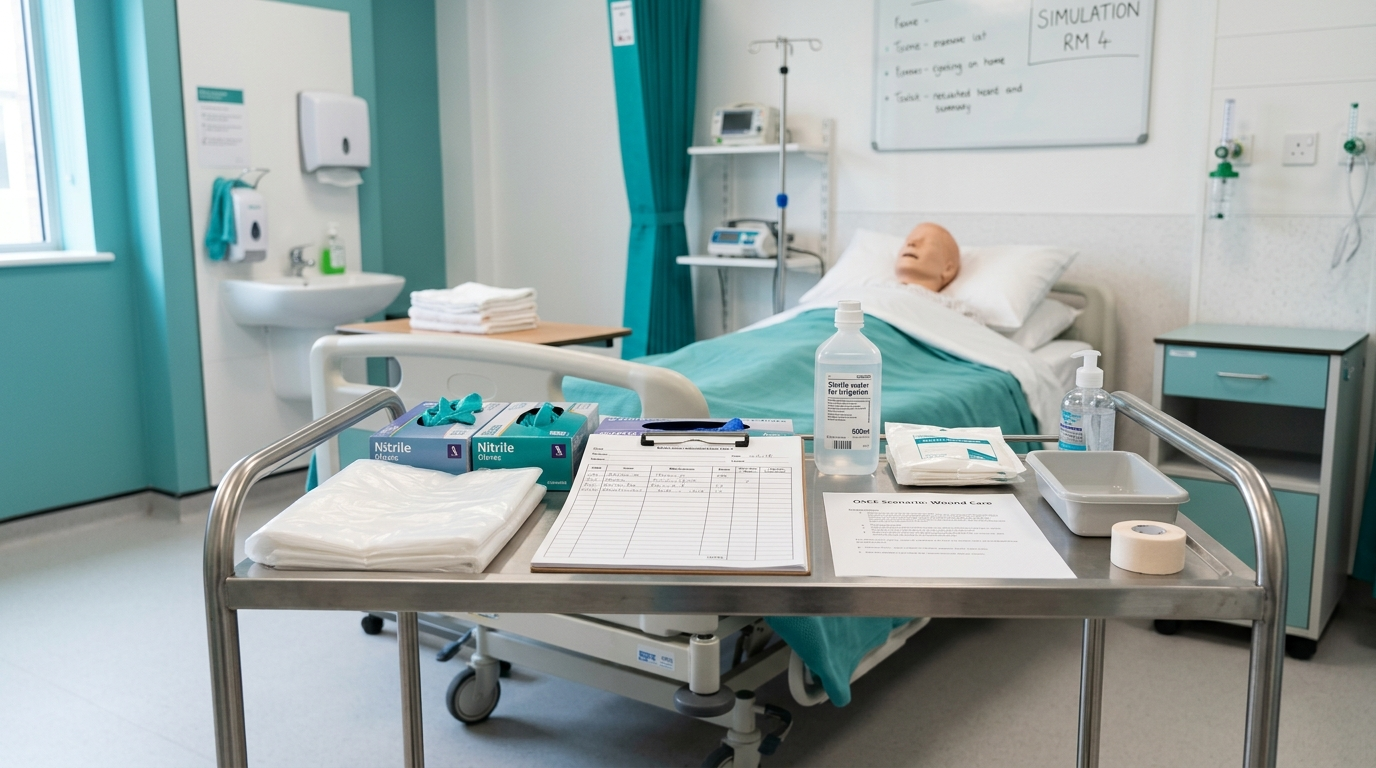
Next, validate the prescription carefully. Then collect the required articles. Before you begin NMC OSCE suppository insertion, preparing the correct equipment is essential. these usually include:
- A clean tray
- Glycerol suppository bottle or pack
- Gallipot with sterile water
- Gauze pieces
- Incontinence pad
- Apron and gloves
When checking the suppository, confirm the medication name, dose, and expiry date. Then cross-check the medication with the prescription chart. This point matters. According to Mentor Merlin guidance, some candidates validate the bottle but forget to cross-check against the chart. In the OSCE, that can lead to failure in a medication station.
After collecting equipment, perform hand hygiene again and put on an apron and gloves before returning to the patient.
Step 4: Reconfirm identity and explain positioning
When you return, ask permission to continue. Then repeat the identity and allergy check. This second check is important in medication administration. Once confirmed, explain the position needed for the procedure.
For the suppository insertion OSCE station, the patient should be in the left lateral position with knees flexed, feet slightly raised, and buttocks close to the edge of the bed. In the exam, the mannequin may already be positioned, but you still need to verbalise what position you would provide.
Ask whether the patient needs assistance and request consent before minimal exposure. Then place an incontinence pad under the buttocks.
Step 5: Assess the rectal area before insertion
Before insertion, assess the area and verbalise your findings. You can mention, such as the absence of soreness, excoriation, haemorrhoids, oedema, rectal prolapse, or infestation. Because this is a mannequin, the findings will usually be normal, but you still need to say them.
This step shows that you are not rushing into the procedure. You are checking whether it is safe and appropriate to continue.

Step 6: Lubricate and insert the suppository correctly
Now you are ready for the actual insertion. Take one suppository. Then dip a gauze piece into sterile water and use the wet gauze to lubricate the suppository. Specifically note that you should not directly lubricate it without the use of the gauze step.
Before touching the buttocks, ask the patient for permission because you are approaching a private area. Then separate the buttocks gently. Ask the patient to inhale and insert the suppository according to the manufacturer’s instructions. In the OSCE, you should verbalise that you are inserting it correctly and advancing it approximately 2–4 cm beyond the sphincter.
That insertion depth matters. It explains that the suppository needs to go beyond the anal canal so it can be retained properly.
After insertion, remove your finger, use dry gauze to wipe away excess lubricant or moisture, and cover the patient again to maintain dignity.
Step 7: Give the key instructions after insertion
This part is easy to underestimate, but it is essential in the marking criteria. Once the suppository has been inserted, explain clearly what the patient should expect and what they need to do next.
- Ask the patient to remain lying down for about 20 minutes, or as long as they can manage.
- Explain that they may feel some discharge as the medication melts.
- Explain that they may feel the urge to open their bowels.
- Reassure them that a bedpan, commode, or toilet is available.
- Offer assistance if they need help.
One useful point is that the incontinence pad should remain in place for around 20 minutes because early evacuation can happen and dignity must be preserved.
Step 8: Document, dispose, and finish professionally
After giving the patient instructions, tell them you are going to document the procedure and that they can use the call bell if they need help. Then discard used items according to hospital policy, remove apron and gloves, and perform hand hygiene. Because this is a medication station, you should sign the prescription chart after administration.
Before leaving, provide brief health education. Useful advice includes:
- Drink plenty of water
- Eat fibre-rich foods
- Stay active if possible
Then finish with the usual comfort check: ask if the patient is comfortable, whether they have any concerns, and remind them about the call bell. Finally, perform hand hygiene and give your closing statement to the assessor, including that you completed documentation according to NMC guidelines, disposed of waste according to policy, cleaned the tray, and ensured patient comfort.
Use Quick checklist for the exam preparation:
ID → Consent → Prescription check → Position → Insert → Care → Document
Use this structure to stay consistent:
- Explain – What you’re about to do
- Check – Patient ID, allergy and consent
- Guide – Clear instructions (e.g., positioning, insertion etc.)
- Reassure – Maintain comfort and dignity
Common mistakes in the suppository insertion station
Many candidates know the overall procedure but still lose marks through avoidable mistakes. The most common ones include:
- Forgetting that it is a medication station and missing ID or allergy checks
- Checking the medication bottle but not cross-checking it with the prescription chart
- Failing to verbalise the patient position
- Not assessing the area before insertion
- Forgetting to ask permission before touching the buttocks
- Not stating the insertion depth of 2–4 cm
- Missing the patient instructions after insertion
- Forgetting to sign the prescription chart
- Time management
Avoiding these common mistakes can significantly boost your chance to pass the station. A good way to avoid these errors is to practise the station in a fixed sequence until it feels natural.
Know more.
OSCE Suppository Insertion Checklist
Use this rapid checklist to confirm everything is complete:
- Patient identity confirmed (2 identifiers)
- Procedure explained and consent obtained
- Allergies and medication checks completed
- Hand hygiene performed at correct moments
- PPE used appropriately
- Patient positioned correctly (left lateral)
- Privacy and dignity maintained
- Suppository inserted safely and correctly
- Patient comfort ensured post-procedure
- Waste disposed of safely
- Documentation completed A simple checklist can be the difference between pass and fail in NMC OSCE suppository insertion.
How Mentor Merlin helps you prepare for the NMC OSCE
At Mentor Merlin, we know that passing the OSCE is not just about memorising a script. You need to understand the clinical logic, the communication style expected in the UK, and the exact sequence that helps you score marks under pressure.
Our NMC OSCE preparation support is designed for international nurses who want clear explanations, realistic walkthroughs, and structured practice. We also support candidates preparing for the full UK registration journey through our CBT and OET programmes, helping you move confidently toward NHS registration and employment.
Frequently asked questions about the NMC OSCE suppository insertion station
How long is the suppository insertion station in the NMC OSCE?
The suppository station is usually a 10-minute skill station. Because the time is short, it helps to complete the introduction within about two minutes and then move through the equipment, procedure, and closing steps in an organised way.
Is suppository insertion a medication station in the OSCE?
Yes. That means you must validate the prescription, check the patient’s identity, confirm allergies, cross-check the medication with the chart, and sign the prescription after administration.
How far should you insert a suppository in the OSCE?
You should verbalise that you advance the suppository approximately 2–4 cm beyond the sphincter. This helps ensure the suppository is retained properly in the rectum.
What position is used for suppository insertion in the NMC OSCE?
The patient should be in the left lateral position with knees flexed, feet slightly raised, and buttocks near the edge of the bed. Even if the mannequin is already positioned, you should still say this during the station.
What should you tell the patient after inserting a suppository?
Tell the patient to remain lying down for about 20 minutes, explain that they may feel discharge as the medication melts, and warn them that they may feel the urge to open their bowels. Also reassure them that assistance and toilet facilities are available.
Final thoughts
By now, you have a complete understanding of how to perform NMC OSCE suppository insertion in a structured, safe, and exam-focused way. The NMC OSCE suppository insertion station becomes much easier when you break it into a repeatable sequence: introduce, identify, validate, position, assess, insert, instruct, document. If you practise that sequence regularly, your confidence will grow and your communication will sound more natural on exam day.
If you want guided support for OSCE stations, medication skills, and the full UK nurse registration pathway, explore Mentor Merlin’s NMC OSCE preparation programmes. You can also learn more about the OSCE Study Guides and Tips section and related NMC OSCE resources for more exam-focused support.
Read our detailed blog – “How to Document NMC OSCE GCS Chart: Step-by-Step Guide for Nurses” – to ensure your journey stays on track.
Why Wait? Just Merlin It!
Free Consultation – Chat now with a Mentor.