
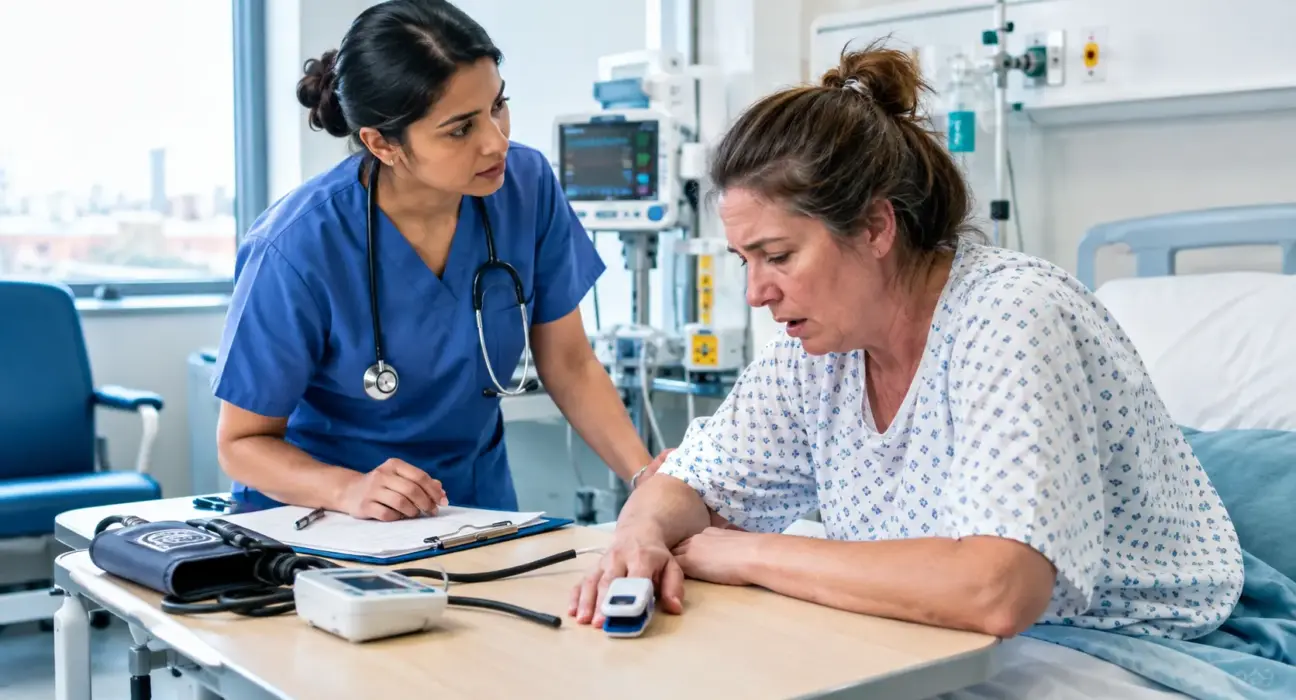
Tripod position in nursing describes a posture in which a person leans forward and supports their upper body with their hands or arms, often on their knees or a table. It may be a way to make breathing feel easier. For a nurse, however, seeing someone adopt this position unexpectedly should prompt an immediate assessment of their breathing and overall condition. The posture can accompany respiratory distress, but it does not identify the cause by itself.
If you are preparing for the NMC Computer Based Test (CBT), understanding the tripod position helps you move beyond memorising a definition. You need to recognise what the observation might mean, decide which assessments cannot wait, and choose safe first actions. This guide explains the clinical reasoning, common causes, practical nursing response and original CBT-style practice questions. Always follow your employer’s escalation pathway and current local guidance in real clinical care.
What is the Tripod Position?
A person in the tripod position usually sits or stands while leaning forward, with their hands resting on their knees, a chair, a bed or a table. The shoulders may be raised and the elbows may be braced. This posture gives the upper body support and may help some people use their breathing muscles more effectively. It is sometimes called a forward-leaning or supported sitting position.
Picture a patient who has been walking to the bathroom. On returning, they sit at the bedside, bend forward, place both hands on their thighs and pause to breathe. They answer only a few words at a time. The posture is an important clue, but the difficulty in speaking, breathing effort and change from the patient’s usual state are equally important.
Not everyone who leans forward is in respiratory distress. A person may sit that way because of pain, fatigue or comfort. Conversely, someone with serious breathing difficulty may not adopt the tripod position at all. Avoid treating the posture as a diagnosis or using its absence as reassurance. Consider the whole patient, including their reported symptoms, observations and recent changes.
Why can leaning forward help breathing?
Breathing relies on the diaphragm, chest wall and other muscles working together. When breathing becomes harder, a person may recruit additional muscles around the neck and shoulders. Supporting the arms and upper body can make it easier for some of these muscles to assist chest movement. A forward-leaning position may also feel more comfortable than lying flat, especially when someone is breathless.
That does not mean the tripod position treats the underlying illness. It may reduce the feeling of breathlessness for an individual while assessment and treatment are arranged, but pneumonia, airway obstruction, an asthma attack or another condition still needs appropriate care. A person may appear calmer after changing position yet remain clinically unwell. Reassess symptoms, observations and response to treatment rather than judging improvement from posture alone.
In an exam question, remember the difference between a supportive measure and a definitive treatment. Helping a patient remain in a comfortable, supported position may be sensible if it is safe. It does not replace an airway and breathing assessment, timely escalation, or treatment prescribed under local protocols.
Clinical significance: What should a Nurse notice?
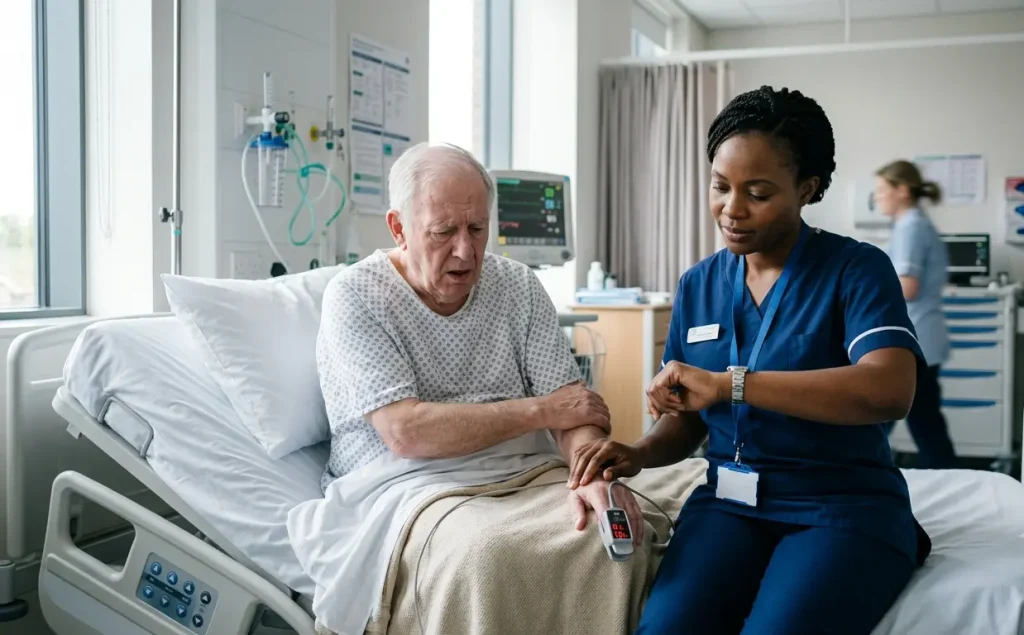
The clinical significance of tripod positioning depends on context. A new forward-leaning posture alongside visible effort to breathe should increase concern, particularly if the patient cannot speak in full sentences or is becoming exhausted. Start by looking at the patient, not just the monitor. Notice whether they are alert, distressed, unusually quiet or less responsive than before.
Assess breathing rate, depth and pattern; work of breathing; chest movement; ability to talk; skin colour; and oxygen saturation where equipment is available. Listen to what the person says about breathlessness, chest pain and how quickly symptoms developed. Check other vital signs, including pulse, blood pressure and temperature, and compare them with previous readings. A single normal-looking number cannot exclude deterioration.
Some warning signs demand particularly urgent attention: increasing drowsiness or confusion, severe difficulty in speaking, marked fatigue, blue or grey colouration, noisy breathing suggesting upper-airway problems, or rapidly worsening symptoms. A quiet chest in a patient with severe asthma symptoms can also be worrying; it is not necessarily a sign of recovery. Follow your organisation’s emergency response and escalation policy when a patient appears severely unwell.
Where your setting uses the National Early Warning Score 2 (NEWS2), record observations accurately and use the score alongside clinical judgement and local escalation rules. Do not wait for a score to rise before seeking help if the patient looks seriously unwell. Good nursing assessment brings together the patient’s appearance, measured observations, medical history and the direction of change over time.
Conditions that may be associated with Tripod positioning
The tripod position is a sign, not a condition. It may be seen in people experiencing an asthma exacerbation or a flare-up of chronic obstructive pulmonary disease (COPD). Both can make breathing feel difficult, although the mechanisms, investigations and treatments may differ. Ask about relevant history and prescribed medicines, but do not assume that an existing diagnosis explains every new episode of breathlessness.
Other possibilities include infection such as pneumonia, heart-related breathlessness, pulmonary embolism, allergic reactions or upper-airway obstruction. These examples are not a diagnostic checklist: a clinician must evaluate the full presentation. Sudden onset, chest pain, fever, wheeze, cough, swelling, recent procedures and exposure to an allergen can all change the level of concern and the likely next steps.
In children, a forward-leaning posture accompanied by drooling, difficulty in swallowing or noisy breathing can raise concern for a threatened upper airway. Do not force a distressed person into a position that worsens breathing. Keep them as calm as possible, seek immediate expert help and follow local emergency procedures. Examinations, interventions and positioning should be guided by the clinical team and the patient’s condition.
People can also lean forward because of non-respiratory discomfort. This is why a safe response begins with assessment rather than a quick label. Ask yourself: Is this new? Is the person working harder to breathe? What has changed since the last review? What other signs or symptoms are present?
How to respond when a patient adopts the Tripod position
First, stay with the patient and assess promptly. Check whether they can speak, whether their airway appears patent, and how much effort breathing requires. Call for assistance early if you see significant distress or deterioration. Use an ABCDE approach – airway, breathing, circulation, disability and exposure—within your competence and local policy. If the patient is critically unwell, activate the appropriate emergency response rather than continuing a lengthy assessment alone.
Second, support safe positioning. If the person is awake and able to maintain their posture, allow a position that makes breathing easier, often upright or leaning forward with support. Avoid forcing them flat simply to obtain observations. Consider falls risk, fatigue and whether they need help to remain safely seated. Reposition only as clinically appropriate and seek senior advice when the airway or consciousness is a concern.
Third, measure and communicate relevant findings. Obtain observations without delaying urgent escalation. Note respiratory rate, oxygen saturation, pulse and other vital signs as appropriate, as well as whether speech is limited and whether accessory muscles appear to be in use. Consider baseline saturation and any prescribed oxygen plan. Oxygen is a medicine: administer it according to local protocols, prescription and the patient’s clinical needs; seek urgent help when immediate treatment is indicated.
Fourth, prepare for further care and reassess. Follow the response team’s instructions, help with prescribed treatment, and repeat observations as directed. Handover clearly using your organisation’s preferred format, such as SBAR (situation, background, assessment, recommendation). Record what you saw, when it began, the observations, who you contacted, interventions undertaken and the patient’s response. A documented change over time can be as important as the initial finding.
In a CBT scenario, your first action usually focuses on recognising risk and addressing immediate safety. “Give reassurance and review later” is not an adequate response to new, marked breathing difficulty. Equally, do not assume a specific diagnosis from posture alone or delay seeking help while collecting every possible detail.

Tripod position, Orthopnoea and Accessory Muscle use: Key Differences
Related terms can appear together in revision materials, but they mean different things. The tripod position describes how someone holds their body: leaning forward while supporting themselves with their arms or hands. Orthopnoea describes breathlessness that worsens when lying flat and improves when sitting up. A person with orthopnoea might sit upright without leaning forward, or might also adopt the tripod position.
Accessory muscle use means additional muscles, often around the neck and shoulders, visibly assist breathing. It is an observation about the work of breathing, not another name for the tripod position. Dyspnoea is the patient’s experience of difficult or uncomfortable breathing. The nurse may observe a posture and increased effort, while the person reports breathlessness.
These distinctions help you describe findings precisely. Instead of writing only “patient tripoding,” document the position in plain language and include the accompanying symptoms and observations. For example: “Sitting forward with arms supported on bedside table; speaking in short phrases; increased breathing effort noted.” Accurate descriptions make handover clearer and support safer decisions.
How the topic may appear in the NMC CBT
The NMC CBT assesses whether candidates can apply nursing knowledge safely, not merely repeat definitions. A question involving a tripod posture may ask what you should assess first, which observation is most concerning, how to prioritise a deteriorating patient, or what to communicate during escalation. The best answer depends on the full scenario, not on a single phrase in the question stem.
Read carefully for clues about timing and severity. “New onset,” “unable to complete a sentence,” “becoming drowsy” and “increasing work of breathing” should change your priorities. Identify what information is given, what action is within a nurse’s role, and whether a delay could place the patient at risk. An apparently helpful option can be wrong if it postpones an airway and breathing assessment.
Use a simple revision framework: recognise, assess, escalate, reassess. Recognise the posture and other warning signs; assess the patient using an appropriate structured approach; escalate in line with urgency; and check the response to any intervention. For guidance on the test format and current registration requirements, consult the Nursing and Midwifery Council registration guidance rather than relying on an old question bank.
Mentor Merlin’s NMC CBT preparation programmes can help you connect clinical concepts with question-solving practice. Use practice questions to explain why one action is safer than another, not simply to memorise the letter of the correct answer.

Tripod Position CBT Practice Questions
The following are original revision questions, not official NMC exam items. They are designed to test clinical reasoning; workplace protocols and the full patient presentation always govern real practice. Try each question before reading the explanation.
Question 1: What does the posture suggest?
A patient sits leaning forward with both hands on their knees after walking a short distance. They say they are struggling to breathe. What is the most appropriate interpretation?
A. The posture confirms pneumonia.
B. The patient may be trying to ease breathing and needs prompt assessment.
C. The posture means oxygen is unnecessary.
D. The patient must be placed flat immediately.
Answer: B. A supported forward lean may help someone cope with breathlessness, but it does not establish a diagnosis or replace assessment. Check the patient’s airway, breathing, observations and overall condition. Do not force a position that worsens their symptoms.
Question 2: What is the priority?
A patient with a history of asthma is leaning forward, speaking only one or two words at a time and becoming visibly tired. Which response is the priority?
A. Leave the patient to rest and return in 30 minutes.
B. Offer written information about asthma.
C. Assess airway and breathing immediately and call for urgent help according to local policy.
D. Ask the patient to walk to the treatment room.
Answer: C. Limited speech and increasing fatigue are concerning signs. Prompt assessment and escalation are safer than delaying care. The history of asthma is useful background, but it does not remove the need to assess the present episode or follow the appropriate emergency pathway.
Question 3: Which description is most accurate?
Which statement correctly distinguishes tripod position from orthopnoea?
A. Both terms mean a low oxygen saturation.
B. Tripod position is a forward-leaning supported posture; orthopnoea is breathlessness that worsens when lying flat.
C. Orthopnoea always means the patient is using accessory muscles.
D. Tripod position is a confirmed diagnosis of COPD.
Answer: B. One term describes posture; the other describes how symptoms change with position. They may occur together, but neither automatically identifies the underlying condition. Describe what you observe and what the patient reports separately.
Question 4: What belongs in a handover?
A nurse calls for help because a patient has developed breathlessness and is sitting forward with arms supported. Which handover is most useful?
A. The patient looks uncomfortable.
B. This is definitely a COPD attack.
C. The patient is newly breathless, speaking in short phrases, with increased work of breathing; here are the latest observations and changes from baseline.
D. The posture is normal, so no assessment is needed.
Answer: C. A useful handover provides the new concern, relevant observations and trend, without claiming a diagnosis that has not been established. Include what you have done, the patient’s response and what help is needed.
Question 5: How should improvement be judged?
A patient says breathing feels easier after sitting forward. What should the nurse do next?
A. Assume the cause is resolved.
B. Continue assessment and reassess symptoms and observations, escalating if concerns remain.
C. Stop recording observations.
D. Tell the patient that posture alone treats the illness.
Answer: B. Greater comfort is welcome, but it does not show that the underlying problem has resolved. Reassess the patient and follow the treatment and escalation plan. Improvement should be supported by the overall clinical picture.

Common revision mistakes to avoid
Calling the posture a diagnosis: leaning forward may indicate distress, but it cannot distinguish between asthma, COPD, infection and other causes. Look for further evidence and report findings accurately.
Focusing only on oxygen saturation: a reading matters, but work of breathing, speech, consciousness and changes from baseline matter too. Interpret observations together and repeat them when the patient’s condition changes.
Delaying escalation while collecting details: severe distress needs urgent help. Continue a structured assessment while assistance is arranged, within your scope and local procedures.
Assuming comfort equals recovery: supported sitting may ease symptoms without fixing the cause. Reassessment is part of safe care. For additional context on recognising deterioration, see NHS England’s NEWS2 resources and follow your workplace’s current guidance. If you are planning your route into UK practice, GOV.UK health and social care information is another useful starting point for official updates.
Frequently Asked Questions
1. Is the Tripod Position always a medical emergency?
No. Some people lean forward because it is comfortable or because of pain. However, a new tripod posture with breathlessness, limited speech, fatigue or other signs of deterioration requires prompt assessment. If the patient appears severely unwell, escalate urgently according to your organisation’s emergency procedures.
2. Does Tripod Positioning mean the patient has COPD?
No. Some people with COPD adopt a forward-leaning position, but it can also be seen with other causes of breathing difficulty. A patient’s history may guide questions and care, yet the posture alone does not confirm COPD or explain a sudden change. Assess the whole clinical picture.
3. Should a Nurse move a breathless patient out of the Tripod Position?
Not automatically. If the patient is conscious and the position helps them breathe, support a safe, comfortable posture while assessing and obtaining help. Avoid forcing them flat merely for convenience. Positioning decisions should reflect airway safety, consciousness, clinical needs and local guidance.
4. What is the best way to remember Tripod Position for the CBT?
Remember “forward, supported, assess.” The patient leans forward with arms supported; the posture may help with breathing; and your nursing priority is to assess for distress and escalate when needed. Practise questions that ask for the safest next step, not just the name of the posture.
Final takeaways for Nursing practice and CBT revision
The tripod position is an observable, supported forward lean that may occur when breathing is difficult. Its meaning depends on the person’s symptoms, vital signs and clinical history. In both clinical care and CBT questions, recognise concerning changes, assess airway and breathing, seek help at the right time and reassess the response. Never use posture alone to diagnose a condition or to decide that a patient is safe.
To build confidence with clinical reasoning, explore Mentor Merlin’s CBT, OSCE and OET preparation programmes. Structured practice can help you turn an observation into a safe decision as you prepare for UK nursing registration.
Read our recent blog – “Clinical Benchmarking and Quality Improvement for the NMC CBT: How Evidence-Based Standards Drive UK Nursing Care” – to ensure your journey stays on track.
Why Wait? Just Merlin It!
Free Consultation – Chat now with a Mentor.