

International nurses preparing for UK registration often discover that infection prevention is not just one topic among many. In the NMC CBT, standard infection control precautions questions can appear in clinical scenarios, patient-safety questions, professional practice items, and decision-making tasks. That means candidates need more than simple memorisation. You must understand when to clean your hands, when to use personal protective equipment, how to manage sharps safely, and how to break the chain of infection in everyday nursing care.
This subject matters because the CBT is designed to test whether you can practise safely in line with UK standards. The Nursing and Midwifery Council expects nurses to protect patients, colleagues, and themselves from avoidable harm. Standard Infection Control Precautions, often called SICPs, are part of that safety culture. In this guide, we explain what every candidate must know, how these precautions are tested in the exam, and how you can study them effectively with Mentor Merlin’s NMC CBT preparation support.
What Are Standard Infection Control Precautions?
Standard Infection Control Precautions are the basic actions used to reduce the risk of spreading infection in all healthcare settings. They apply to every patient, every time, regardless of whether an infection is known or suspected. This is an important point for the NMC CBT. A question may not say that a patient has a specific infectious disease, but the safest answer may still involve standard precautions because nurses should assume that blood, body fluids, non-intact skin, and mucous membranes can transmit infection.
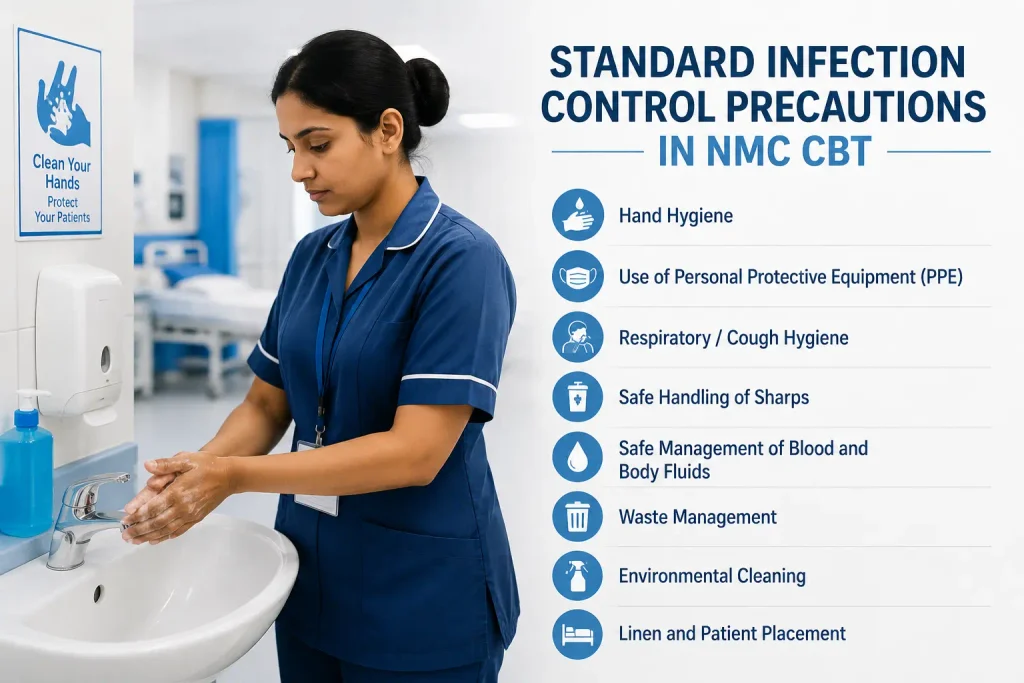
In UK practice, these precautions support patient safety, staff safety, and public health. They include hand hygiene, appropriate use of PPE, respiratory and cough hygiene, safe handling of sharps, environmental cleanliness, proper waste disposal, safe management of blood and body fluids, and correct decontamination of reusable equipment. In some guidance, patient placement and linen handling are also discussed as part of wider infection prevention practice.
For CBT purposes, you should think of SICPs as your default safe practice framework. When answering a question, ask yourself: what action best reduces infection risk while protecting dignity and following policy? This approach will help you avoid options that sound reasonable but are not the safest according to evidence-based nursing practice.
Why SICPs Matter So Much in the NMC CBT
The NMC CBT is not only about remembering facts. It assesses whether you can apply nursing knowledge in real situations. Infection prevention and control is central to this because poor infection control can quickly lead to patient harm, outbreaks, delayed recovery, staff illness, and serious professional consequences. In NHS settings, even small lapses can have major effects.
That is why standard infection control precautions in NMC CBT may appear in many forms. You may see direct knowledge questions, such as the correct sequence of donning and doffing PPE. You may also see scenario-based questions where the right answer depends on recognising a contamination risk. For example, a candidate may need to identify when to wash hands with soap and water instead of using alcohol hand rub, when gloves are needed, or how to respond after a needlestick injury.
This topic also connects closely with the NMC Code, professional accountability, safeguarding vulnerable patients, and maintaining a clean care environment. Strong understanding here supports better performance across several sections of the exam. If you are studying with Mentor Merlin’s NMC CBT preparation programme, infection control should be treated as a high-priority topic rather than a last-minute revision area.
Core Areas Every Candidate Must Master
1. Hand Hygiene
Hand hygiene is one of the most tested and most important infection prevention topics in nursing. Candidates should understand that hands can carry harmful microorganisms from one patient, surface, or task to another. Proper hand hygiene breaks that chain.
In the CBT, you should know when hand hygiene is required, including before touching a patient, before clean or aseptic procedures, after exposure to body fluids, after touching a patient, and after touching the patient’s surroundings. You should also know the difference between alcohol-based hand rub and soap and water. Alcohol hand rub is commonly used when hands are visibly clean. Soap and water are preferred when hands are visibly soiled or when certain organisms are suspected, such as those associated with diarrhoeal illness.
Questions may also test practical details. Jewellery, long nails, and damaged skin can interfere with effective hand hygiene. Sleeves should not obstruct proper cleaning. Candidates should revise the principle that technique and timing both matter. Cleaning hands at the wrong moment is not enough, and cleaning them poorly is also unsafe.
2. Personal Protective Equipment (PPE)
PPE is used according to the risk of exposure, not simply according to habit. This is a common exam trap. Gloves, aprons, masks, and eye protection should be selected based on the task and the likely contact with blood, body fluids, secretions, excretions, or droplets.
For example, gloves may be needed when there is a risk of contact with blood or body fluids, but they do not replace hand hygiene. Aprons or gowns protect clothing and skin during tasks with splash or contamination risk. Masks and eye protection may be necessary if droplets or splashes are possible. Candidates should also understand that unnecessary glove use can increase cross-contamination if hands are not cleaned correctly before and after use.
Many NMC CBT infection control questions test whether the nurse chooses the least excessive but safest protection. Overuse of PPE is not always the best answer. The best answer is the option that matches the assessed risk and follows standard precautions.
3. Respiratory Hygiene and Cough Etiquette
Respiratory hygiene became even more visible during and after the COVID-19 pandemic, but it remains a standard principle beyond one disease. Nurses should encourage patients, visitors, and staff to cover coughs and sneezes, dispose of tissues promptly, perform hand hygiene after contact with respiratory secretions, and use masks if indicated by policy or clinical condition.
In exam scenarios, candidates may need to identify early actions when a patient has coughing symptoms in a shared area. The safest option usually combines source control, hand hygiene, and minimising transmission risk. Always focus on immediate, practical steps that protect everyone in the care environment.
4. Safe Use and Disposal of Sharps
Sharps safety is another high-yield CBT topic. Needles and other sharp instruments can cause injury and transmit blood-borne infections. The basic principles are straightforward but essential. Do not recap used needles unless a specific safety device or policy requires it. Dispose of sharps immediately after use at the point of care into an approved sharps container. Do not overfill sharps bins. Keep them secure and correctly assembled.
Candidates should also know the immediate response to a sharps injury. Encourage bleeding if appropriate according to policy, wash the area, report the incident promptly, and follow occupational health or local exposure procedures. In the CBT, the best answer usually shows rapid action, reporting, and adherence to policy instead of delay or self-management only.
5. Safe Handling of Blood and Body Fluids
Blood and body fluids should always be treated as potentially infectious. This principle helps candidates answer many scenario questions correctly. If a spill occurs, the nurse should respond promptly using the appropriate protective equipment and local decontamination procedures. If specimens are collected, they must be labelled correctly, handled safely, and transported according to policy.
The CBT may test whether you can choose safe action when contamination risk is present. For example, handling soiled dressings, cleaning a body fluid spill, or changing linen after incontinence care all require the nurse to think about PPE, waste segregation, hand hygiene, and environmental cleaning.
6. Cleaning, Decontamination, and Equipment Safety
Reusable equipment can spread infection if it is not cleaned between patients. Items such as blood pressure cuffs, commodes, thermometers, and moving-and-handling equipment may require cleaning or decontamination according to manufacturer instructions and local policy. Single-use items must not be reused.
For the CBT, remember the difference between cleaning and full decontamination concepts at a practical level. You do not need to overcomplicate every question, but you do need to identify when an item is safe to use and when it requires cleaning before the next patient. If a question involves visible contamination, patient transfer, or shared equipment, infection prevention should be part of your reasoning.
7. Waste and Linen Management
Healthcare waste must be segregated correctly. Linen should be handled carefully to avoid dispersing microorganisms into the environment. Candidates should avoid shaking used linen and should place contaminated items into the correct bags or containers according to local systems. The exact colour codes may vary by policy and provider, so the CBT typically focuses more on principles: separate waste appropriately, reduce contamination risk, and follow policy.
When revising, focus on the reason behind each action. Waste and linen management are not housekeeping issues alone. They are patient safety responsibilities and part of the nurse’s duty of care.

How Infection Control Appears in CBT Questions
Many candidates expect direct recall questions only, but the CBT often uses applied scenarios. You may be asked what the nurse should do first, which action best reduces infection risk, or which practice is unsafe. This means you must think clinically and professionally, not just memorise a list.
Typical question patterns include:
- Choosing the correct hand hygiene method in a given situation
- Selecting appropriate PPE based on exposure risk
- Identifying poor practice during wound care or specimen handling
- Responding to a sharps injury or contamination incident
- Recognising when equipment must be cleaned or replaced
- Prioritising actions when a patient has symptoms that may spread infection
When you answer these items, try using a short internal checklist: Is there a risk of transmission? What is the immediate safest action? What standard precaution applies? Does the option follow policy, protect the patient, and protect the nurse? This exam mindset can improve accuracy under pressure.
Common Mistakes Candidates Make
One common mistake is treating infection control as a memorisation topic instead of a clinical reasoning topic. Candidates may learn definitions but struggle when the same principles appear in scenarios. Another mistake is assuming gloves remove the need for hand hygiene. They do not. Hand hygiene before and after glove use remains essential.
Some candidates also choose answers that are too extreme. For instance, wearing maximum PPE for every task may sound very safe, but the best answer is the one based on appropriate risk assessment. Others forget that cleaning shared equipment between patients is part of routine safe care. There can also be confusion between standard precautions and additional transmission-based precautions. In CBT questions, read carefully and answer based on the information provided.
Finally, some candidates ignore the word first in priority questions. If a patient, nurse, or environment is at immediate risk, the first action should usually reduce that risk quickly while following policy.

Study Tips to Remember Standard Infection Control Precautions
If you want to master standard infection control precautions in NMC CBT, revision should be active, not passive. Start by grouping the topic into practical themes: hands, PPE, sharps, environment, fluids, waste, and patient interaction. Then create short scenarios for each group. Ask yourself what the nurse should do before, during, and after the task.
Practice with multiple-choice questions regularly. After answering, do not stop at whether your answer was right or wrong. Ask why the correct answer is safest. This strengthens your clinical judgement. You can also make comparison tables, such as alcohol hand rub versus soap and water, or gloves needed versus gloves not needed.
Another helpful strategy is to link infection control to real nursing workflows. For example, imagine taking observations, dressing a wound, giving personal care, or collecting a urine sample. What precautions apply at each stage? This method is especially useful for international nurses who are adapting to UK practice expectations.
Mentor Merlin’s NMC CBT preparation resources can help you revise these high-yield topics in a structured way. Guided question practice, focused topic review, and exam-based explanations can make complex safety concepts much easier to retain.
Why This Topic Also Supports OSCE and UK Practice
Although this article focuses on the CBT, infection control knowledge supports success well beyond one exam. The same principles appear in the OSCE, in supervised practice, and in day-to-day NHS care. A candidate who truly understands hand hygiene, aseptic principles, PPE, and contamination risks will be safer and more confident in practical settings.
That is why integrated preparation matters. Mentor Merlin supports international nurses across the wider journey, including NMC CBT preparation, OET support, and OSCE preparation. When you study infection control well now, you are not only improving your chances of passing the exam. You are also building habits expected in UK clinical practice.
FAQ: Standard Infection Control Precautions in NMC CBT
What are standard infection control precautions in the NMC CBT?
They are the basic infection prevention measures expected in all patient care situations, including hand hygiene, PPE use, safe sharps disposal, environmental cleaning, and safe handling of blood, body fluids, waste, and equipment.
Is hand hygiene an important topic in NMC CBT infection control questions?
Yes. Hand hygiene is one of the most important infection prevention topics in the exam. Candidates should know when to clean hands, which method to use, and why glove use never replaces proper hand hygiene.
Do I need to memorise every infection control policy for the CBT?
You should understand the main UK principles and how to apply them safely in scenarios. The exam usually focuses more on correct clinical judgement and standard precautions than on detailed local policy wording.
How can I study PPE in NMC CBT effectively?
Study PPE by linking each item to exposure risk. Practise questions about gloves, aprons, masks, and eye protection, and focus on why each item is needed for a specific task rather than trying to memorise isolated facts.
Can infection control knowledge help with OSCE preparation too?
Absolutely. Infection prevention principles are essential in the OSCE and in real UK nursing practice. A strong foundation in these areas supports safer technique, better decision-making, and stronger professional confidence.

Conclusion
Understanding standard infection control precautions in NMC CBT is essential for every international nurse preparing for UK registration. This topic is not only about passing an exam. It is about demonstrating safe, professional, patient-centred nursing practice. If you master hand hygiene, PPE selection, sharps safety, equipment cleaning, waste management, and contamination control, you will be better prepared for the CBT and for life in UK healthcare settings.
If you want structured support, Mentor Merlin’s NMC CBT preparation programme can help you revise high-yield topics with confidence. You can also explore Mentor Merlin’s OET preparation and OSCE preparation support to strengthen every stage of your UK nurse registration journey.
Reference Link – Know More.
Read our recent blog – “Tuberculosis in the NMC CBT: Infection Control Guide?” – to ensure your journey stays on track.
Why Wait? Just Merlin It!
Free Consultation – Chat now with a Mentor.